


Across Europe, a quiet revolution is taking place on the rails. Trains are swiftly reclaiming their place as one of Europeans’ favourite ways to travel, driven by a powerful blend of environmental consciousness and a desire for more meaningful journeys. A recent survey of 11,000 people paints a clear picture: nearly half intend to travel more by train and less by plane over the next five years. This isn’t just a passing trend; it’s a significant shift in mindset. However, this growing passion for rail travel is meeting a sobering reality. Travellers are increasingly aware that the existing infrastructure, ticket costs, and service availability are struggling to keep pace with the soaring demand. The same survey reveals a telling statistic: globally, seven in ten people said they would use public transport more if it were better connected. This gap between ambition and reality is perhaps most vividly illustrated by the story of Europe’s night trains, where public enthusiasm is currently running far ahead of the actual offerings.
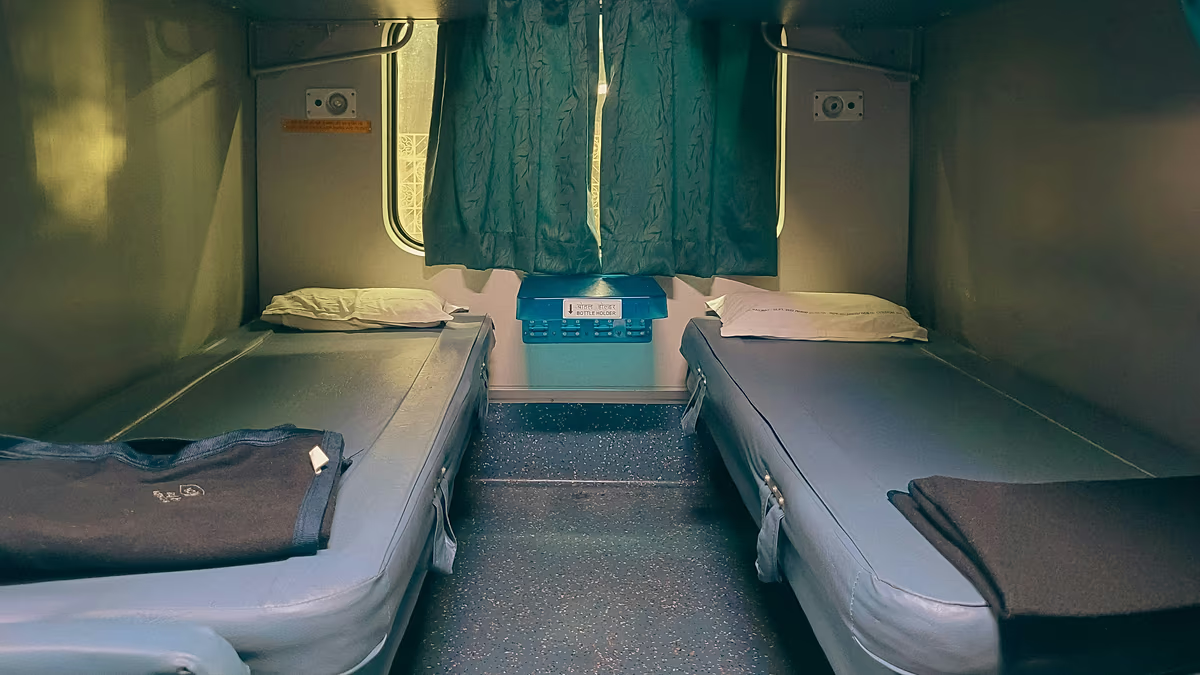
The plight of the night train is a poignant symbol of this mismatch. Despite the urgency of the climate crisis, the continent has witnessed a paradoxical trend: short-haul flights are increasing in frequency while classic sleeper services are being scaled back. To illuminate this situation and empower travellers, the European network Back-on-Track.eu has released its comprehensive 2026 interactive night train map. This invaluable resource charts all regular overnight routes across the continent. As the organisation stated, the map’s release is timely, highlighting night trains as a “viable, sustainable solution” amid a looming fuel crisis and a public clamouring for accessible, green travel options. The map itself is a fascinating and practical tool, displaying connections in a clear, transport-network style, while a supporting website offers a detailed database with route specifics and booking advice.
A closer look at the 2026 edition reveals a dynamic but challenging landscape for overnight rail. There is progress to celebrate, with five new connections appearing, including the much-anticipated Paris–Berlin service from European Sleeper and new Polish routes linking to Prague and Munich. A planned Brussels–Milan line also promises to fill a crucial gap. Yet this progress is tempered by significant losses. Ten lines have vanished from the map, most notably several popular routes operated by ÖBB Nightjet and, strikingly, the epic 1,456-kilometre journey from Stockholm to Narvik—one of the longest night train routes in Europe. Other services have been curtailed; for example, a service that once ran directly from Bratislava to the Croatian coast of Split now begins further west in Vienna. This constant churn of routes creates uncertainty for travellers and hinders the reliable, continent-wide network needed to truly compete with aviation.
According to Juri Maier, Chair of Back-on-Track and the map’s designer, the root cause of these setbacks is clear: a critical lack of investment in the trains themselves. “The demand is there, and competition with planes is not as fierce anymore,” Maier explains. He points to innovative concepts that could carry up to 750 sleeping passengers per train, making operations profitable on many routes. “But to unlock this potential,” he stresses, “we need significant investments—now.” Beyond the trains, the tracks themselves pose another hurdle. Extensive engineering works across Europe frequently disrupt the precise schedules that night trains depend on, undermining their reliability. While there is hope on the horizon—with new infrastructure by 2032 promising better continental connections—the current reality is one of logistical challenges and missed opportunities.
The journey to a revitalised night train network is fraught with operational complexities, even for new and promising routes. Giovanni Antoniazzi, Back-on-Track Vice Chair and the spatial data scientist who coordinated the project’s Open Night Train Database, illustrates this with the planned Brussels–Milan service. “The new line would truly fill a gap on our map,” he notes, “but the route through Switzerland will be an operational challenge. We’re excited to see if it works out.” This comment underscores that launching a new line involves navigating a labyrinth of technical specifications, international agreements, and coordination between multiple national rail companies. It’s a stark reminder that rebuilding a seamless European night network requires not just money and political will, but immense technical and diplomatic effort.
Ultimately, the story told by the interactive map—freely available online and as a printed poster—is one of crossroad. The public’s appetite for comfortable, slow, and sustainable travel across Europe’s enchanting landscapes has never been stronger. The vision of falling asleep in one city and waking up refreshed in another, all with a minimal carbon footprint, is a compelling alternative to the strain of airports and short-haul flights. Yet, as the map’s evolving lines show, this romantic ideal is grappling with the hard truths of underinvestment and infrastructural hurdles. The path forward requires a concerted effort: significant capital to modernise rolling stock, unwavering commitment to improving and maintaining tracks, and seamless cross-border cooperation. For the dream of a truly connected, green European night train network to become a lasting reality, the momentum of passenger demand must now be met with decisive and coordinated action from industry and governments alike.