

The Portuguese government moved swiftly on Wednesday to downplay the impact of a nationwide general strike, framing it as a disruptive but largely ineffective protest. Following a meeting of the Council of Ministers, Prime Minister Luís Montenegro acknowledged the constitutional right to strike but asserted that the action had primarily served to “harm a lot of people.” He cited children unable to attend school, students missing exams, patients facing cancelled medical procedures, and commuters stranded as the real consequences. This narrative was bolstered by Labour Minister Maria Rosário da Palma Ramalho, who presented a picture of a country functioning normally. She reported “negligible” participation in the private sector, claiming all factories, retail shops, and banks remained operational, and that tourism was largely unaffected. While acknowledging greater impact in the public sector, with an estimated 23% absence rate, she insisted essential services were being maintained and reiterated the government’s respect for the right to strike.
This official portrayal, however, stood in stark contrast to the on-the-ground reality described by union leaders and evidenced by widespread disruptions across critical sectors. The secretary-general of the CGTP-IN, Tiago Oliveira, declared the strike a major success, presenting data showing 100% participation in significant industrial plants and severe impacts in the transport network. The Lisbon Metro was completely halted, key river crossings were suspended, and national rail operator CP was running only minimum services. Crucially, the unions contradicted the minister’s claim about private hospitals, noting significant stoppages at major facilities in Lisbon and Sintra. The divergent accounts painted two different pictures of the day: one of minor inconvenience and the other of a substantial, coordinated work stoppage expressing profound discontent.
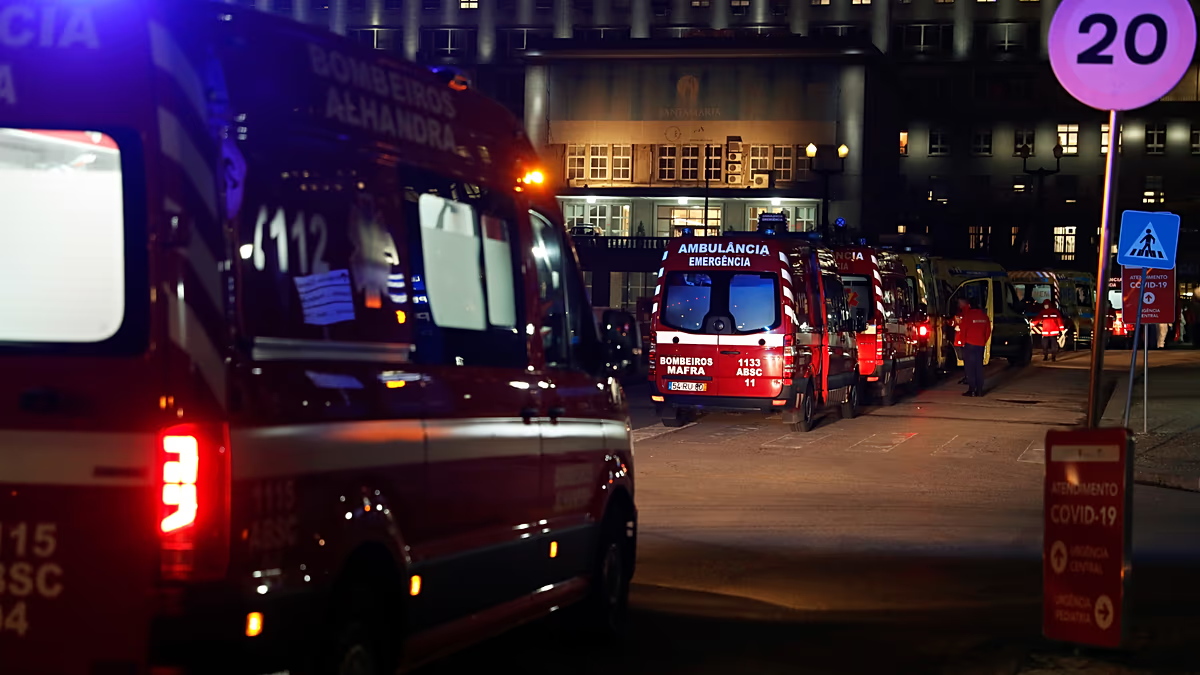
The most profound effects were felt within the National Health Service, where the strike revealed deep-seated frustrations. Night shifts preceding the strike saw participation rates between 95% and 100%, an extraordinary figure indicating near-total withdrawal of labour. Major hospitals in Lisbon, Porto, Coimbra, and Santarém reported overwhelming adherence, leading to the cancellation of non-urgent consultations and procedures. Notably, staff at the SNS24 telephone advice line joined a general strike for the first time, causing waiting times to potentially stretch to three hours amidst already high demand. This sector-wide action underscored that the protest was not a minor grievance but a resounding rejection from the heart of the country’s public services.
Education was another frontline of the dispute, with the strike directly clashing with national academic schedules. Schools across the country, from Sintra to Castelo Branco, were forced to close, disrupting the lives of thousands of families. Most symbolically, the strike fell on the same day as the national 6th-year Portuguese exam, leading to accusations that the government valued bureaucratic procedure over practical reality. Union leaders argued that the Minister of Education’s refusal to postpone the exam demonstrated that student assessments were treated with indifference, a charge that added an emotional layer to the logistical chaos. For parents and students, the abstract debate over labour laws translated into immediate, personal disruption.
Transport and commerce formed the third pillar of the strike’s visible impact, tangibly demonstrating the protest’s reach to the public. Nearly 190 flights were cancelled across Lisbon, Porto, and Faro airports, disrupting both domestic and international travel. Beyond the metro stoppages, numerous urban transport companies reported participation rates above 85%, paralysing local commutes. While the government emphasized that shops remained open, the paralysis in movement and logistics suggested a nation not in normal operation but in a state of significant friction. The fact that more than two dozen companies nationwide suspended activities entirely further contradicted the official message of business as usual.
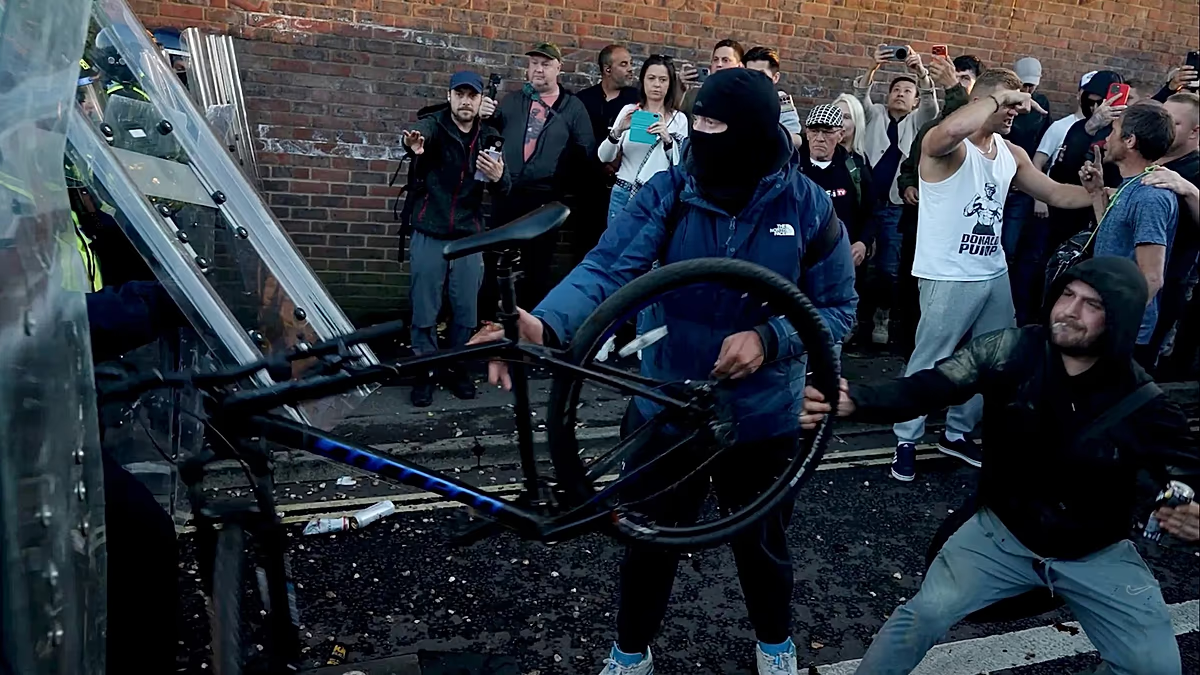
The root of this widespread action lies in the government’s proposed “Trabalho XXI” package, a sweeping set of over 100 amendments to the Labour Code. Unions view these changes as a profound erosion of workers’ rights and protections. The strike was called after the government, led by Prime Minister Montenegro, failed to reach an agreement with social partners during the Social Concertation process, a mechanism designed for consensus. The day’s events culminated in disturbances outside the Assembly of the Republic, where protests led to clashes, several arrests, and property damage, highlighting how political tensions had spilled onto the streets. Ultimately, the day was defined by this clash of narratives: the government’s minimization of a disruption versus the unions’ presentation of a powerful, popular mandate against the proposed laws. The tangible disruptions in healthcare, education, and transport proved that regardless of the official spin, the strike succeeded in making its point through a forceful, nationwide statement of opposition.