
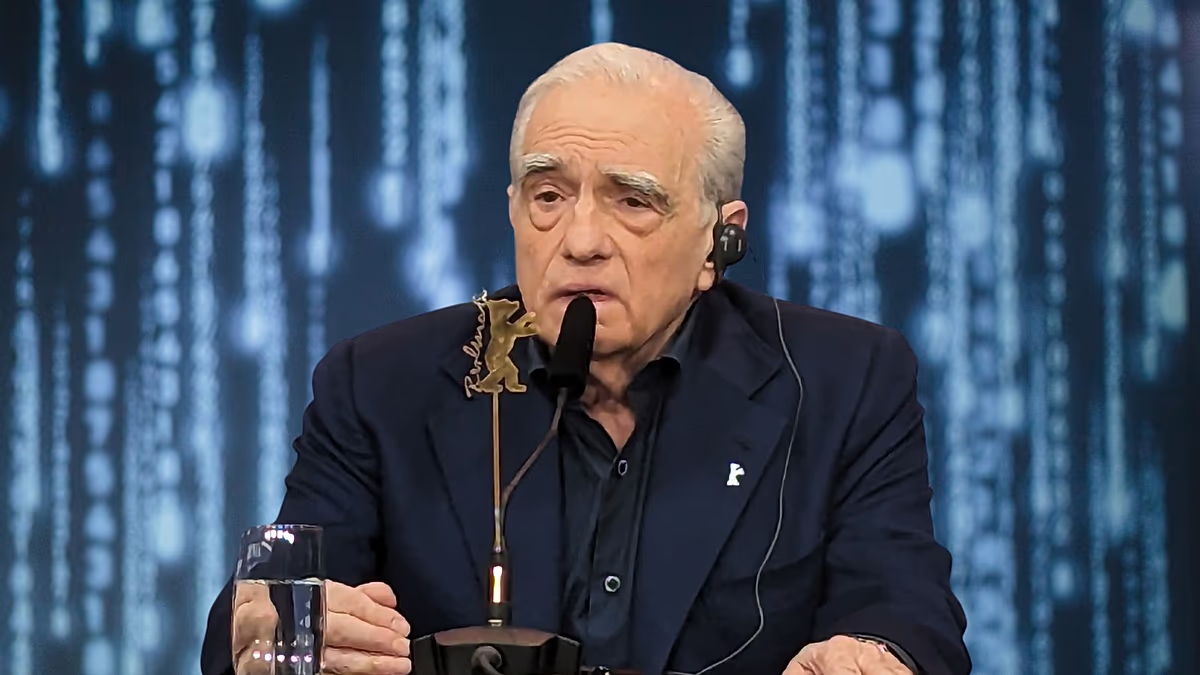


Martin Scorsese, the 83-year-old cinematic legend behind enduring masterpieces like Taxi Driver, Raging Bull, Goodfellas, and The Departed, occupies a unique and revered place in our cultural imagination. More than just a director, he is a passionate scholar and defender of film as an art form—a man whose recent, playful cameo in The Mandalorian And Grogu and openness to appearing on a Charli XCX album cover reveal a vibrant engagement with contemporary pop culture. His lifetime of work is built on a profound belief in the power of human storytelling. It is precisely this legacy that has made his recent public endorsement of artificial intelligence so startling and, for many, deeply disappointing. By aligning himself as an advisor for tech company Black Forest Labs and its FLUX image generation program, Scorsese has ignited a fierce debate, forcing us to reconcile his artistic principles with an embrace of one of the most disruptive and divisive technologies of our time.
Scorsese’s rationale, as shared in a promotional video, is practical and born from a filmmaker’s lifelong frustration. For decades, he has painstakingly hand-drawn storyboards, struggling to perfectly translate the visions in his mind to his collaborators. He frames AI as a powerful new tool to bridge that gap—a means to quickly and clearly communicate with production designers and cinematographers, thereby saving precious time and money in pre-production without sacrificing creative intent. This is not entirely out of character; Scorsese has a history of adopting new technologies, from the immersive 3D of Hugo to the digital de-aging in The Irishman. At the Berlin Film Festival, he championed the resilience of cinema, arguing it is not dying but transforming, and that the individual artist’s voice can thrive on any platform, from TikTok to a four-hour epic. His message was clear: “We shouldn’t let the technology scare us.” Yet, for countless artists, AI is not just scary—it feels like an existential threat.
The backlash from the creative community has been swift and virulent. Many see Scorsese’s endorsement as a profound betrayal, a direct contradiction to his famous critique of corporate, assembly-line filmmaking like the Marvel universe. Artist Karla Ortiz, who worked on major Marvel films, accused him of throwing every storyboard artist he’s ever worked with “under the bus,” noting that the AI models he promotes are likely trained on the very work of those same artists. Filmmaker Boots Riley speculated cynically that financial motives for his family might be at play. The core of the outrage lies in the fear that a titan who has long stood for human artistry is now legitimizing a tool many view as the engine of “AI slop”—a force that could erase jobs, dilute creativity, and prioritize efficiency over craft. This sentiment highlights a raw nerve in the industry, where AI is perceived not as a paintbrush but as a potential replacement for the painter.
Scorsese is, however, not alone in his exploration. He finds himself in a growing, albeit controversial, cohort of industry figures willing to experiment with AI’s potential. James Cameron has joined the board of an AI company, discussing its use to double the speed of visual effects work. Directors like Steven Soderbergh and Darren Aronofsky have used AI for specific visual tasks in documentaries and short films. Even Steven Spielberg has acknowledged AI’s utility as a tool for logistical legwork like location scouting, though he firmly insists it must never have the “final word” on creative decisions. Major festivals like Cannes and Tribeca are now programming AI-generated films, with Tribeca’s co-founder defending one such entry as the only way an Iranian director could safely tell a vital story under oppressive constraints. This evolving landscape presents a complex spectrum, from pragmatic tool-use to entirely AI-generated narratives, leaving the industry to grapple with where to draw the line.
The implications of Scorsese’s move extend beyond one filmmaker’s choices; it acts as a lightning rod for broader anxieties about art’s future. For emerging voices like 20-year-old filmmaker Kane Parsons, AI represents a “cultural and economic rot”—a symptom of a system increasingly favoring cheap, automated output over human expression. While Parsons is interested in artistically examining AI’s iconography in our world, he rejects using it to create art, seeing that as defeating the purpose entirely. This generational perspective underscores the deep philosophical divide: is AI a revolutionary new medium or the commodification of creativity? Scorsese’s alliance with Black Forest Labs, regardless of its actual scope, feels to many like a chilling endorsement of the latter, lending his hard-earned credibility to a technology that unsettles the very foundation of artistic labor.
Ultimately, the full extent of Scorsese’s partnership remains unclear, and his next major film project, starring Leonardo DiCaprio and Jennifer Lawrence, will likely be a traditional, human-driven endeavor. Yet, the controversy serves as a crucial wake-up call. The film industry stands at a crossroads, and artists are demanding clear, ethical boundaries. As Hollywood unions like SAG-AFTRA assert, creativity must remain human-centered. The task ahead for revered figures like Scorsese is not just to explore new tools, but to consciously and vocally champion the irreplaceable value of the human hand, eye, and heart in the artistic process. In doing so, they can help ensure that technology serves storytelling, rather than the other way around.