



As summer settles over the British Isles, forecasts are increasingly pointing toward another significant spell of intense heat. Following May’s record-breaking temperatures, which soared to an unprecedented 35.1C, meteorological models now suggest the UK is on the cusp of its next official heatwave. According to recent data from the GFS weather model, a three-day scorcher is predicted to commence around June 17th, potentially pushing thermometers as high as 32C in the hottest regions. This would not only mark a sharp rise from recent conditions but would also meet the official Met Office criteria for a heatwave across several counties, reigniting conversations about the increasing frequency and intensity of such events in a changing climate.
The projected heatwave is expected to build gradually, offering a preview of summer’s potency. On Monday, June 17th, the initial surge of warmth is forecast to bring pleasantly high temperatures across the nation. The south-east could bask in highs of 28C, while East Anglia might see 27C. Further north, the Midlands and north-west could reach 26C, with North Wales not far behind at 24C. Scotland and Northern Ireland are anticipated to remain somewhat cooler, though still experiencing notably warm conditions for the time of year. This day would serve as a precursor, setting the stage for a more intense escalation as the week progresses.
The mercury is predicted to climb markedly by Tuesday, June 18th. The south-east of England is likely to breach the 30C threshold, a significant psychological and meteorological benchmark. The heat is forecast to extend its reach northwards, with Yorkshire potentially experiencing highs of 29C. Even regions typically more temperate are set to feel the burn, with parts of Northern Ireland possibly hitting 26C and Wales firmly entrenched in the mid-to-high 20s. This widespread warmth would underscore the event’s extensive geographic footprint, affecting a vast swathe of the population.
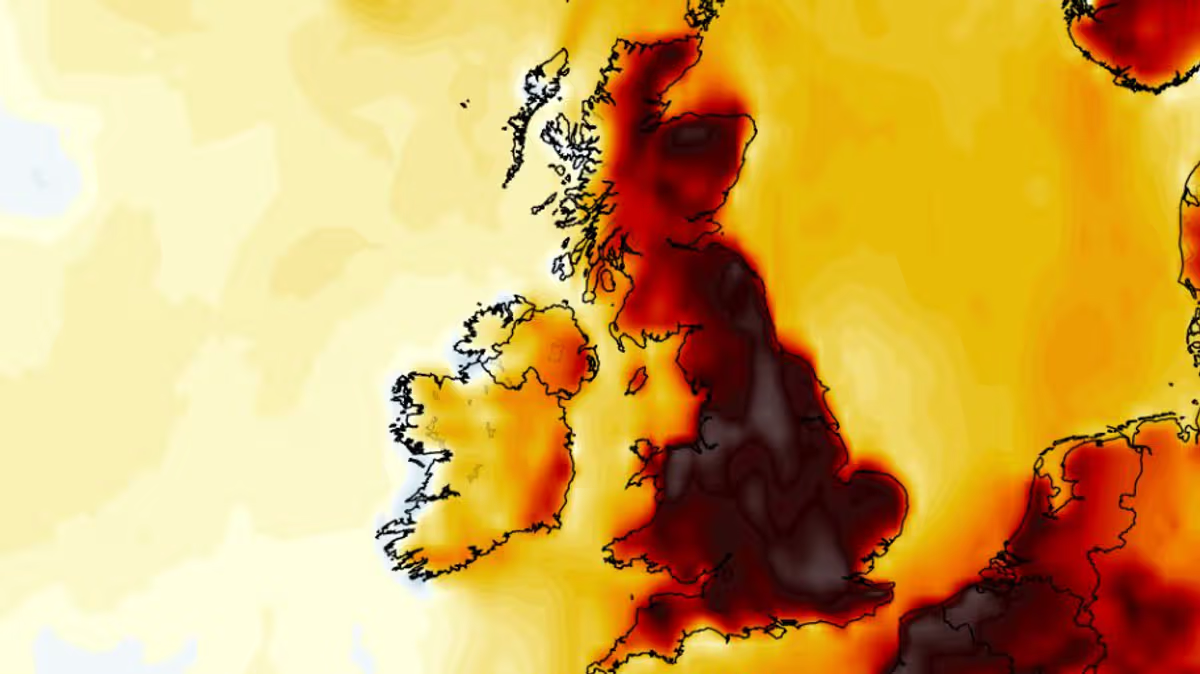
Peak conditions are anticipated on Wednesday, June 19th, painting the weather maps in deep shades of red and orange. The GFS model indicates that vast expanses of England could endure temperatures of 30C or more. Once again, the south-east is expected to be the focal point of the heat, with a possible maximum of 32C. Remarkably, the warmth is forecast to push into southern Scotland, where highs of 27C are possible. Data suggests that as many as 13 English counties, from Yorkshire and Lancashire in the north to Kent and Surrey in the south, could endure temperatures exceeding 31C on this single day, highlighting the event’s potential severity.
Should this modelled scenario unfold, it would formally constitute a heatwave for many areas. The Met Office defines a heatwave as at least three consecutive days where daily maximum temperatures meet or exceed a region-specific threshold. This threshold ranges from 28C in the hotter south-east to 25C in cooler northern areas. The projected temperature sequence of 28C, 30C, and 32C over June 17th-19th in the south-east would squarely meet this definition. Such official designations trigger public health warnings and preparedness measures, emphasising the risks associated with prolonged heat, particularly for vulnerable groups.
Looking ahead to the broader period, the Met Office’s outlook for late June suggests a complex weather pattern. While the initial phase of this period may be dominated by high pressure, bringing largely dry and very warm conditions, the stability is not guaranteed to last. Their forecast for June 18th to July 2nd indicates that low pressure systems could begin to exert more influence towards the end of the month, especially across southern Britain. This shift could replace the persistent heat with a heightened risk of heavy, potentially torrential showers and thunderstorms. Consequently, the predicted hot spell may be both a highlight of the summer and a catalyst for volatile weather, illustrating the delicate and often unpredictable balance within the UK’s climate system.