
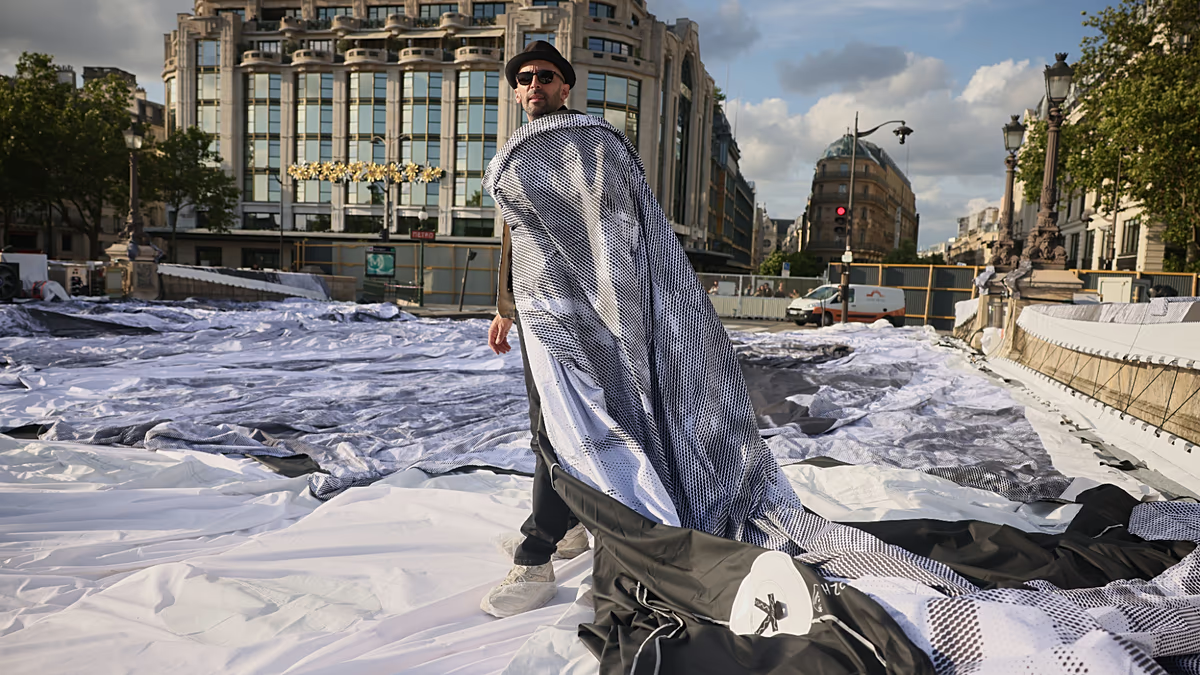


Paris’s venerable Pont-Neuf, the city’s oldest standing bridge, has weathered the elements for over four hundred years. In a poignant contrast, a monumental contemporary artwork created to adorn its historic space has proven unexpectedly vulnerable. The highly anticipated installation, titled “La Caverne” by the celebrated artist JR, was to be a grand homage, a sensory successor to a famed artistic moment. Yet, just four days before its public inauguration, the project’s organizers were forced to announce a postponement. The culprit was the very force the Pont-Neuf has defied for centuries: inclement weather. Damaging winds and rain assaulted the installation, with shared images on social media revealing a torn canvas flapping against its inflatable support structure, a sudden and sobering rupture in the artistic vision.
This abrupt delay is a significant setback for a project meant to be a vibrant, temporary gift to the city. “La Caverne” was conceived as a direct tribute to the legendary artists Christo and Jeanne-Claude, who famously wrapped the entire Pont-Neuf in fabric in 1985. Following in the spirit of that iconic project, JR’s work was also funded entirely through private sponsorship, ensuring no burden on public funds. For several days prior to the incident, the imposing trompe-l’œil structure—a giant, realistic depiction of a rocky cave mouth—had already towered over the Seine, sparking curiosity and debate among Parisians and visitors alike. It was to remain freely accessible around the clock until the end of June, an open-air spectacle in the heart of Paris.
The ambition of “La Caverne” extended far beyond the visual. JR and his collaborators designed it to be a deeply immersive experience, a work meant to “engage all the senses.” This was not merely a sculpture to be seen, but an environment to be felt. To this end, a haunting soundscape was composed by none other than Thomas Bangalter, the former half of the iconic electronic duo Daft Punk, promising to envelop visitors in an auditory dimension. Furthermore, the renowned perfume house Odore Scola crafted a unique olfactory experience, scenting the very air around the installation to, as the artists stated, “inject narrative and emotional force” into the space. This multisensory approach aimed to transform a simple viewing into a profound and memorable encounter.
Now, however, that encounter is on hold. The joint statement from Atelier JR, the Christo and Jeanne-Claude Foundation, and the Amicale des Ponts de Paris struck a careful, professional tone, prioritizing safety and assessment. They confirmed that a thorough technical evaluation is currently underway to determine the full extent of the damage. The difficult but necessary decision was made to postpone the opening until after June 6, with a new date to be set once the condition report is complete. This process underscores the fragile and ephemeral nature of such large-scale, temporary public art, where ambition meets the unpredictable realities of the outdoor environment.
The incident invites reflection on the cycle of artistic creation and its challenges. The original 1985 wrapping of the Pont-Neuf by Christo and Jeanne-Claude itself was a feat of engineering and perseverance, realized after nearly a decade of preparation. Now, decades later, a new generation of artists faces its own trials in the same location. The damaged canvas of “La Caverne” serves as a stark reminder that even the most meticulously planned public installations are at the mercy of nature. The postponement is not just a logistical hiccup but a chapter in the artwork’s own story, a testament to the vulnerability that often accompanies great creative ambition.
All eyes now turn to the forthcoming press conference scheduled by the project’s partners. This briefing will be crucial in outlining the path forward, detailing the repair process, and ultimately, providing a new date for the public to finally experience “La Caverne.” While the wait continues, the episode has already added a layer of narrative to the installation—one of resilience and problem-solving. The hope remains that, like the enduring Pont-Neuf itself, the artistic vision will prove strong enough to overcome this temporary frailty, allowing Parisians and the world to soon step inside and experience the full sensory homage JR and his team have dreamed of creating.