



A Promise Unfulfilled: Spain’s Healthcare Workers Confront a Reform That Falls Short
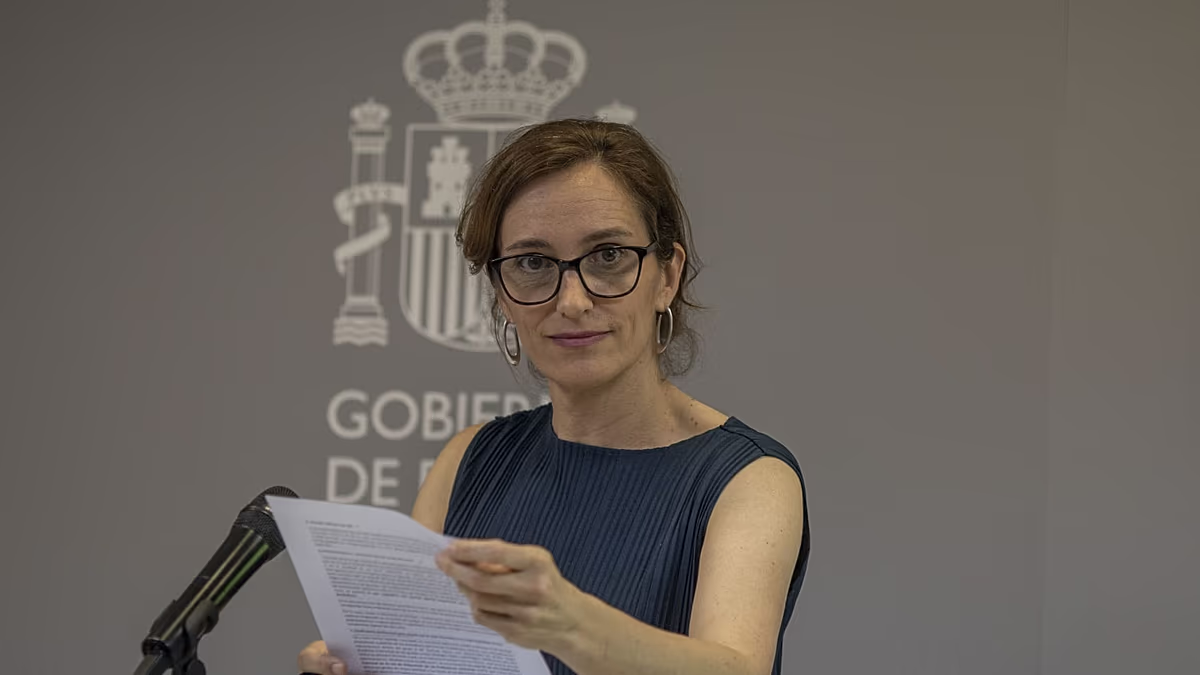
In a move that spoke louder than any press conference, Spain’s Health Minister Mónica García chose to be absent from the public presentation of her own ministry’s flagship reform. This symbolic absence framed the unveiling of the new Framework Statute for healthcare staff—a long-awaited update to a two-decade-old law—not as a celebration, but as an admission of its contentious nature. After months of persistent, widespread demonstrations that united doctors, nurses, and ancillary staff across ideological divides, the minister delegated the defense of the statute to the government spokesperson, Pilar Alegría. This decision immediately cast the reform as a political document struggling for legitimacy, rather than a healing balm for a beleaguered public health system. The stage was set not for applause, but for renewed conflict, as the very professionals whose lives the statute aims to regulate watched from the sidelines, their hopes for transformative change already dimming.
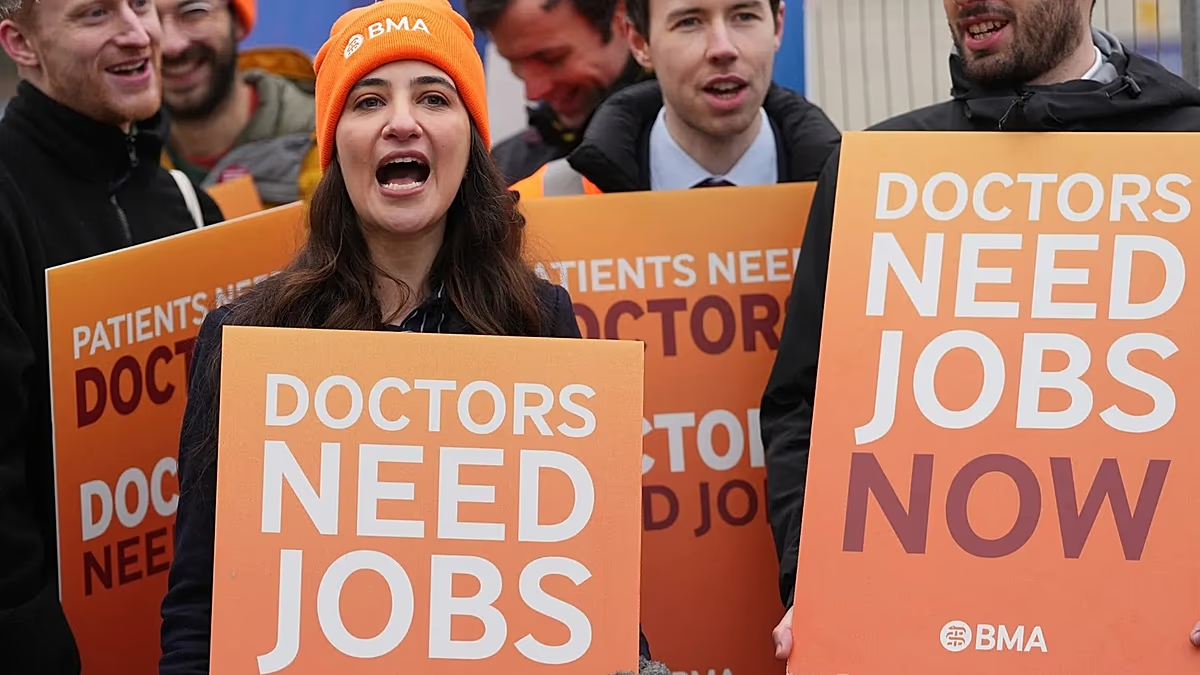
The government, through spokesperson Alegría, positioned the statute as a product of consensus, championed by the “majority trade unions” like SATSE, CC.OO., UGT, and CSIF. This framing, however, served to highlight a stark division within the sector’s workforce. It implicitly contrasted these signatories with the coalition of vocal, critical professional associations—such as CESM, AMYTS, and Metges de Catalunya—who have been the driving force behind the historic street protests. For these groups, the approved text represents a profound betrayal of core demands. They sought not just an update, but a revolution in working conditions: a maximum 35-hour work week for clinical duties, the creation of a specific top-tier professional category for doctors, and a ban on forced redeployments that rip professionals from their communities and families. Most symbolically, they demanded that the grueling, sleep-depriving “on-call” shifts, long treated as an exceptional appendage to the workday, finally be fully counted for pension contributions—a matter of basic justice and recognition for a lifetime of disrupted rest.
At first glance, the statute offers some tangible improvements. It formally reduces the maximum legal working week to 45 hours—still above the European average for healthcare, but a reduction nonetheless. It also addresses the infamous 24-hour on-call shifts, ostensibly capping “effective work” during these periods at 17 hours. Yet herein lies the crux of the professionals’ disillusionment: the devil is in the legislative details. A critical clause, Article 97, creates a sweeping exception, allowing these maximums to be exceeded whenever “organisational or care-related reasons” justify it. In a system perpetually stretched thin by understaffing and high demand, healthcare workers rightly fear this exception will become the ruthless rule. Furthermore, the statute’s modest gains are overshadowed by what it glaringly omits. The core demands on working hours, pensionable on-call time, and voluntary early retirement schemes are absent, leaving the feeling that the reform tinkers at the edges while ignoring the structural crisis burning at the core of the profession.
This perceived gap between promise and delivery has not pacified the movement; it has galvanized it. Far from accepting the draft, the critical unions have announced a new nationwide demonstration for June 15th, directly outside the Health Ministry. Their accusation is severe: they condemn the Ministry’s strategy as one of “delay, inaction and a total absence of proposals.” This planned protest is a clear signal that the statute, rather than closing a chapter of discontent, has opened a new one. It underscores that for many healthcare workers, this is not merely a negotiation over percentages and hours, but a last-ditch fight for the dignity and sustainability of their vocation. They see the reform as a political document designed to claim a legislative victory, rather than a pragmatic one crafted to solve a human resources emergency that is pushing experienced staff to leave and discouraging a new generation from entering.
The government’s defense, as articulated by spokesperson Alegría, retreats behind the complex architecture of Spanish governance. She notes that many of the outstanding demands, particularly relating to pay, specific staffing levels, and the granular organization of services, fall under the remit of Spain’s 17 autonomous regional governments, not the central ministry. While constitutionally accurate, this argument rings hollow to professionals on the front lines. It is perceived as a bureaucratic evasion, a passing of the buck that fails to acknowledge the central government’s role in setting a powerful, attractive framework that the regions would be compelled to follow and fund. By not enshrining stronger, more ambitious standards in the national statute, critics argue the ministry has missed a historic opportunity to lift conditions uniformly across the country and has instead legitimized a race to the bottom, where regions with fewer resources will continue to stretch their staff to the breaking point.
Ultimately, the story of this Framework Statute is one of a profound disconnect. It is a reform born from pressure but lacking the courage to meet that pressure with transformative action. The absence of the Health Minister at its birth speaks to its political fragility. The angry planning for fresh demonstrations confirms its failure to address the raw nerve of professional indignation. The healthcare workers who have marched through Spain’s cities are not merely bargaining for better shifts; they are fighting for the soul of a public system they cherish but feel is being mismanaged into exhaustion. They see the new statute as a diluted compromise that manages workloads on paper but does not safeguard the well-being of those who carry the workload. As the text now moves to Congress for debate, the challenge for lawmakers is not just to pass a law, but to bridge this chasm of trust. Without addressing the deep-seated calls for dignity, respect, and a sustainable career, any legislative victory may prove to be a Pyrrhic one, leaving the halls of hospitals and health centers filled with the same echo of discontent that has been ringing for months.