

The intricate dance between climate, mosquitoes, and human health is yielding alarming new choreography, as revealed by a significant study published in Frontiers in Cellular and Infection Microbiology. Conducted by scientists in China, the research maps a future where the painful and debilitating viral disease chikungunya could find new homes far beyond its current tropical boundaries. The study identifies 139 countries or regions—over 21% of the world’s landmass—as current risk zones. But the central, unsettling finding is that under climate change models, these zones are predicted to expand northward, pushing into temperate regions previously considered relatively safe. As co-author Dr. Ye Xu explains, this expansion specifically threatens areas like northeastern North America, central Europe, and East Asia, painting a picture of a world where the health impacts of warming are felt directly in our bodies.
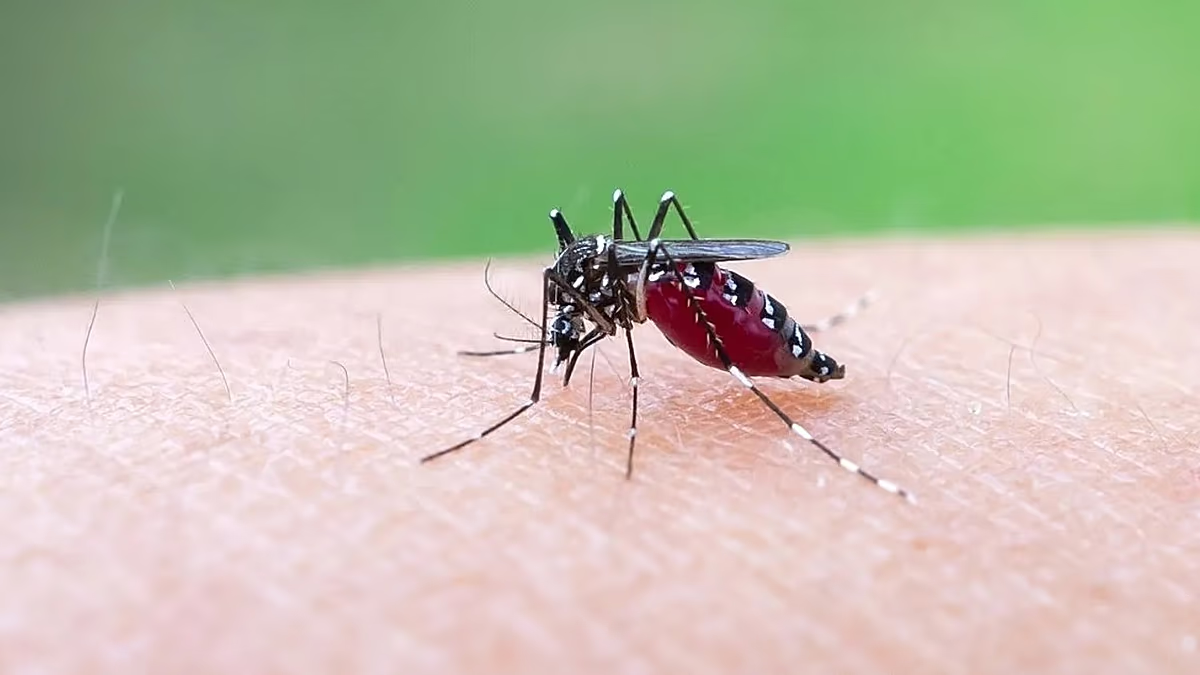
The mechanism behind this expansion is a complex biological chain reaction triggered by rising temperatures. Chikungunya has historically been transmitted primarily by the yellow fever mosquito, Aedes aegypti, a species intimately linked to human habitats in warm climates. However, climate change is not only expanding the geographical comfort zone of such insects but is also influencing the virus itself. A pivotal event occurred during a major 2005-2006 outbreak in the Indian Ocean, where the virus mutated, enhancing its ability to be carried by another mosquito: the Asian tiger mosquito, Aedes albopictus. This species, as co-author Dr. Yang Wu notes, tolerates cooler conditions better than its cousin. Warming temperatures may now allow this mosquito to establish itself in regions once too cold, effectively building a bridge for the virus into new populations. Furthermore, heat accelerates the virus’s development inside the mosquito; between 18°C and 28°C, it becomes ready to transmit four to five times faster, dramatically shortening the window between an insect biting an infected person and becoming a threat to others.
The potential scale of this spread is vast. Chikungunya is already a formidable global threat, with indigenous transmission reported in 114 countries and more than three-quarters of the global population living in risk areas. Its burden is measured not just in acute suffering—characterized by severe joint pain, fever, and fatigue—but in lasting disability and loss of life. The study notes a case fatality rate of approximately 1.3 per thousand and an annual loss of around 284,000 disability-adjusted life years. To forecast the future, the researchers built models based on tens of thousands of geo-tagged records of the virus and its mosquito vectors, projecting their range changes up to 2100 using 16 different United Nations climate scenarios. While the exact degree of expansion varies with each emissions pathway, the maps consistently highlight new hotspots: north-central Europe, northeastern North America, and eastern Asia. For now, cases in these regions are largely imported by travelers, but the foundation for local, self-sustaining outbreaks—the establishment of competent mosquito populations—is being laid by climatic changes.
This research arrives against a backdrop of already rising case numbers, underscoring the urgency of its projections. According to 2025 data from the Pan American Health Organization, there were over 500,000 reported cases and 186 deaths across 41 countries and territories. This existing burden, the scientists warn, is poised to escalate as climate change profoundly reshapes the landscape of infectious diseases. The message from the research team, however, is not one of panic but of imperative preparation. “The public does not need to panic, but health systems should prepare early,” Dr. Xu cautions. The shift from a tropical to a potential temperate disease requires a fundamental rethink in public health strategy for many nations. Health systems in countries like the United Kingdom, Germany, the United States, China, and Japan, which lie along the identified future risk zones, must prioritize actions now to mitigate crises later.
The blueprint for preparation is multifaceted and proactive. Key recommendations include establishing robust surveillance programs to track the presence and density of Aedes mosquitoes, particularly the invasive Asian tiger mosquito. Equally critical is training healthcare workers in temperate regions to recognize and diagnose chikungunya swiftly, as its symptoms can be mistaken for other ailments. Strengthening mosquito control infrastructure—from public education to larval source reduction—is another pillar. Finally, developing and resourcing rapid-response plans for outbreak containment must be done before cases emerge locally. These steps, as Dr. Xu emphasizes, are especially vital in regions where this disease has never been a routine public health concern. The goal is to build a defensive wall before the invaders—the mosquitoes and the virus they carry—arrive in force.
In conclusion, this study serves as a stark epidemiological forecast, linking greenhouse gas emissions directly to future hospital beds. It demonstrates that climate change is not a distant environmental phenomenon but a driver of immediate biological changes that rearrange the map of human disease risk. The expansion of chikungunya into the temperate heartlands of North America, Europe, and Asia is a testament to this interconnectedness. The call to action is clear: by investing in surveillance, education, and health system readiness before 2040, nations can transform a predicted trajectory of suffering into a managed, contained challenge. The fight against chikungunya’s spread is, therefore, also a fight against the broader consequences of a warming world, demanding integration of climate policy and public health strategy to safeguard global populations.