

Paragraph 1
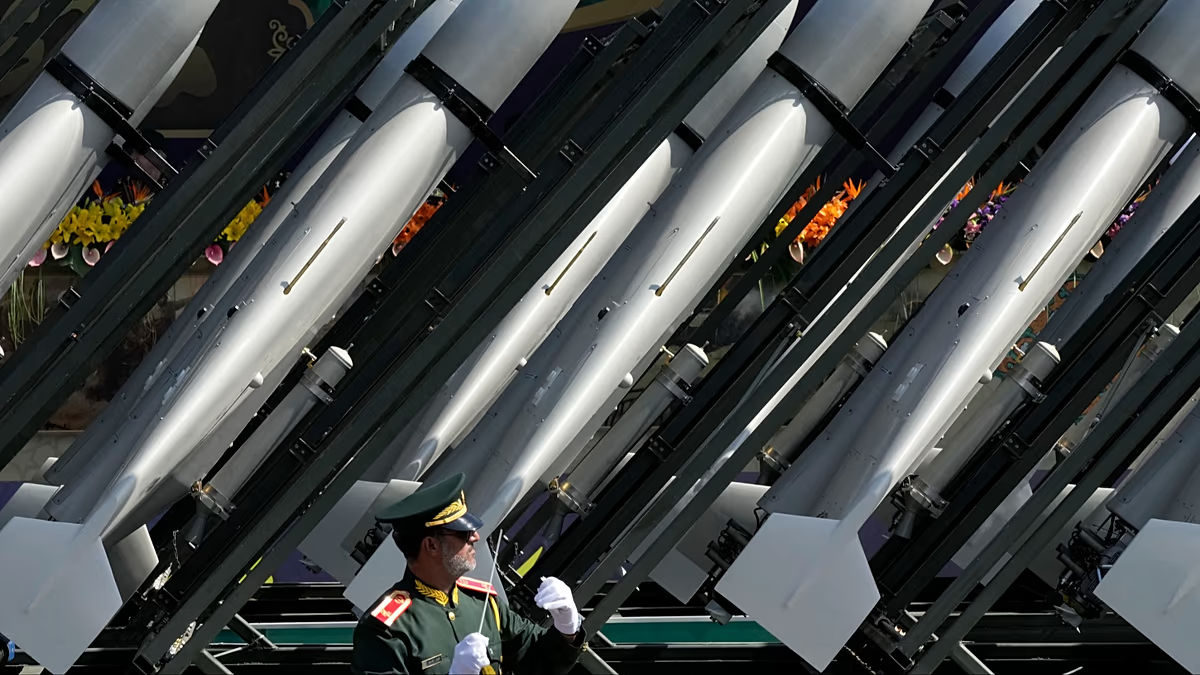
A senior Iranian military official has issued a stark warning regarding the nation’s undisclosed military strength, emphasizing readiness for potential conflict even with the United States and NATO. Brigadier General Mohammad Jafar Asadi, a key figure within Iran’s Islamic Revolutionary Guard Corps (IRGC), stated in a televised address that Iran has deliberately kept many of its capabilities secret, holding them in reserve as strategic “trump cards” to be deployed if necessary. He framed this posture not as aggression, but as a rational response to an environment where surrender is not considered an option. Asadi’s remarks, delivered from his position in Iran’s central wartime command structure, reflect a deep-seated institutional mindset that views perpetual preparedness for war as essential for national survival and sovereignty.
Paragraph 2
General Asadi elaborated that any future confrontation would be fundamentally different from past engagements, marked by shifts in operational tactics, expanded geographic scope, and the deployment of new weaponry. This declaration underscores a confidence within the IRGC that Iran’s defensive and asymmetric warfare strategies have evolved. The official’s tone was one of grim resolve, dismissing the potential involvement of a powerful alliance like NATO as a factor that would deter Iran’s actions. These statements are designed to project an image of unwavering strength to both domestic and international audiences, reinforcing the narrative that Iran cannot be intimidated and is willing to endure the costs of conflict to protect its interests.
Paragraph 3
This uncompromising military rhetoric exists in sharp contrast to the uncertain and fragile state of diplomatic efforts between Iran and the United States. Reports from Iranian media indicate a pause in the indirect talks aimed at establishing a preliminary understanding on nuclear issues and regional tensions. Iranian officials state that proposals are under intensive review by top security councils, with no immediate decisions expected. The core diplomatic hurdle remains a profound lack of trust; Iranian negotiators are insisting on concrete, verifiable benefits and ironclad guarantees from the U.S., citing a history of abandoned commitments. This creates a diplomatic limbo where progress is halting and reversible.
Paragraph 4
From the American perspective, officials like Secretary of State Marco Rubio acknowledge that discussions have broached previously off-limit topics, suggesting a narrow opening for dialogue. However, they simultaneously temper expectations, openly cautioning that these talks may not culminate in a mutually acceptable agreement. This public hedging by both sides reveals the deep chasm of mistrust that defines the relationship. Each action is scrutinized for hidden motives, and every statement from one capital is met with skepticism in the other. The diplomatic process is thus a tentative exploration, constantly at risk of being derailed by hardline positions or external events.
Paragraph 5
The internal political dynamics within Iran critically shape this cautious and often contradictory approach. Decision-making is not monolithic but is instead a tense balancing act among competing factions. Hardline elements, particularly within the powerful IRGC and closely linked to the Supreme Leader’s office, advocate for a more confrontational stance, deeply skeptical of negotiations with the West. Figures like acting IRGC Commander-in-Chief Ahmad Vahidi are identified as influential voices pushing this line. Their pressure is a significant factor behind the current suspension of talks, illustrating how domestic power struggles can directly impact foreign policy and international security.
Paragraph 6
Finally, Iran’s strategic calculus is inextricably linked to its network of regional allies, known as the “Axis of Resistance.” This network, which includes groups like Hezbollah in Lebanon and the Houthis in Yemen, represents a core pillar of Iran’s foreign policy and deterrent capability. Iranian officials have explicitly connected the fate of bilateral negotiations with the U.S. to the ceasefire status on these regional fronts, warning that hostilities in Lebanon or Gaza could unravel any broader understanding. By tethering diplomacy to the actions of its proxies, Iran demonstrates a holistic view of its security, where battlefield outcomes in neighboring countries are as consequential as the wording of a diplomatic draft in Vienna. This intertwining of direct military readiness, fraught diplomacy, internal political rivalries, and regional proxy relationships paints a picture of a nation navigating an immensely complex and high-stakes geopolitical landscape.