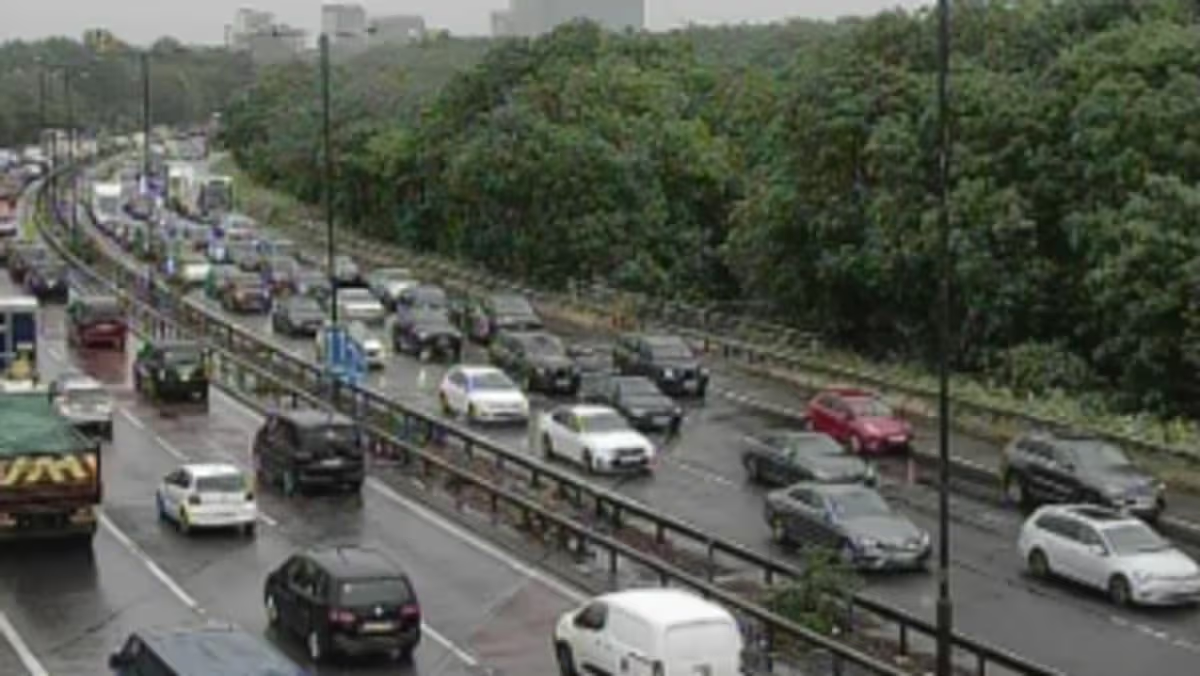


A somber and urgent investigation is now underway following a tragic nighttime collision on the M4 motorway in Hillingdon, which resulted in the death of one man and left a woman fighting for her life. The Metropolitan Police were alerted at approximately 11:37 PM on Monday, June 1st, to reports of a devastating crash involving two vehicles on the busy stretch of road near Junction 4. Initial accounts indicate a collision of significant force, prompting an immediate and substantial emergency response. This incident serves as a stark, heartbreaking reminder of how swiftly routine journeys can transform into scenes of profound loss and crisis, casting a pall over the families involved and the officers tasked with unraveling the precise sequence of events.
Upon arrival at the scene, police and paramedics from the London Ambulance Service were met with a harrowing sight. One of the vehicles involved, a white Volkswagen Golf, had sustained severe damage. Its occupants required urgent medical attention on the motorway itself. Despite the best efforts of the emergency crews, a 63-year-old man, a passenger in the Golf, was tragically pronounced dead at the scene. The profound personal tragedy of this moment—a life ended abruptly on a routine stretch of road—cannot be overstated. Specialist family liaison officers have been deployed to support his grieving next of kin, a small but crucial measure of compassion amidst the procedural necessities of a major police investigation.
The aftermath of the collision left two others gravely injured. A 62-year-old woman, also an occupant of the Golf, was rushed from the scene to a nearby hospital. Her injuries were assessed as life-threatening, and she remains in critical condition, her survival hanging in the balance. A second man, aged 29, was transported to hospital as well; thankfully, medical professionals have assessed his injuries as being neither life-threatening nor life-changing. This gradation of outcomes within a single vehicle—from fatal to critical to serious but stable—illustrates the cruel randomness of such high-impact events. While one family mourns an irreplaceable loss, another maintains a tense vigil at a hospital bedside, and a third breathes a sigh of cautious relief, all bound together by the same fleeting, violent moment.
Crucially, the investigation has revealed a complex and disturbing dimension to the tragedy. The second vehicle involved was a black BMW 320i. Authorities have disclosed that, prior to the fatal collision on the M4, this same BMW had been the subject of a police pursuit. Officers from Thames Valley Police had attempted to stop the car on suspicion of it being stolen. However, in a critical detail, the Met has confirmed that this police pursuit was not active at the precise moment the two cars collided. This distinction is vital, both for the ongoing investigation into potential causation and for the formal procedures that govern high-speed police pursuits, aiming to balance law enforcement with public safety.
In the chaotic moments following the impact, the driver of the black BMW, described only as a man, allegedly fled the scene on foot, abandoning the wreckage and the victims. This act has launched a parallel manhunt, with officers now engaged in extensive efforts to track down and apprehend this individual. His decision to flee not only compounds the tragedy but transforms the incident from a potential case of dangerous driving into one that also involves failing to stop at the scene of a fatal accident. Identifying and locating this man is now a paramount objective, as he is considered a key witness—and potentially a suspect—in understanding the full circumstances that led to the catastrophic crash.
This incident now rests at the confluence of multiple profound inquiries: a forensic investigation into the mechanics of the collision itself; a search for a missing individual; and a review of the events leading up to it, including the prior police interaction. For the Metropolitan Police, the immediate tasks are painstakingly reconstructing the final seconds before impact, pursuing all lines of enquiry to find the man who fled, and providing continuous support to the victims’ families. Beyond the procedural steps, however, lies a profound human cost—a beloved 63-year-old man lost, a woman clinging to life, and a community reminded of the fragility that exists on the roads we travel every day. The pursuit of answers continues, not just for the sake of justice, but to provide some semblance of clarity and closure for all those whose lives have been irrevocably altered.