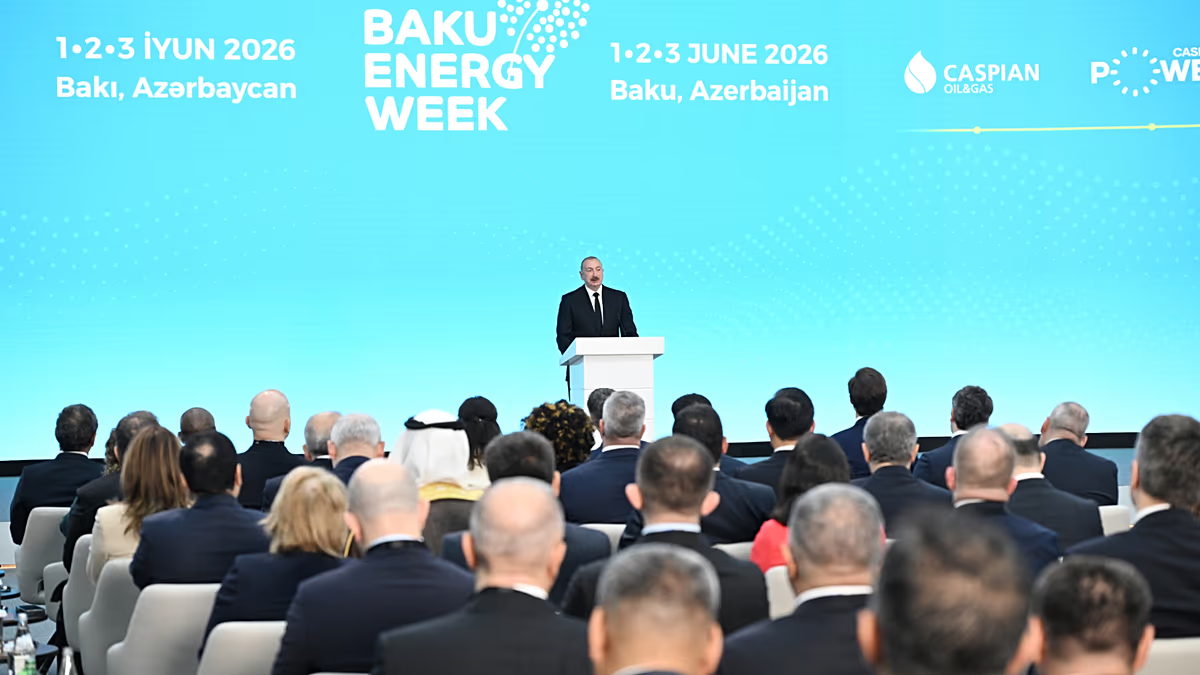


The opening day of Baku Energy Week 2026 presented a global energy industry at a profound and complex crossroads, captured in the dual message of its host. In his opening address, Azerbaijan’s President Ilham Aliyev articulated the central tension defining the era: the undeniable present necessity of fossil fuels and the urgent future imperative of renewables. His statement that the “world cannot live without fossil fuels” was a pragmatic acknowledgment of current energy security and economic stability needs, particularly for nations like those in Europe seeking reliable, diversified supplies. He underscored Azerbaijan’s own pivotal role in this landscape, noting it was “difficult to imagine” the European market without the energy corridors of the South Caucasus. Yet, he immediately balanced this by insisting countries “should be judged on how they invest in renewables,” framing the energy transition not as an immediate replacement but as a parallel track of essential investment. This set the stage for a forum examining not an either-or choice, but a multifaceted integration of old and new.
The discussions vividly reflected an industry in rapid evolution, with artificial intelligence, digitalization, and methane reduction dominating the technical dialogue. Far from being abstract concepts, AI was showcased as a practical toolkit revolutionizing upstream operations. Exhibitors demonstrated AI-powered drilling systems, predictive maintenance software, and machine learning models that optimize exploration and maximize output from aging fields. This digital shift was framed as a commercial necessity for improving efficiency and profitability in a competitive market. Closely linked was the intense focus on methane emissions, with a suite of monitoring, leak-detection, and carbon-management technologies on display. Here, a clear business case was articulated: reducing emissions is no longer just a climate obligation but an operational advantage, preventing product loss and waste. The message was that the industry’s core mission of secure supply is now inextricably tied to technological modernization and environmental performance.
This fusion of energy and technology pointed to a broader theme: the growing and essential partnership between traditional hydrocarbon engineering and the global tech sector. The event itself became a nexus where oil producers, software developers, and engineering firms converged, highlighting how digital infrastructure is now as critical as physical pipelines. This collaborative spirit extended into the geopolitical realm, where the forum served as a key platform for energy diplomacy. Officials like Moldova’s Energy Minister, Dorin Junghietu, shared experiences of strengthening energy security through interconnectivity and diversifying away from single suppliers. He praised Azerbaijan as a “trustable partner,” whose gas provided crucial stability during the regional crisis, while also detailing Moldova’s own strides in installing over a gigawatt of renewable capacity. This illustrated the minister’s central thesis: the modern energy strategy must simultaneously pursue security, affordability, and a “sustainable and just” transition.
The strategic role of Azerbaijan and the Caspian region as a sustainable energy hub was a constant refrain. Bulgaria’s Deputy Energy Minister, Kiril Temelkov, crystallized this view, describing Azerbaijan as a “sustainable and reliable partner” supplying over 30% of Bulgaria’s gas. He emphasized that Baku Energy Week has evolved into a genuine innovation summit, looking beyond gas to a future of green corridors. His vision of a corridor supplying green energy from Azerbaijan, through Bulgaria, to Southeastern Europe symbolized the forum’s forward-looking dimension. He argued that deep regional interconnection—for both molecules and electrons—is the only way to achieve broader EU energy and climate goals, with battery storage, nuclear power, and modernized grids forming the essential pillars of a stable transition.
Parallel discussions in the forum sessions grappled with the long-term challenges of investment and risk. Against a backdrop of geopolitical instability and transition policies, executives debated how to attract capital for the hydrocarbon projects still deemed essential for medium-term security while meeting stringent emissions targets. The conversation acknowledged the delicate balancing act: maintaining investment in existing infrastructure to prevent volatility, while simultaneously financing the clean energy build-out. The perspective from Central Asia, voiced by Kyrgyzstan’s Energy Minister Taalaibek Ibraev, added crucial depth. He highlighted his country’s existing 90% green electricity generation from hydropower and ambitious plans for 1.9 gigawatts of new solar capacity, viewing the forum as a vital platform for exchanging expertise. His presence underscored that the energy transition is a global mosaic, where hydrocarbon exporters, transit states, and renewable-rich nations must all find their path and partnership models.
In conclusion, the opening day of Baku Energy Week 2026 painted a picture of an integrated, not fragmented, energy future. The industry showcased is one where AI optimizes fossil fuel extraction, where methane reduction technologies become standard practice, and where reliable gas supplies provide the financial and stability foundation for massive renewable investment. Azerbaijan positioned itself at the center of this convergence—as a traditional supplier, a prospective green energy exporter, and a digital innovation hub. The overarching narrative was not of contradiction but of synthesis: security with sustainability, tradition with innovation, and regional partnership with global ambition. The path forward, as detailed across these discussions, requires managing these dualities simultaneously, ensuring that the energy systems of tomorrow are built on the lessons, infrastructure, and partnerships of today.