


Spain is currently hosting MILEX 26, a pivotal European Union military exercise taking place throughout June at the San Gregorio Training Centre in Zaragoza. This large-scale maneuver, which commenced earlier this month and will culminate on June 18th, is far more than a routine drill. Its primary purpose is to rigorously assess the EU’s Rapid Deployment Capacity (RDC), a critical initiative designed to strengthen the bloc’s ability to respond swiftly and cohesively to international crises. By simulating a complex fictional crisis scenario, the exercise acts as a vital stress test for European military coordination, probing its effectiveness across the strategic, operational, and tactical levels. The ultimate goal is to evaluate not just combat readiness, but the very speed and efficiency with which the EU can mobilize and project a unified force when needed, moving from political decision to effective action on the ground.
The scale of MILEX 26 is significant, involving approximately 2,500 troops drawn from thirteen different EU member states, with Spanish forces forming the substantial core of over 1,600 personnel. The command structure reflects a multi-layered, integrated European approach. Strategic oversight is managed from Brussels by the EU’s Military Planning and Conduct Capability (MPCC). On the ground in Zaragoza, the operational headquarters is led by Eurocorps, a multinational corps staffed by personnel from several member states. At the tactical heart of the exercise is the EU Battlegroup 2026 (EUBG26), which is under Spanish leadership for this rotation. The central unit of this battlegroup is Spain’s Canary Islands Brigade XVI, which has provided a major portion of the deployed soldiers and equipment.
Bringing this force to life requires a formidable array of modern military assets, showcasing the technological depth of Europe’s combined forces. The ground component is built around the Infantry Regiment Soria No. 9 and includes formidable assets like Leopard 2A4 main battle tanks and Pizarro infantry fighting vehicles. The drills are supported by a comprehensive suite of specialized units: artillery, engineering, and nuclear, biological, and chemical defence teams stand ready alongside unmanned aerial vehicles for reconnaissance, military police, and canine units. The exercise also incorporates critical 21st-century capabilities like dedicated signals units, electronic warfare, information operations, and intelligence and reconnaissance elements. Air mobility is provided by transport helicopters such as the Super Puma and AB-212, while civil-military coordination is highlighted by the participation of Spain’s Civil Guard in roles like border control and investigations.
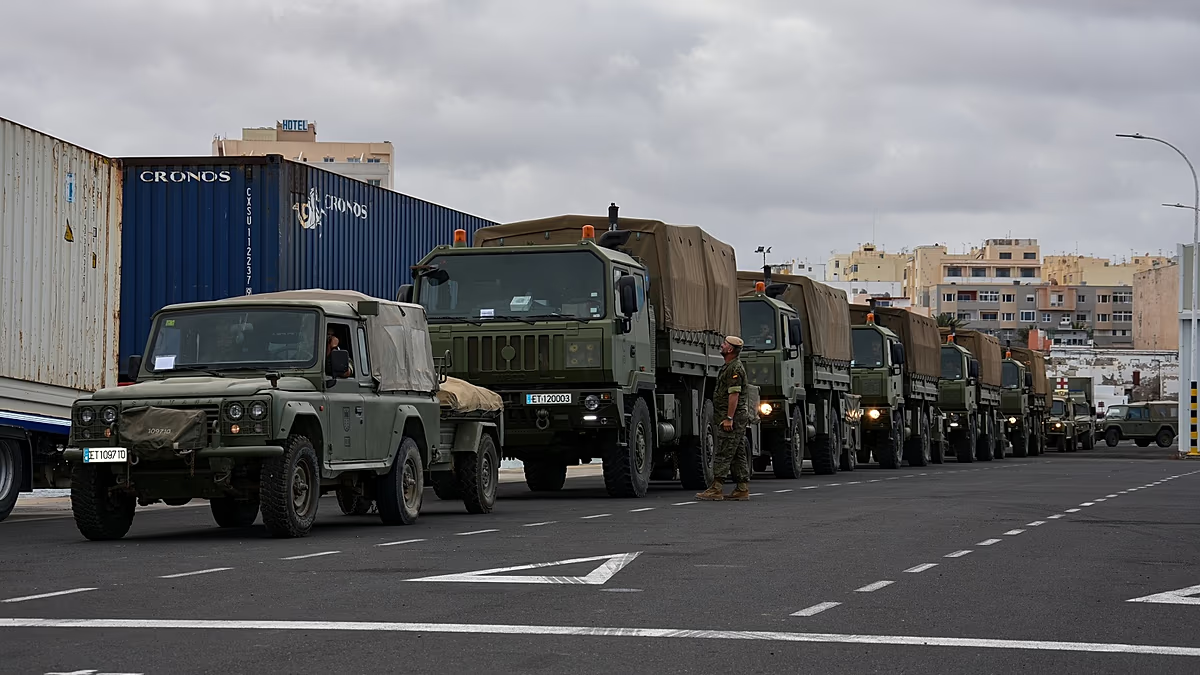
A remarkable logistical feat underpins the entire operation, demonstrating the practical challenges of rapid deployment. A significant portion of the forces, including the core Canary Islands Brigade, had to be projected over a vast distance—from the Spanish archipelago off the coast of Africa to the mainland peninsula. This intricate transfer of thousands of troops alongside their heavy vehicles, tanks, and equipment is being executed in five phased stages, utilizing both sea and air transport. This aspect of the exercise is crucial; the ability to quickly move a capable force across European territories, or beyond, is a fundamental component of any credible rapid reaction capability. The success of this complex logistical ballet is as much under assessment as the live-fire maneuvers themselves.
The exercise will reach its public climax on June 18th with a live-fire tactical demonstration presented before civilian and military authorities. This dynamic display will see the integrated multinational force responding in real-time to the unfolding fictional crisis, putting all the coordinated pieces into action. From the strategic directives issued from Brussels to the operational commands in Zaragoza and down to the individual soldiers, pilots, and specialists on the ground, the demonstration aims to showcase a seamless chain of command and effective interoperability among diverse national units. It is the tangible proof of concept for years of planning and coalition building within the European defense framework.
In essence, MILEX 26 represents a concrete step toward a more autonomous and responsive European security and defense policy. While NATO remains the cornerstone of transatlantic defense, exercises like this one are vital for the EU to master its own internal coordination and ensure it can act decisively in a crisis, whether for evacuation missions, humanitarian interventions, or stabilization operations. By testing the full spectrum of capabilities—from strategic decision-making and long-range logistics to combined arms tactics and cutting-edge electronic warfare—Spain and its partner nations are not only honing their military skills but also actively forging a more resilient and capable European Union, one prepared to shoulder greater responsibility for stability in its neighborhood and beyond.