


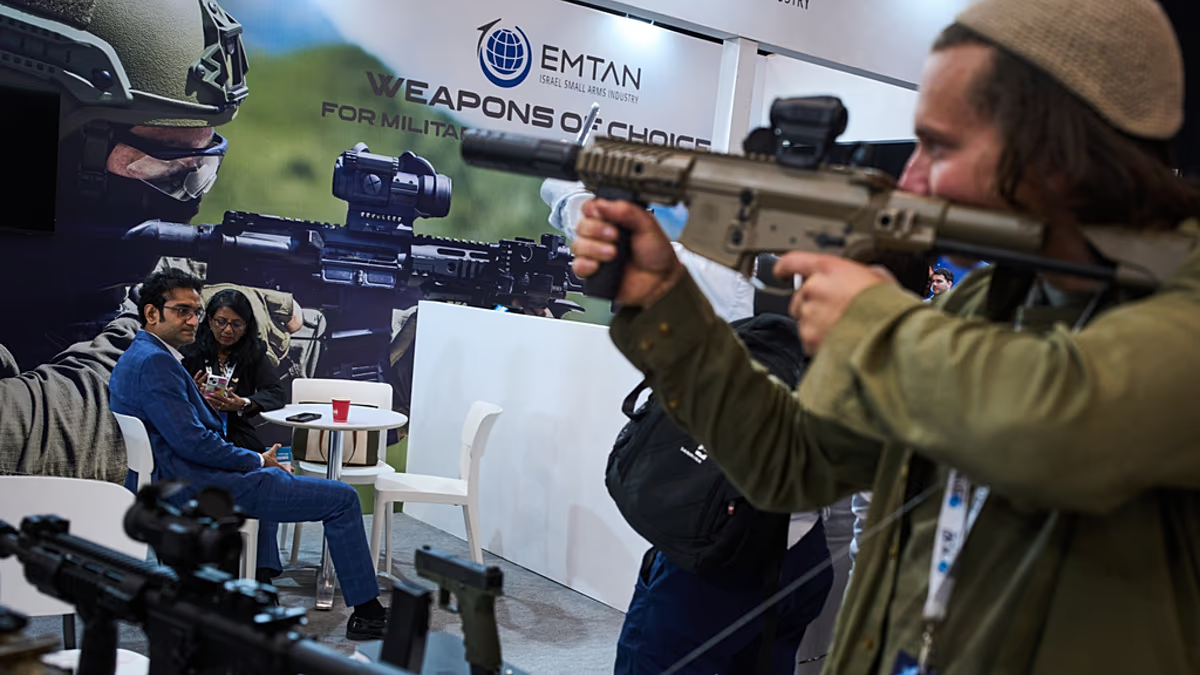
France has made a definitive decision regarding Israeli participation in the upcoming Eurosatory 2026 defence trade fair, opting to permit only defensive systems while explicitly banning the display of offensive weaponry. According to Charles Beaudouin, president of COGES Events, the organisers, this directive comes directly from the French government’s Defence Council. The ruling is clear-cut: Israeli companies may exhibit anti-ballistic and anti-air defence systems, but any firm that manufactures rockets or other offensive arms will be prohibited from displaying them. The French Armed Forces Ministry confirmed this “clear framework,” stating that Israeli exhibitors adhering to these defensive parameters would be welcome. This move effectively prevents Israel from organizing a cohesive national pavilion, fragmenting its representation to only a segment of its defence industry.
The Israeli government has reacted with strong condemnation, characterizing the French decision as “shameful” and accusing it of being driven by political and commercial calculations. The Israeli Defence Ministry announced it would be unable to participate in the fair or establish a national pavilion under these conditions, framing the action as part of a worrying trend in Franco-Israeli relations. This dispute is not an isolated incident but the latest in a series of tensions regarding Israel’s presence at major French arms exhibitions, reflecting the profound diplomatic friction exacerbated by ongoing conflicts in the Middle East.
Indeed, this marks a continuation of recent controversies. At the previous Eurosatory in 2024, French authorities initially excluded Israeli companies altogether, citing the war in Gaza as creating an unsuitable environment. That ban was later overturned by the Paris Commercial Court, which deemed it unlawfully discriminatory. Similarly, at the 2025 Paris Air Show, a standoff occurred when Israeli firms like Rafael were barred after refusing to remove offensive weapons from their displays. The current 2026 decision appears to be a more targeted, legally framed compromise—allowing a presence but strictly circumscribing its nature—aimed at navigating both judicial precedent and political pressures.
This policy is deeply intertwined with France’s evolving diplomatic stance in the region. Since late February, Paris has repeatedly condemned Israeli military strikes within Lebanese territory, which target the Hezbollah militant group. Tensions escalated recently when France called for an emergency UN Security Council meeting following the Israeli army’s capture of the historic Beaufort Castle in Lebanon. France’s trade fair restrictions, therefore, are not merely commercial regulations but a calibrated political signal, reflecting its concern over regional escalation and a desire to distance itself from offensive operations it views as destabilizing.
Against this diplomatic backdrop, the Eurosatory fair itself prepares to open its doors from June 15th to 19th at the Paris Nord Villepinte exhibition centre. The event remains a colossal gathering in the global defence calendar, expecting over 2,000 exhibitors from 42 national pavilions, hundreds of official delegations, and tens of thousands of professional visitors. The controversy surrounding Israeli participation underscores how such trade fairs are not neutral marketplaces but arenas where geopolitical alliances and disputes are visibly performed and negotiated, with national stands serving as extensions of foreign policy.
Ultimately, France’s attempt to draw a line between defensive and offensive technology at Eurosatory 2026 is a nuanced, yet potent, diplomatic tool. It allows for maintained industrial and diplomatic channels with Israel, but on terms that publicly align with France’s recent critiques of Israeli military actions. For Israel, the partial exclusion is perceived as a prejudicial act that undermines its defence industry and sovereign rights. This episode encapsulates the complex interplay between international arms commerce, national sovereignty, and the moral and political considerations that governments must balance in a conflict-ridden world, setting a precedent for how nations might use trade platforms to express diplomatic censure without severing ties entirely.