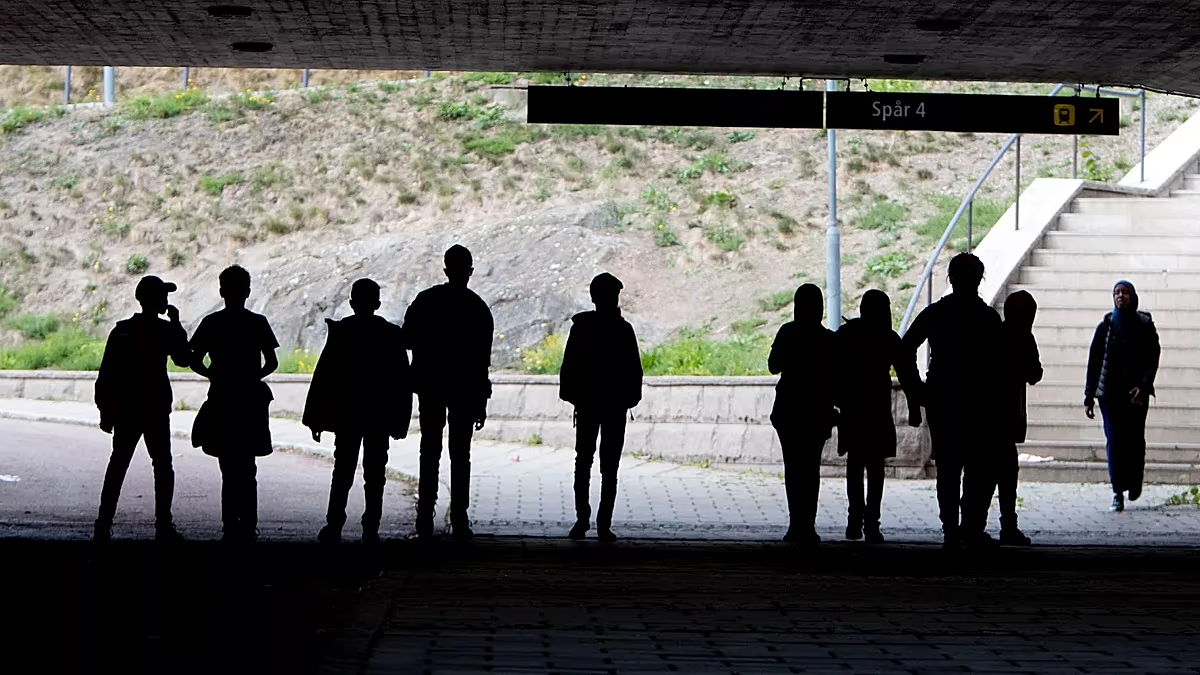



In a significant and welcomed shift, Sweden has moved to reform a set of highly contentious immigration rules that had led to the distressing phenomenon of so-called “teenage deportations.” The practice, which sparked national outrage, involved young people who arrived in Sweden as children with their asylum-seeking parents being ordered to leave the country upon turning 18, even when their families were granted the right to stay. This created heartbreaking scenarios where families were torn apart by bureaucracy, as adolescents were deemed not to independently fulfil asylum requirements the moment they reached legal adulthood. The policy was widely criticized across the political spectrum, leading the Swedish Migration Agency to halt such deportations in March 2026 after the government signaled its intent to change the law.
The core of the reform, announced jointly by the right-wing government and its far-right supporting partner, the Sweden Democrats, focuses on extending the protective umbrella of childhood. Most notably, the age at which migrant children are considered adults under immigration law will be raised from 18 to 21. This three-year extension acknowledges that a person’s life and integration are not magically complete on their eighteenth birthday. Furthermore, the changes offer a path to redress for those already caught in the system. Individuals under deportation orders who are still in Sweden can now submit new applications for residence permits, while those who have already left may reapply online or at an embassy if they held a family reunification permit within the past three years.
Migration Minister Johan Forssell hailed the changes as an “important step,” emphasizing that teenagers who “have done everything right should, of course, have the opportunity to work, study and become part of our beautiful country and our society.” This statement highlights the fundamental injustice the reform seeks to correct: penalizing young people who have grown up in Sweden, attended its schools, and built their lives there, through no fault of their own. The reform recognizes that these young individuals are, in every practical sense, already members of Swedish society, and their deportation to often-unfamiliar countries of origin is a profound human and social cost.
The problematic rules originated from a policy shift in 2021. Previously, when parents were granted asylum, their children automatically received permanent residence. However, the newer system granted children only temporary permits, forcing them to re-apply independently upon adulthood—a hurdle many could not clear, leading directly to the deportation orders. The recent reform, therefore, is a correction to a system that created a precarious limbo for children within families that were otherwise permitted to stay, effectively holding them accountable for legal criteria they could not meet as dependents.
It is crucial to contextualize this humanitarian adjustment within Sweden’s broader, still-restrictive immigration stance. The coalition government, supported by the anti-immigration Sweden Democrats, came to power in 2022 pledging to tighten asylum rules, a trend that began years earlier following the large influx of refugees in 2015. Minister Forssell explicitly stated that the government remains committed to a “very strict asylum policy.” This reform, therefore, is a targeted exception—a fix for a specific and glaring flaw—rather than a wholesale relaxation of Sweden’s approach. It addresses an issue of basic fairness for integrated youth without altering the fundamental principles of the government’s stringent migration agenda.
In conclusion, Sweden’s policy change represents a measured and humane response to a recognized failure within its immigration framework. By raising the age of assessment and providing reconciliation mechanisms, it aims to prevent the tearing apart of families and the exile of young adults who consider Sweden their home. While the nation’s overall asylum policy remains firm, this crucial amendment acknowledges that integration and belonging cannot be disregarded in the pursuit of border control. It stands as a testament to the power of public discourse and political accountability in rectifying policies that, in practice, inflicted undeniable human suffering.