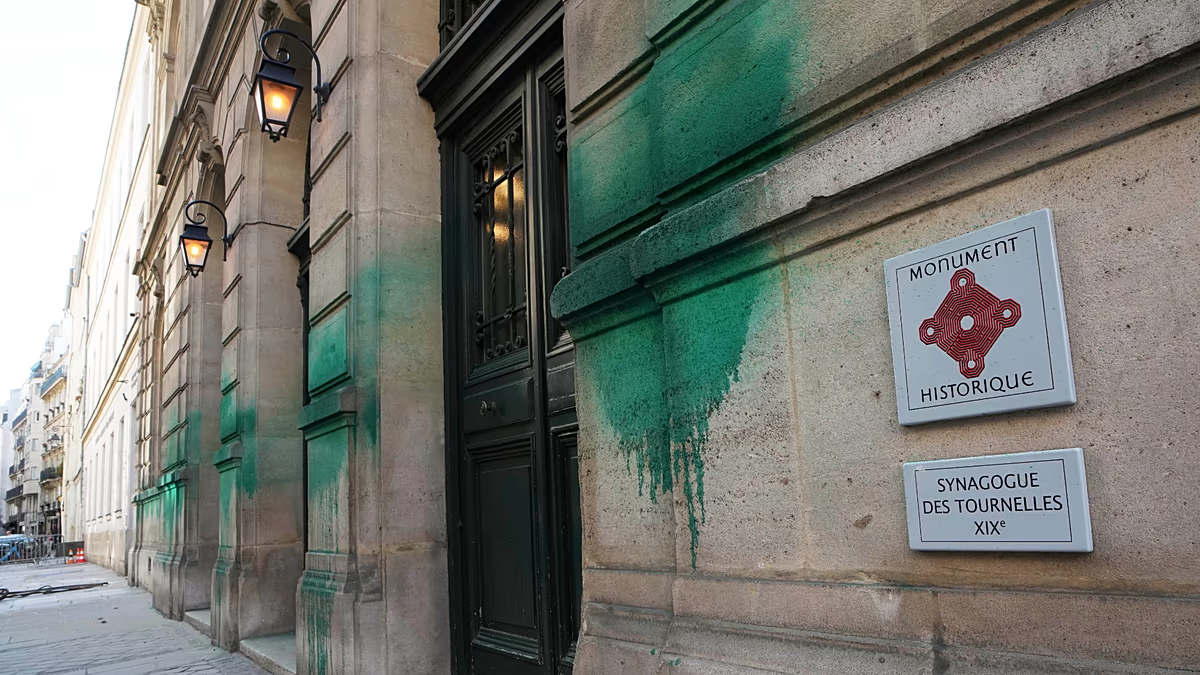



A sobering report released by France’s Interior Ministry this week paints a stark picture of rising religious hatred across the nation. The document, which provides a comprehensive overview from 2010 to 2025, underscores a deeply worrying trend: acts targeting individuals and property based on their real or perceived faith are increasing significantly, undermining the very fabric of French society. While a slight dip occurred in 2020, attributed to pandemic lockdowns, the data reveals a sharp resurgence following the Hamas attacks on October 7, 2023, and the ensuing Israel-Hamas conflict. This surge has been driven overwhelmingly by a dramatic rise in antisemitic acts, alongside increases in attacks against Christians and Muslims. The government acknowledges that these figures, focused on the three main monotheistic religions, are likely underestimated due to unreported incidents, and warns that such acts directly assault freedom of conscience, weaken national cohesion, and endanger the societal balance.
The most alarming finding is the overwhelming and sustained rise of antisemitism. Since 2010, antisemitic acts have climbed steadily, with a record-breaking peak in 2023. The report notes a staggering 1,209% increase between September and October of that year, with the resurgence beginning immediately after October 7th. Although numbers dipped slightly in 2025, they remain at a historically high level, now constituting more than half (53%) of all anti-religious acts in France. The nature of these attacks is particularly distressing: most target individuals directly through threatening remarks, gestures, and graffiti, with a tripling of physical assaults since 2022. The ministry also highlights the persistent poison of antisemitism among younger generations, largely fueled by the rampant spread of violent speech and behavior on social media since the October 2023 attacks.
Attacks against the Christian community, while differing in proportion and nature, also show a concerning upward trajectory. These acts have climbed steadily since 2010, now accounting for about a third of all anti-religious incidents. While attacks on property—such as vandalism of churches—remain dominant, 2025 saw a sharp 70% increase in attacks on individuals. This included a doubling of physical assaults, often targeting leaders of places of worship, and a tragic culmination in the murder of an Iraqi Christian man in Lyon. The year was also marked by a significant rise in the disruption of religious services and threats against worshippers. Notably, almost all these acts target the Catholic community, reflecting its widespread presence and symbolic buildings across France.
The report details a similarly sharp and painful rise in attacks against Muslims. After a peak in 2015 following terrorist attacks in France, the numbers had fluctuated but saw a drastic 88% increase in 2025. This surge was driven mainly by a 151% rise in attacks on individuals and was punctuated by spikes around religious periods like Ramadan or during heated public debates. Particularly vile tactics, such as dumping pig carcasses outside prayer rooms, saw a shocking 317% increase. The government suggests that part of this rise may be due to better reporting, aided by organizations like the Association for the Defence against Discrimination and Anti-Muslim Acts (ADDAM), which has enhanced monitoring and partnership with authorities. This, however, does not diminish the reality of the increased hostility faced by the Muslim community.
In response to this alarming landscape, the French government has mobilized a cross-departmental effort, prioritizing the fight against anti-religious acts. A tangible sign of this commitment is the allocation of more than €47.8 million since 2015 to secure nearly a thousand places of worship. Through the “Securing Religious Sites” program, the state helps finance CCTV, anti-intrusion devices, and internal security measures for vulnerable religious buildings. Beyond physical protection, the Interior Ministry has also developed an awareness-raising module for faith communities, covering security issues and response mechanisms. Hundreds of these sessions have already been held, equipping community leaders with knowledge and resources, with plans to continue this educational outreach in 2026.
Ultimately, this report is not just a collection of statistics; it is a mirror reflecting a fractured social reality. The data tells a story of communities living under heightened threat, where places of solace require fortification and individuals face violence for their identity. The government’s financial and educational measures are necessary responses, but the core challenge laid bare by the document is one of national conscience. The rising hatred, fueled by global events and amplified through digital channels, strikes at the heart of France’s republican values of liberty and equality. Addressing it requires not only steadfast security and justice but a profound, collective recommitment to mutual respect and the protection of every citizen’s right to belief and peace.