


Summary and Humanization of Statements Regarding the Drone Incident in Romania
Paragraph 1: A Breach of Norms and a Statement of Accountability
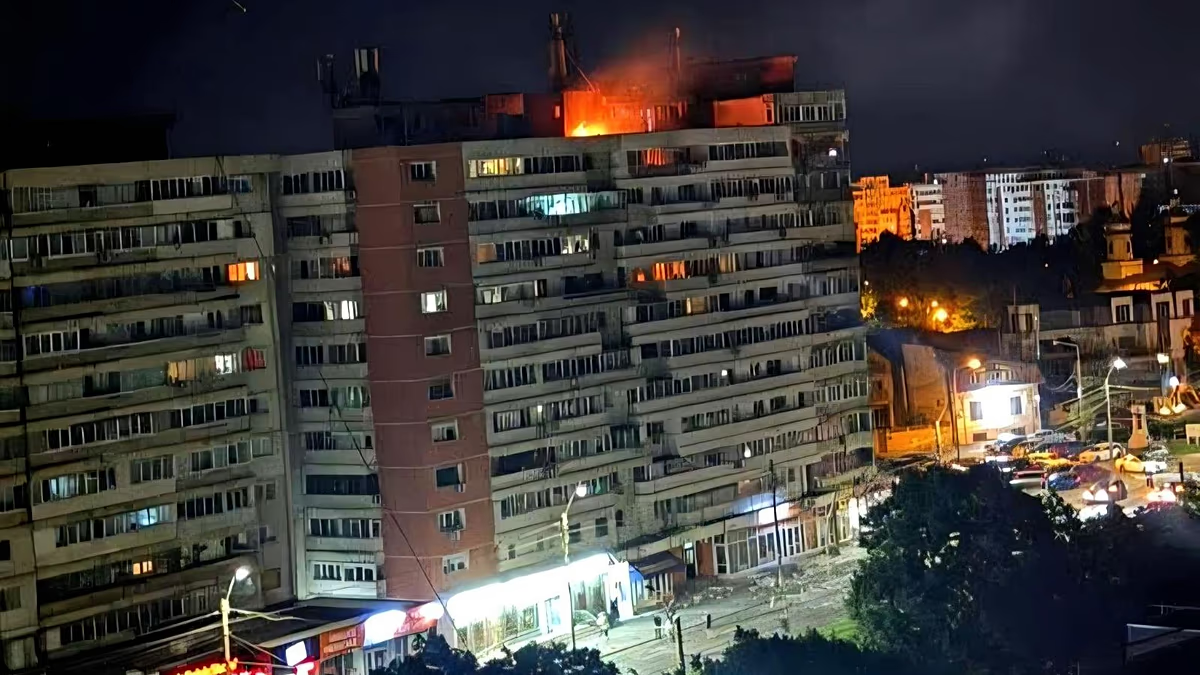
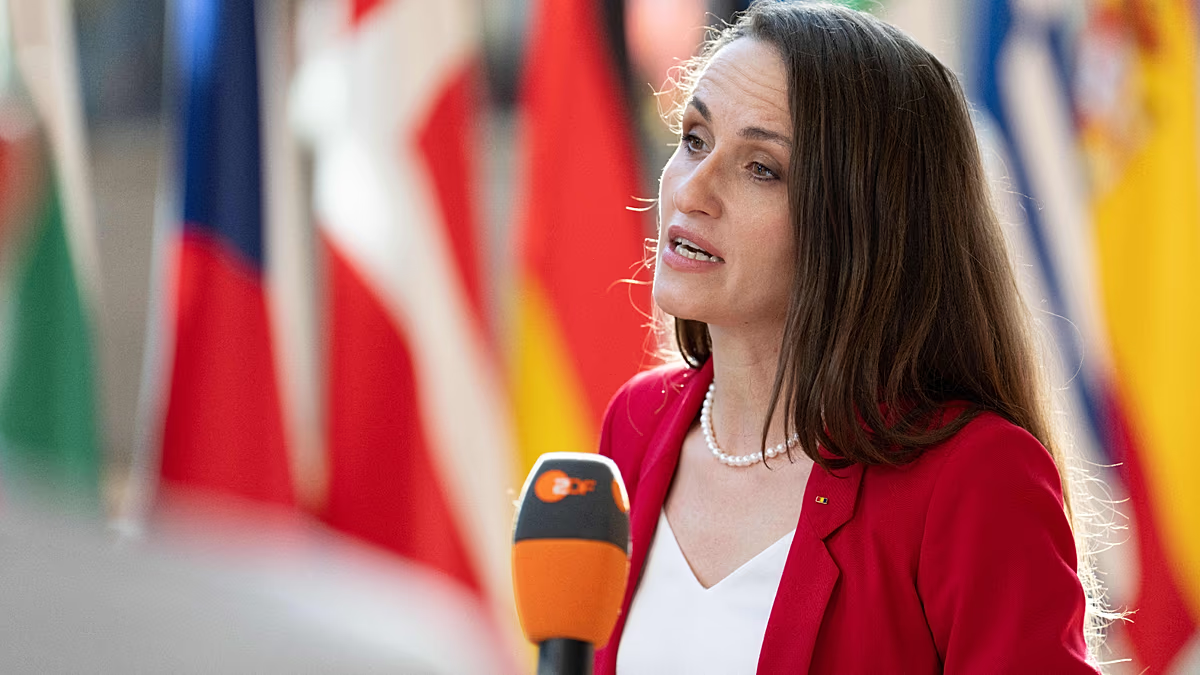
In the wake of a profoundly unsettling incident where a drone struck a residential building on Romanian soil, Foreign Minister Oana Țoiu has articulated a position of grave and unambiguous accountability. Speaking with the clarity demanded by the circumstances, she stated that the responsibility for the resultant harm to Romanian civilians rests entirely with Russia. This declaration transcends a mere political accusation; it is a foundational claim about the violation of a sovereign nation’s physical and psychological space. The incident is framed not as a peripheral spillover, but as a direct consequence of actions taken in a war of aggression, making the source of that aggression answerable for its expanding radius of destruction. Minister Țoiu’s words humanize the bureaucratic concept of territorial integrity by anchoring it to the real, lived terror of citizens who, in their own homes, found themselves unwillingly on the front lines of a conflict they are not a party to.
Paragraph 2: From Speculation to Final Confirmation: The Weight of Evidence
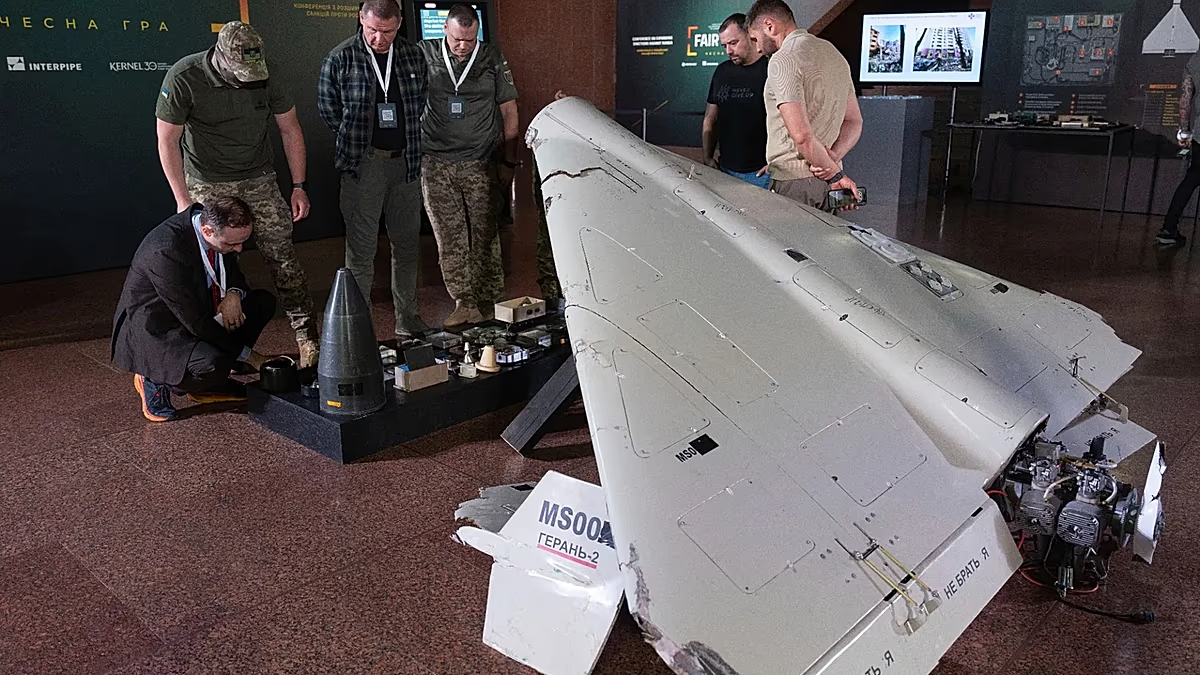
Crucially, Minister Țoiu’s statement moved beyond initial reports and swirling speculation to deliver what she termed “final confirmation” of a chilling detail: the drone in question “was carrying explosives.” This confirmation is a critical piece of the narrative, shifting the discussion from an assumption of accidental debris to a conscious act of deploying a weaponized system. It answers the haunting question of intent, not in the geopolitical sense, but in the mechanical one. A crashed surveillance drone tells one story; an explosive-laden drone, even if downed or errant, tells another. This confirmed detail adds a layer of severity to the incident, underscoring the destructive potential that crossed into Romania’s airspace. It transforms the event from a potentially tragic accident of war into a demonstrable breach involving a live instrument of war, thereby intensifying the gravity of the violation and solidifying the basis for Romania’s firm stance.
Paragraph 3: The Human Dimension Beyond the Diplomatic Language
While the language is that of diplomacy and international law, the human reality it seeks to address is raw and immediate. The phrase “civilians were harmed” is a formal encapsulation of what, on the ground, translates to shattered windows, torn-apart apartments, injuries treated in hospitals, and families gripped by fear and trauma. Minister Țoiu’s statement, by naming civilian harm explicitly, serves to center these lived experiences. It is a reminder that behind the discussions of sovereignty and airspace violations are ordinary people whose sense of security has been violently compromised. This human dimension is the core of Romania’s outrage. The government’s response is not merely about a point on a map being violated; it is about the breach of the fundamental expectation that one’s home is a sanctuary, an expectation that this incident has, for those affected, tragically obliterated.
Paragraph 4: Navigating the Precarious Position of a NATO Frontier State
Romania’s response must also be understood within its strategic context as a NATO member state sharing a direct border with an active warzone. This position is uniquely precarious. Every incident, especially one causing civilian harm, tests the alliance’s collective defense principles while demanding a response that is firm yet measured to avoid uncontrolled escalation. Minister Țoiu’s clear attribution of “full responsibility” to Russia serves multiple purposes: it provides a definitive narrative for the Romanian public, asserts the nation’s dignity in the face of aggression, and signals to NATO allies the serious nature of the transgression. It is a calibrated act of statecraft, expressing righteous anger while operating within the frameworks of alliance consultation. The statement is thus both a national assertion and a piece of diplomatic communication to the international community, highlighting the ongoing risks the war poses to European stability beyond Ukraine’s borders.
Paragraph 5: The Broader Implications for European Security and War Conduct
This incident and Romania’s formal response reverberate beyond the Black Sea region. It represents a tangible case of the “spillover” that Western leaders have long warned about. The violation of a NATO member’s territory, resulting in civilian harm, marks a dangerous erosion of the boundaries of the conflict. It raises urgent questions about the conduct of hostilities and the apparent disregard for the risk posed to neighboring states by the use of long-range, often imprecise, weapon systems like drones. For Europe, it is a stark lesson in how modern warfare, with its ubiquitous drones and missiles, can defy old notions of contained battlefields. Minister Țoiu’s statement is therefore a contribution to a larger, grim record of this war’s expanding footprint, serving as evidence in the ongoing assessment of its long-term implications for continental security architecture and the norms of warfare.
Paragraph 6: A Defining Moment for Romanian Resolve and Sovereignty
Ultimately, the interview with Foreign Minister Țoiu captures a nation at a defining moment. It is the moment when abstract geopolitical threat became concrete physical damage. Her words are the official, humanized voice of a country reaffirming its sovereignty in the most direct terms possible: by naming the responsible party and detailing the nature of the violation. The confirmation of an explosive payload is the evidentiary cornerstone of this reaffirmation. While the next steps—whether further military reinforcement, diplomatic measures, or NATO consultations—remain to be seen, the statement itself is a critical act. It documents the incident, establishes Romania’s victimhood and moral high ground, and sets an unequivocal baseline of accountability. It is a declaration that the safety of Romanian citizens is non-negotiable and that violations of their peace will be met with a formal, firm, and principled response, reflecting both the anger of a harmed community and the calculated resolve of a state defending its place within a threatened European order.