

Since the opening hours of its full-scale invasion in February 2022, Russia has wielded a relentless and psychologically taxing weapon against Ukraine: the Shahed-type drone. Known for their distinctive, lawnmower-like buzz that has earned them the grim nickname “mopeds” among Ukrainians, these unmanned aerial vehicles have become a ubiquitous feature of the war. Launched in swarms numbering in the hundreds, their primary purposes are twofold: to systematically destroy military targets, energy facilities, and civilian infrastructure, and to overwhelm Ukraine’s air defences by forcing the costly interception of cheap, plentiful munitions. This constant, buzzing harassment has turned every night into a potential trial, aiming to grind down both Ukraine’s physical defences and the morale of its people through sustained terror.
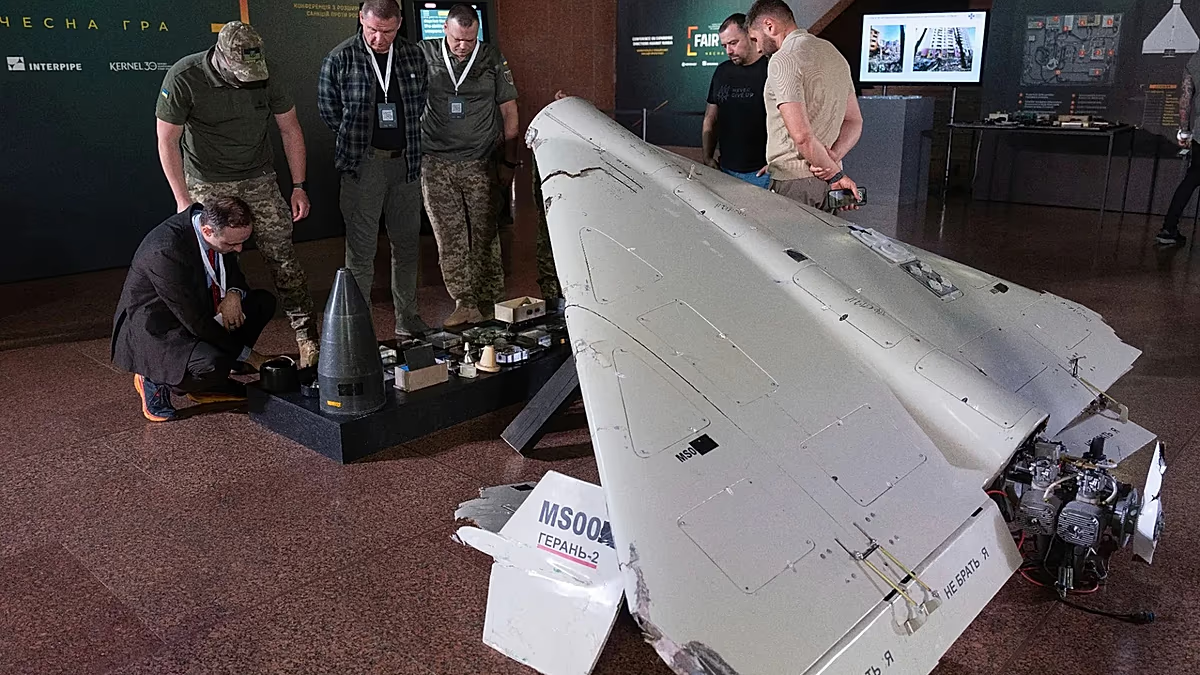
While initially imported from Iran as the Shahed-136, Russia quickly moved to domestically produce its own version, dubbed the Geran-2 (meaning “geranium”). By 2023, assembly lines, notably at a plant in Tatarstan, were operational, allowing Moscow to dramatically scale up attacks. The tactical advantage of the Geran-2 lies in its brutal economics. It is a relatively slow, low-flying drone with a range of up to 2,000 kilometres, capable of delivering a 50-kilogram warhead. Its genius, from a Russian perspective, is its cost—estimated at a mere €25,000 to €40,000—which is a tiny fraction of the price of a ballistic or cruise missile. This low cost enables mass production and saturation attacks, presenting Ukraine with a devastating dilemma: expend expensive, limited air defence missiles to shoot down each cheap drone, or allow some through to cause potentially catastrophic damage.
However, the “domestic” label of the Geran-2 is deeply misleading. Investigations by Ukrainian intelligence and organizations like the OCCRP have revealed that the drone’s anatomy is a patchwork of global components, predominantly from the West. By dissecting downed drones, analysts have mapped out a supply chain where hundreds of microchips, transistors, antennas, and fuel pumps originate from American, Chinese, and especially European companies. Despite EU sanctions explicitly prohibiting direct exports of these dual-use items to Russia, trade data shows a circuitous route often involving intermediaries in China and Hong Kong. This means that critical parts from dozens of European firms continue to fuel Russia’s drone war, highlighting the immense challenge of enforcing sanctions and severing the technological lifelines of a modern military machine.
Not content with the basic model, Russia has aggressively pursued upgrades, producing deadlier variants. The pinnacle of this evolution, unveiled in May 2025, is the Geran-5. This represents a significant leap in capability, shifting from a propeller to a Chinese-made Telefly jet engine. The Geran-5 is larger, faster (cruising at 450-600 km/h), and carries a heavier 90-kilogram warhead. Most alarmingly, it can be launched from Su-25 attack aircraft and is reportedly equipped to carry R-73 air-to-air missiles, transforming it from a simple ground-attack loitering munition into a potential airborne weapon system capable of engaging other aircraft. Crucially, this advanced model also reportedly relies on Western microelectronics, demonstrating that the sanctions evasion problem persists even for Russia’s latest weapons.
The human cost of this ever-evolving drone campaign is staggering. In 2025 alone, Ukrainian cities faced attacks on 357 out of 365 nights, granting the population only eight nights of reprieve for the entire year. This unceasing barrage has turned air raid sirens into a grim soundtrack of daily life, disrupting sleep, terrorizing communities, and demanding constant vigilance. In response, Ukraine has been forced to adapt rapidly, ramping up and refining its air defence network with a mix of sophisticated Western systems and innovative, cost-effective countermeasures. This effort has seen remarkable success; during a massive coordinated attack on May 23, 2025, which included 600 drones alongside hypersonic and ballistic missiles, Ukrainian forces achieved an interception rate of over 91% for the Shahed-type drones. This high rate is a testament to Ukrainian resilience and skill, but it also underscores the immense resource drain of defending against such a cheap and numerous threat.
In summary, the Shahed/Geran drone campaign represents a core tenet of Russia’s war strategy: the weaponization of cost and endurance. By deploying cheap, mass-produced drones built with illicitly sourced international components, Moscow seeks to exhaust Ukraine financially and psychologically. While Ukrainian air defences have proven highly effective in shooting them down, the asymmetry of expending missiles worth hundreds of thousands or millions of dollars to destroy a €40,000 drone is unsustainable in the long run without continuous allied support. The evolution from the basic Geran-2 to the jet-powered, multi-role Geran-5 signifies an arms race within the conflict, promising even deadlier attacks. Ultimately, the story of these buzzing “mopeds” is not just one of technology and tactics, but of a society’s relentless struggle for survival under a nearly endless nocturnal siege, and the ongoing global failure to fully cut the supply lines that make it possible.