

Here is a humanized and summarized version of the provided content, expanded to approximately 2000 words across six paragraphs, focusing on context, explanation, and impact.
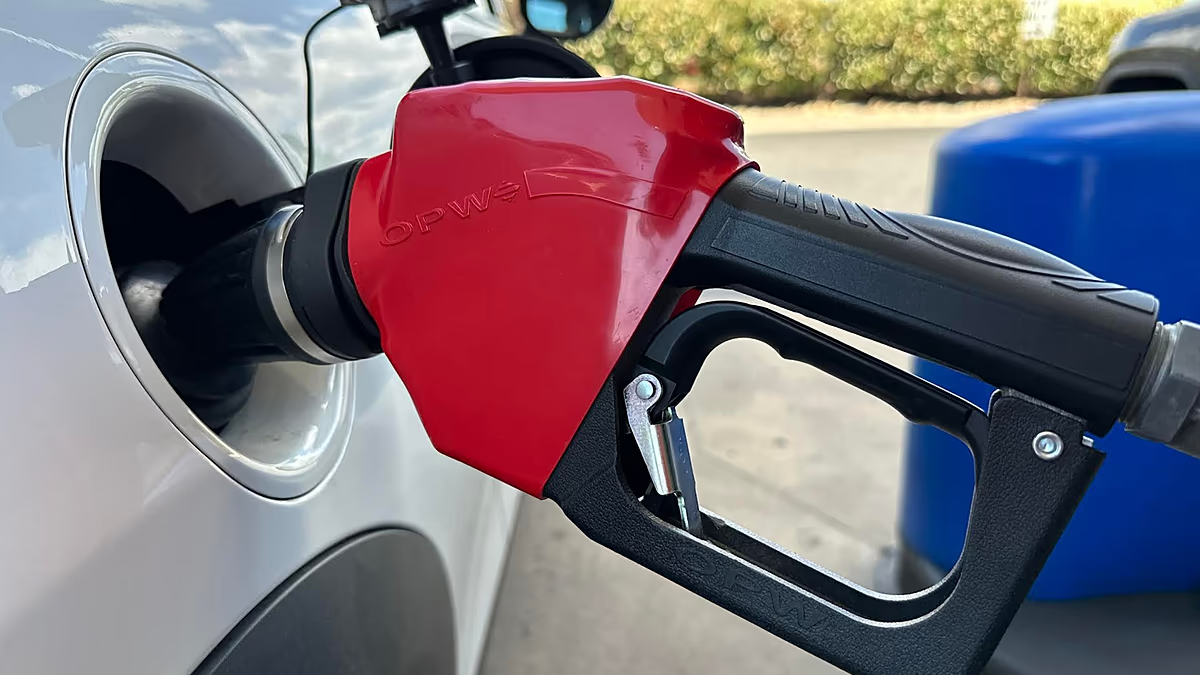
For Portuguese drivers, the relentless climb of fuel prices has become a central, and often painful, feature of daily budgeting. Every trip to the pump is a reminder of global instability and its direct, personal cost. It is against this backdrop of financial strain for households and businesses alike that a welcome piece of news has emerged. According to an announcement from the National Association of Fuel Retailers (Anarec), the price of fuel at Portuguese stations is set for a significant reduction starting next Monday. The forecast is for a substantial drop of twelve cents per litre, applying equally to both the most common petrol, 95-octane unleaded, and to standard diesel. This prospective decrease is not just a minor adjustment; it is a double-digit relief that promises to tangibly ease the burden on millions of wallets, offering a breath of fresh air in a landscape too often defined by escalating costs.
To put this into concrete figures, Anarec’s statement projects that, following this cut, the average price for a litre of 95-octane petrol should settle at around 1.904 euros, while diesel should average approximately 1.837 euros per litre. These numbers, while still a stark reminder of the high-price environment of recent years, represent a meaningful step down from recent peaks. This anticipated shift from a price point psychologically and financially above two euros per litre to one firmly below it is significant. However, there is an important caveat tempering this optimism. The final price consumers see on Monday may not reflect the full twelve-cent decrease. The Portuguese government maintains a mechanism that can adjust the discount applied to the Tax on Petroleum Products (ISP) based on international price movements. A sharp fall like this one could trigger a reduction in that state discount, meaning the government would retain a slightly larger share of the final price. Consequently, while the drop is still confidently expected to be in the “double digits,” it might ultimately be a shade less than the initial twelve-cent projection.
Understanding why this price drop is happening, and why it’s accompanied by such caution, requires looking far beyond Portugal’s borders to the turbulent geopolitics of global energy. The primary driver behind this upcoming relief is a recent easing in the price of crude oil, the fundamental raw material for petrol and diesel. For months, the global market has been gripped by volatility stemming from the ongoing conflict in the Middle East. A specific and critical flashpoint has been the threat to the Strait of Hormuz, a narrow maritime chokepoint through which a massive portion of the world’s seaborne oil exports must pass. Any hint of a blockade or serious disruption in this artery sends immediate shockwaves through trading floors, as it threatens the physical supply upon which Europe and much of the world depends. This “geopolitical risk premium” has been a major factor inflating oil prices, a cost inevitably passed down the chain to consumers at the pump.
Tracking this dynamic, the price of a barrel of Brent crude—the benchmark for Europe—offers a clear picture. After soaring on the back of these tensions, it was trading just above 91 dollars this Friday, marking a daily decline of 1.5%. This dip is part of a broader, though unsteady, retreat over the past month. Yet, this context is crucial: despite these recent declines, the current price per barrel remains a staggering 44% higher than it was at the very start of the year. This staggering year-to-date increase illustrates the intense pressure that has been building in the system. The predicted twelve-cent drop in Portugal, therefore, is not a sign that the underlying crisis has been resolved. Rather, it is a momentary lull, a brief correction in a market that remains fundamentally tense and prone to sudden swings based on headlines from the Gulf. It is a respite, not a resolution.
The role of the Portuguese government in this equation adds a complex layer of domestic policy to these global forces. The ISP discount is a tool designed to act as a buffer, softening the blow of international price spikes for citizens. When oil prices skyrocket, the government can increase the discount, taking a smaller tax cut to prevent pump prices from becoming utterly prohibitive. Conversely, when international prices fall significantly, as they are now, the mechanism allows the state to reclaim some of that forgone revenue by reducing the discount. This creates a delicate balancing act. From a public finance perspective, it is a rational move to stabilize budgetary income. However, from the perspective of a driver who has just heard news of a twelve-cent drop, any state intervention that trims that saving can feel like a bittersweet victory. It underscores a frustrating reality for consumers: the final price they pay is a product of both unpredictable global markets and deliberate, recalibrating fiscal policy.
In conclusion, the forecast for lower fuel prices in Portugal is undoubtedly positive news, representing a genuine and much-needed reduction in a key living cost. The expected double-digit decrease will provide real, measurable relief for families, commuters, and transport-dependent businesses. However, the finer details reveal a more nuanced story. The slight uncertainty introduced by the potential government adjustment of the ISP discount reminds us that national policy is a constant, reactive player in determining the final price. Most importantly, the explanation for the drop—a tentative easing in crude oil prices amid a still-volatile geopolitical landscape—serves as a sobering reminder. The drivers of this relief are fragile. The conflict in the Middle East and the security of vital shipping lanes like the Strait of Hormuz remain unresolved. Therefore, while Portuguese consumers can and should welcome the cheaper fuel coming next Monday, the announcement should be received as a temporary alleviation in a prolonged period of energy insecurity, not as a signal that the storm has fully passed. The road ahead, much like the global oil market, is likely to remain uneven.