


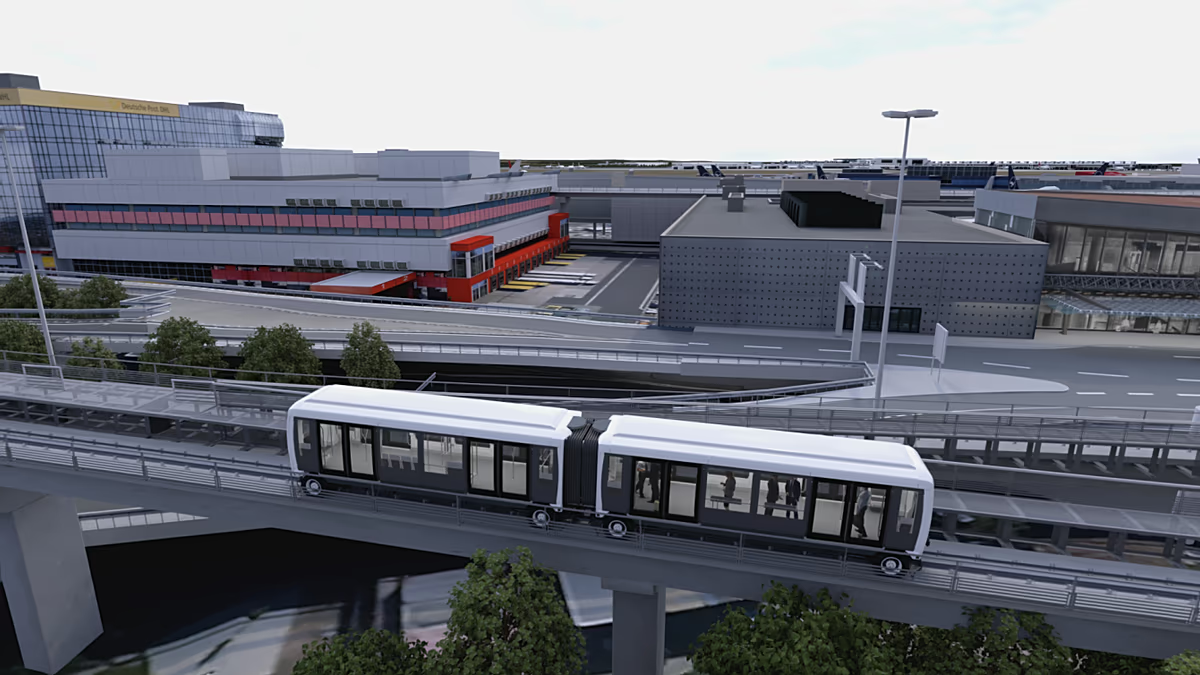
The recent inauguration of Terminal 3 at Frankfurt Airport was heralded as a significant leap into the future for Germany’s primary aviation hub. This state-of-the-art facility, representing a colossal investment of four billion euros, is designed to usher in a new era of passenger experience, with the capacity to serve up to 19 million travelers annually. Central to this modern vision was the new Sky Line train (Line 2), a driverless system intended to be the artery connecting the entire complex. Its 5.6-kilometre route was engineered to whisk up to 4,000 passengers per hour between Terminal 1, the existing railway stations, and the new Terminal 3 in a mere eight minutes, promising a seamless, efficient, and free transfer service. The opening of this automated people mover was meant to be the crowning achievement, physically and symbolically linking the airport’s past infrastructure with its ambitious future.
However, this vision of seamless connectivity has encountered a stark and frustrating reality. Mere weeks after its celebratory launch, the brand-new Sky Line has been abruptly taken out of service indefinitely. Travelers arriving at Frankfurt Airport are now met with announcements and website notices informing them that the promised “perfect connection” is, for now, broken. The stated reason from operator Fraport is “necessary technical inspections and adjustments to the overall system,” a phrase that, while logical, offers little comfort to those caught in the disruption. This unexpected suspension underscores the immense complexity of such large-scale technological systems, where even the most rigorous testing can reveal issues only after public launch under full operational loads.
In place of the sleek, automated trains, passengers must now rely on a fleet of shuttle buses to make the same journey between terminals. This substitution represents a significant step backward in the travel experience. What was designed to be an eight-minute, weather-protected, and predictable train ride is now subject to road traffic, potential delays, boarding queues, and the logistical hassle of handling luggage on and off buses. For travelers already navigating the stresses of international air travel—particularly those with tight connections or weary from long flights—this disruption is more than a minor inconvenience; it directly impacts the efficiency and comfort that a modern global hub like Frankfurt aims to guarantee.
The timing of this failure is particularly conspicuous and damaging. The suspension coincides directly with the critical, ongoing transition of airline operations from Terminal 2 to Terminal 3, a move scheduled for completion in mid-June. This period of migration is inherently complex, requiring clear and reliable signage and transportation for passengers who may already be confused by new procedures and layouts. The absence of the Sky Line, the primary advertised link for this new terminal, adds a layer of uncertainty and complication during a phase when operational smoothness is paramount. It risks casting a shadow over the inauguration of Terminal 3 itself, shifting the narrative from one of celebration to one of logistical strain.
Fraport, the airport’s operator, has publicly asked for passengers’ understanding and assured the public that teams are working to restore service as swiftly as possible. Yet, the company has provided no estimated timeline for the Sky Line’s return, leaving travelers and airlines in a state of limbo. This silence on a resolution date is perhaps the most anxiety-inducing aspect, as it makes planning difficult. The situation presents a stark lesson in managing public expectations for major infrastructure projects: the fanfare of a grand opening creates an immediate and high standard for performance, and any subsequent failure is therefore magnified in the public eye.
Ultimately, the story of Frankfurt’s Sky Line is a modern tale of ambition meeting reality. It highlights the tremendous challenge of integrating cutting-edge, automated technology into the live, high-stakes environment of a major international airport. While the long-term benefits of Terminal 3 and its connecting train remain undeniable, this initial stumble serves as a reminder that the path to a more efficient future is not always a smooth ride. The airport’s reputation now hinges on how quickly and transparently it can resolve these technical issues, restore the promised service, and fulfill the modern, connected experience it has spent billions of euros to build. For now, the future of Frankfurt Airport is moving forward, but it is doing so on shuttle bus wheels, not on its intended high-tech rails.