


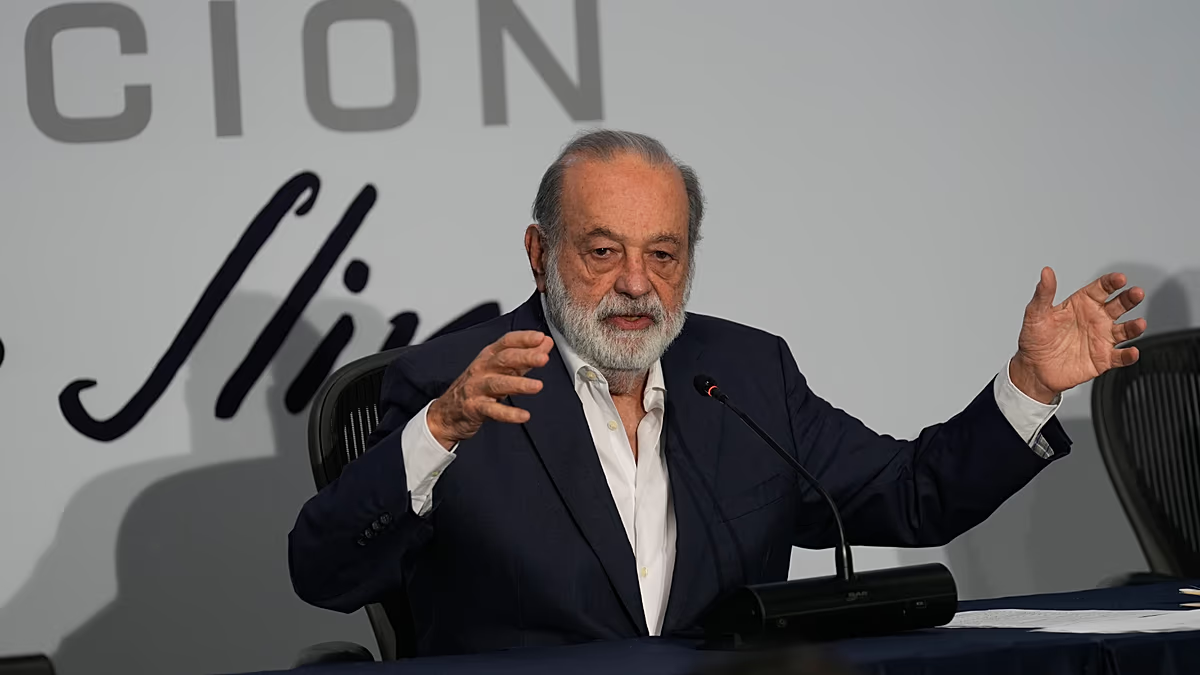
The profound and persistent crisis engulfing Mexico’s state-owned oil giant, Petróleos Mexicanos (Pemex), represents the single most critical challenge facing the nation today. This sobering assessment comes not from a political opponent, but from Carlos Slim Helú, the 86-year-old billionaire who is Mexico’s wealthiest individual. With a fortune estimated at approximately $125 billion, Slim’s perspective carries immense weight in both financial and national discourse. His declaration, made during his widely-followed annual press conference, cuts to the core of a systemic issue that threatens Mexico’s fiscal stability, energy sovereignty, and broader economic future. By identifying Pemex not merely as a troubled company but as the country’s paramount problem, Slim frames the situation as one of urgent national priority, transcending ordinary business difficulties to touch upon the very foundations of the state’s finances and strategic resources.
The dimensions of Pemex’s crisis are staggering and quantify Slim’s grave concern. The company is saddled with a monumental debt burden of roughly $85 billion, a financial albatross that constrains all other operations. This debt exists alongside a persistent narrative of declining crude oil production, reflecting years of underinvestment and operational challenges. The situation has become so dire that even with significant government intervention, Pemex concluded the 2025 fiscal year with losses nearing $2.5 billion. This bleak financial picture underscores a vicious cycle: the company is too financially strained to invest sufficiently in exploration and modern extraction technology, which perpetuates falling output, which in turn deprives it of the revenue needed to address its liabilities. The Mexican government’s ongoing, aggressive financial support acts as a lifeboat, preventing immediate collapse but not yet charting a course toward true viability and growth.
During his expansive press conference, Slim, the owner of América Móvil, also turned his attention to the broader economic landscape under President Claudia Sheinbaum. He offered praise for her administration’s overall economic management, suggesting a level of confidence in the government’s macroeconomic stewardship. However, this praise stood in pointed contrast to his sharp criticism of the recent decision by the credit rating agency Moody’s to downgrade Mexico’s sovereign debt rating. Such downgrades typically increase borrowing costs for the country and can dampen foreign investor sentiment. Slim’s rebuttal of Moody’s assessment can be seen as a public vote of confidence, aiming to bolster market perceptions. Furthermore, he pledged a significant personal commitment to the nation’s economy, announcing investment plans totaling around $5 billion for the coming year, although specific details were not disclosed. This move signals his continued belief in Mexico’s underlying potential, even as he highlights its largest systemic risk.
Central to Slim’s proposed solution for Pemex is a clear and focused operational goal: the immediate and substantial increase in crude oil production. He has characterized the current output levels as critically insufficient, a view that underscores how the company’s financial woes are intrinsically linked to its core operational failing. Slim posits a tangible target, suggesting that a concerted infusion of new capital—from both public and private sources—could potentially elevate production by approximately 800,000 barrels per day. This figure is not trivial; it represents a significant boost that could transform Pemex’s revenue streams, enhance Mexico’s energy independence, and provide a tangible path toward servicing its daunting debt. His perspective implicitly advocates for a pragmatic approach that prioritizes measurable, hydrocarbon-based results as the fastest route to stabilization, potentially opening the door to more nuanced debates about the role of private investment in a constitutionally protected state monopoly.
The juxtaposition of Slim’s stark warning and his announced investments paints a picture of a patriarch deeply invested in his country’s fate. His analysis moves beyond simple criticism to construct a framework for action, blending caution with conditional optimism. By publicly identifying Pemex’s crisis as the nation’s biggest problem, he places immense pressure on the Sheinbaum administration to address it with unprecedented seriousness and perhaps with more innovative tools. His concurrent show of faith, through both verbal support for the government and concrete investment pledges, suggests a desire to be part of a constructive solution rather than a mere observer of decline. This duality reflects the complex reality of modern Mexico, where private capital and state enterprise are inextricably linked, and where the fortunes of the nation’s richest man are, in many ways, still tied to the health of its most emblematic state-owned company.
Ultimately, Carlos Slim’s intervention transforms Pemex’s financial and operational quagmire from a technical issue for energy ministers into a central topic of national discourse. His status grants him a unique platform, and his message is unambiguous: for Mexico to thrive, Pemex must be fixed. The path he outlines—prioritizing production increases through investment—offers one clear roadmap, though it inevitably sparks discussions about resource nationalism, environmental considerations, and long-term energy transition. Whether the government fully embraces this prescription remains to be seen. However, Slim’s powerful delineation of the problem ensures that the crisis can no longer be managed quietly on the sidelines. The sustainability of Pemex is now unmistakably framed as a decisive test for President Sheinbaum’s leadership and for the economic resilience of Mexico itself, with the watchful eyes of both the market and the public awaiting a credible and effective response.