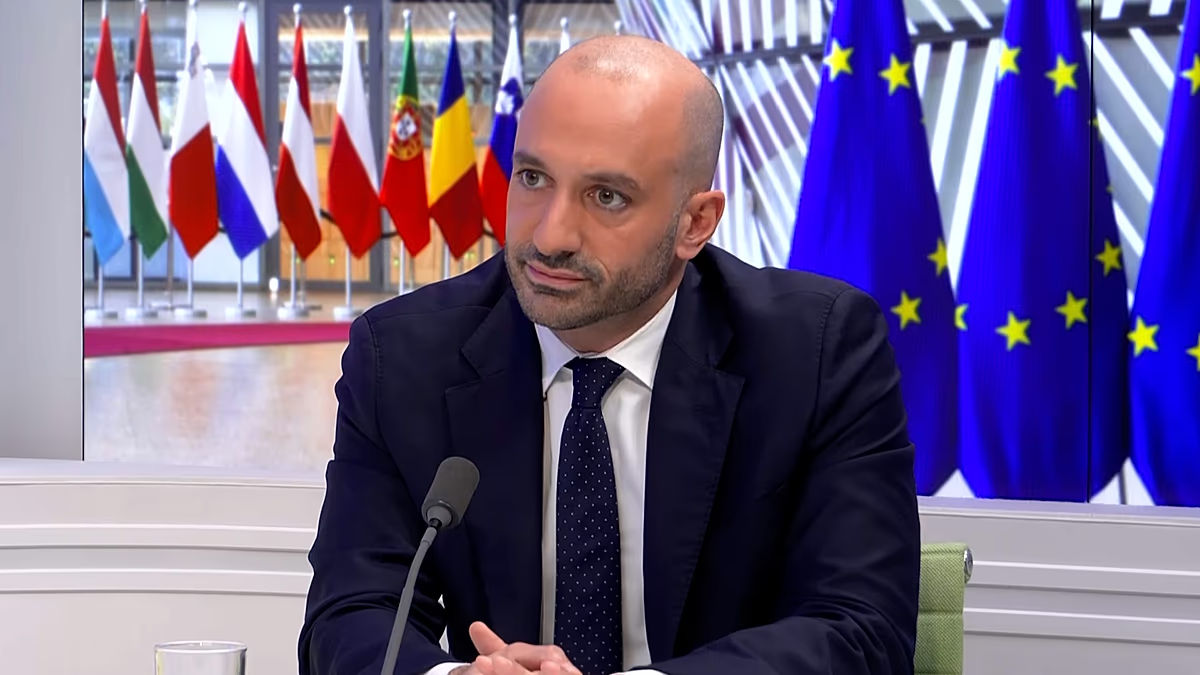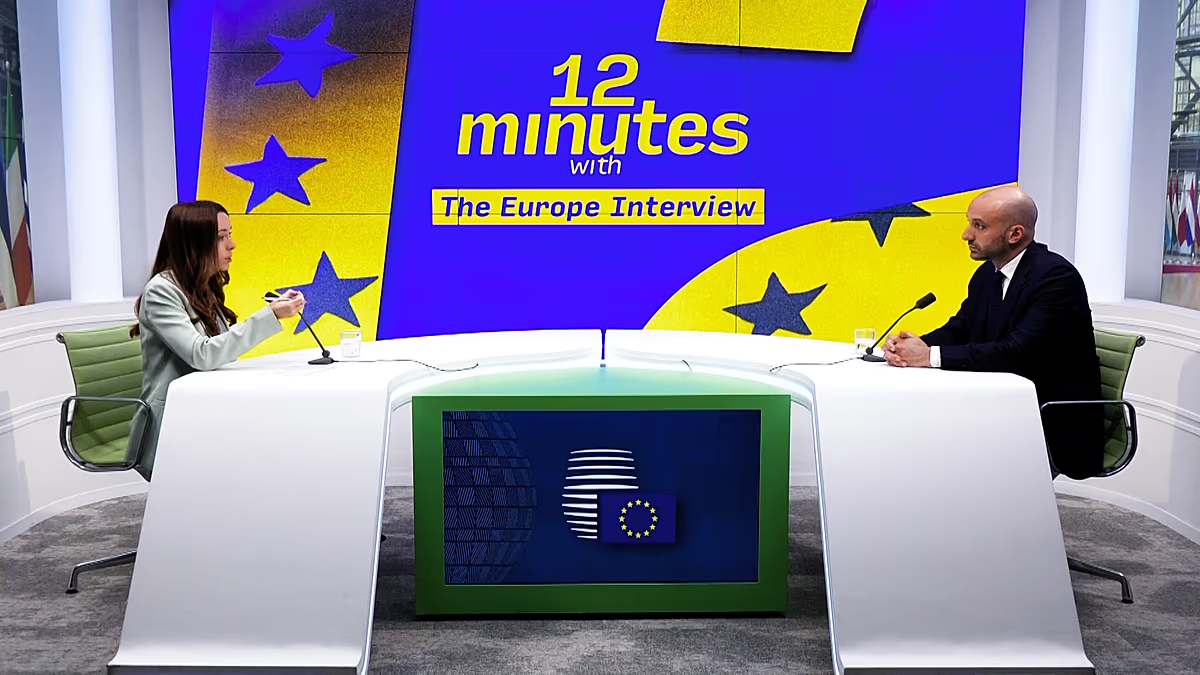



A profound shift is underway in how Europe views its place in the global economic order, moving from a posture of open-armed trade evangelism to one of pragmatic self-defense. France’s EU Affairs Minister, Benjamin Haddad, crystallized this sentiment in a recent interview, arguing forcefully that the European Union must employ “all the tools” at its disposal to protect its industries from aggressive foreign trade practices. His comments arrive at a critical juncture, as the European Commission prepares to debate stronger measures against a flood of subsidized imports, particularly from China, which threaten to overwhelm key European sectors. For Haddad, the era of naivety is over; the foundational principles of fairness and reciprocity in trade are under threat, and Europe can no longer afford to be their last guardian in a world that has moved on. This is not merely about economic policy, but about geopolitical sovereignty—the ability to defend European interests and ensure its industrial base is not cannibalized by state-backed competitors who play by a different set of rules.
The heart of the issue, as Minister Haddad framed it, is a crisis of faith in the international trading system. Europe, he suggested, has been “the last evangelists of a religion that no one is practising anymore,” clinging to the World Trade Organization’s vision of unfettered free trade long after both the United States and China abandoned it in practice. This devotion has left the bloc vulnerable, slow to react as competitors leverage massive state subsidies, dominate strategic supply chains, and build overwhelming industrial overcapacity. The result is a market flooded with artificially cheap products, from electric vehicles to solar panels, which undercut European manufacturers who must adhere to stricter environmental and labor standards. The upcoming EU discussions on harsher countermeasures, including potential tariffs, represent a painful but necessary reckoning with this new reality. It is a move from idealism to realism, acknowledging that openness must be balanced with the capacity for swift and firm defense.
However, forging a unified European front is fraught with difficulty, exposing deep internal fissures. Nations like France, Italy, and Spain are pushing urgently for a robust defensive toolkit, while economic heavyweight Germany remains more cautious, fearing retaliatory measures that could jeopardize its substantial trade and investment ties with China. This divergence underscores a central tension within the EU: the conflict between immediate national economic interests and the long-term strategic imperative of a cohesive, sovereign bloc. Haddad points to a dawning realization across Europe, citing the sobering loss of an estimated 124,000 German jobs, many in the iconic automotive sector, as a catalyst for change. The lesson is clear, he implies: exporting technology and expertise while importing deindustrialization is a losing strategy. The single market is Europe’s greatest asset, but only if its collective power is leveraged decisively to ensure a level playing field.
Beyond trade defense, Minister Haddad championed a more radical and contentious solution for long-term competitiveness: joint EU borrowing. Echoing President Macron’s call for a reset of the EU’s economic doctrine, Haddad argued that massive, coordinated investment in critical fields like defense, artificial intelligence, and space is non-negotiable if Europe is to keep pace with the United States and China. He presented this not as a burden, but as an opportunity, noting strong market appetite for EU-backed debt from reliable, trusted issuers. Yet, this vision crashes against the steadfast opposition of the so-called “frugal” member states, who recoil at the idea of shared debt amid already soaring national deficits and tight fiscal space. The geopolitical shocks from conflicts like the war in Iran, which disrupt energy supplies and inflate costs, only deepen this dilemma, squeezing European industry from all sides and making the investment imperative more urgent even as fiscal room shrinks.
Faced with this potential impasse, Haddad suggested a path forward that could redefine European integration: enhanced cooperation among a “core group” of willing nations. If unanimity among all 27 member states proves elusive on joint debt or other ambitious projects, a coalition of the willing could move ahead independently, borrowing and investing together to create concrete momentum. This idea of flexible, multi-speed integration is not new, but applying it to such a fundamental area of fiscal policy and industrial strategy would be a significant evolution. It acknowledges that in a time of rapid geopolitical and technological change, Europe cannot be held hostage by its slowest common denominator. The goal would be to demonstrate success, build capability, and ultimately draw other reluctant members into the fold, proving that unity in action is the only route to securing future prosperity and strategic autonomy.
In conclusion, Benjamin Haddad’s interview outlines a European Union at a profound crossroads. The conversation is moving beyond technical trade disputes to a broader debate about European sovereignty, resilience, and the very model of capitalism it wishes to uphold. It is a call to shed naivety, to match a commitment to rules with the strength to enforce them, and to back defensive trade measures with offensive investments in its own technological future. Whether through tariffs, joint debt, or coalitions of the willing, the underlying message is one of urgent self-reliance. The coming months, as EU leaders debate and decide, will reveal if Europe can bridge its internal divides and muster the collective will to defend its interests and shape its own destiny in an increasingly contested world. The alternative—a fragmented bloc reacting piecemeal to external pressures—risks consigning its industry and influence to irreversible decline.