


Of course. Here is a humanized and expanded summary of the event, structured into six paragraphs.
Paragraph 1: The Sudden Shock of a Distant War
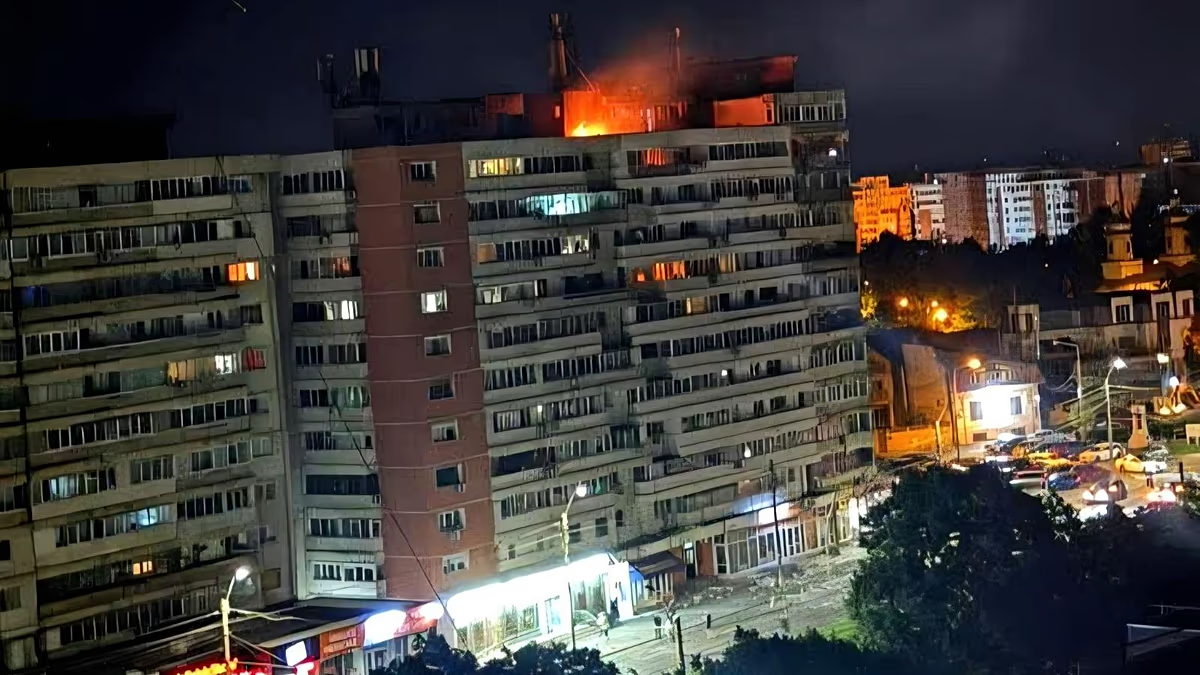
In the early morning hours of May 29, 2026, the familiar, tense quiet of a Romanian border town was violently shattered. For years, communities along the Danube had watched the war in Ukraine unfold just across the water, a looming reality seen through the lens of news reports and the occasional distant rumble. But on this day, the war did not remain a distant spectacle. A Russian Geran-2 drone, one of the low-cost but deadly “kamikaze” drones used extensively in the conflict, veered catastrophically off course. Its intended target in Ukraine will never be known. Instead, its final, fiery trajectory ended not on a battlefield, but against the concrete and brick of a civilian apartment building, turning a home into a crater in an instant.
Paragraph 2: The Human Toll Behind the Headlines
The immediate aftermath was one of chaos and terror for the residents. The impact was not a mere thud; it was an explosive event that sparked a significant fire, sending plumes of acrid smoke into the dawn sky. Panicked families fled in their nightclothes, while the wail of sirens quickly filled the air as emergency services scrambled to the scene. The human cost, while tragically common in Ukrainian cities, was a profound shock here. Romanian authorities confirmed that two individuals were injured in the attack. These are not abstract statistics; they are neighbors, parents, or workers, now dealing with the physical and psychological trauma of a sudden, violent invasion of their safety. Their homes, a place of sanctuary, were transformed into a stark symbol of a conflict’s terrifying spillover.
Paragraph 3: The Grave Political and Strategic Breach
This incident transcended a tragic accident; it represented a severe geopolitical escalation. Romania is not just any neighbor to Ukraine; it is a steadfast member of the North Atlantic Treaty Organization (NATO), bound by the collective defense principle of Article 5. A deliberate attack on Romanian soil could be construed as an act of war against the entire alliance. While initial assessments pointed to a malfunction or misdirection of the drone rather than a deliberate strike, the violation of sovereign airspace and the resulting damage created an intense diplomatic crisis. It forced the question: was this a reckless error, or a dangerous test of NATO’s resolve and red lines?
Paragraph 4: The Delicate Dance of Diplomatic Response
In the hours and days that followed, the response unfolded on a razor’s edge. Romanian officials, alongside NATO allies, were tasked with responding with firmness to uphold territorial integrity, while calibrating their actions to prevent a direct and wider confrontation with Russia. Condemnations were swift and unanimous from Western capitals, demanding explanations and accountability. Investigations were launched to recover debris and conclusively trace the drone’s origin. The diplomatic language was careful but steely, emphasizing that the protection of Allied territory is “sacrosanct.” This moment became a critical test of NATO’s unity and its strategy of supporting Ukraine without becoming a direct belligerent.
Paragraph 5: The Ripple Effects on Local and Regional Security
For the residents of eastern Romania, life was irrevocably altered. The abstract concept of “living near a warzone” became a palpable, frightening reality. Discussions in town squares and kitchens no longer centered on distant news, but on local safety, the sound of aircraft, and the reliability of air raid sirens. On a broader scale, the attack triggered an immediate reassessment of NATO’s eastern flank air defenses. It exposed a potential gap in shielding against low-flying, small drones that can slip across borders. Calls intensified for a more integrated, technologically advanced air shield across the Black Sea region, turning this single incident into a catalyst for a significant military and security overhaul.
Paragraph 6: A Stark Symbol in a Protracted Conflict
Ultimately, the drone crash in Romania stands as a stark, grim symbol of modern conflict’s unpredictable and borderless nature. It demonstrated with terrible clarity that in an age of aerial drones and long-range missiles, the front line is a fluid concept. Civilians far from traditional battlefields can become casualties, and a localized war can spark international crises in a heartbeat. The event served as a sobering reminder to the world that the war in Ukraine is not an isolated event, but a conflict with the persistent potential to draw in other nations, either by accident or design. It underscored a painful truth: in our interconnected world, the reverberations of war are seldom contained, and the cost is always, ultimately, human.