

Paragraph 1: The Operation Unfolds
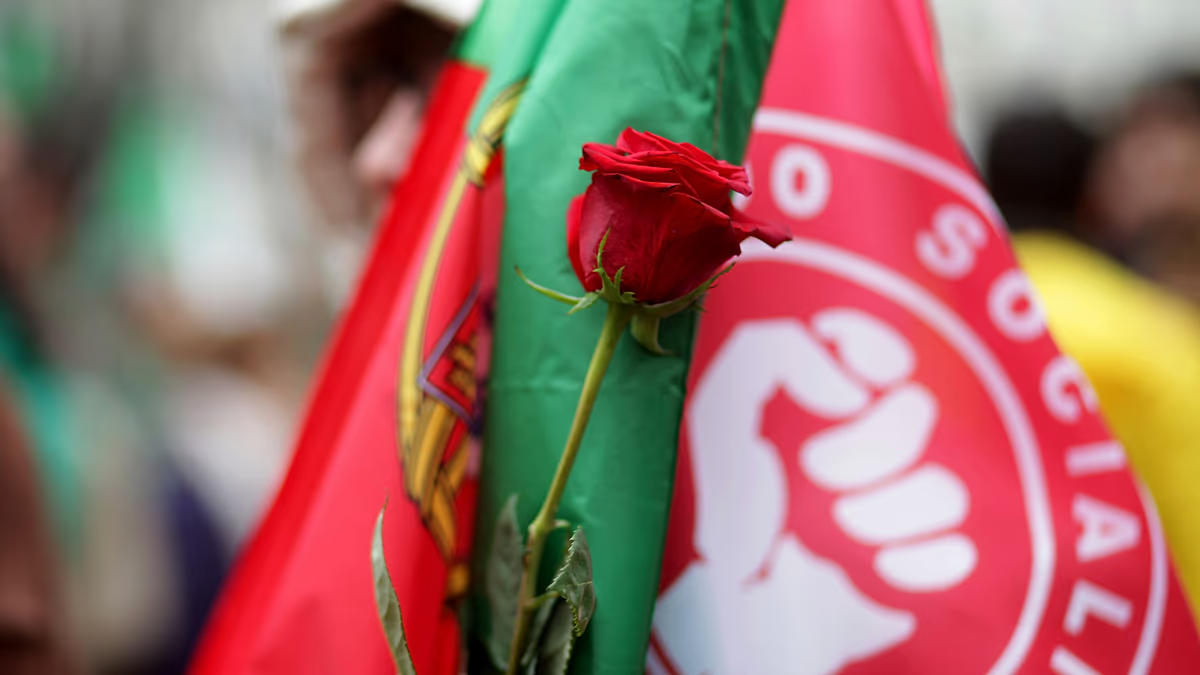
On a late spring Thursday, Portugal was rocked by a sweeping anti-corruption operation that cut to the heart of its political establishment. The nation’s Judicial Police (PJ), acting through its National Anti-Corruption Unit, launched a coordinated series of raids across multiple regions, including Lisbon, Mafra, Oeiras, and Coimbra. The scale was significant: 92 total search warrants, targeting both private homes and non-residential premises. The objective was to dismantle what investigators described as a deeply embedded “network” allegedly operating within the local government strongholds of the Socialist Party (PS), the nation’s dominant political force. As the day progressed, the PJ confirmed five arrests and identified a staggering 37 individuals as formal suspects, signaling a probe of considerable depth and reach. The operation sent immediate shockwaves through the political landscape, hinting at systemic issues rather than isolated lapses.
Paragraph 2: The Allegations at the Core
The legal basis for this dramatic police action centers on two serious crimes: malfeasance and economic participation in business by public officials. According to the PJ’s official statement, the investigation focuses on the awarding of various public contracts by municipal and parish councils. The core allegation is that these contracts were granted through “direct award procedures or prior consultation processes” that brazenly violated legal norms designed to ensure transparency and competition. This process, investigators assert, resulted in “evident harm to the public treasury.” In simpler terms, the state is accused of being systematically defrauded through a scheme that bypassed fair and open bidding, allegedly funneling public funds to a select group of companies and individuals connected to the political network in question.
Paragraph 3: The Scale and Political Reach of the Probe
The first media reports, notably from CNN Portugal, began to fill in the disturbing picture. The investigation is reportedly examining an “alleged network built around the PS’s local government power,” with a specific focus on the “hiring of party members and the awarding of contracts to companies owned by Socialists through direct negotiations.” The financial scale, even in just one segment of the inquiry, was substantial: over 800,000 euros in such contracts between 2016 and 2022 alone. The political sensitivity of the operation was underscored by the confirmation that searches would extend to the very headquarters of the Socialist Party in Lisbon. This move symbolized that the investigation was not merely looking at peripheral figures but was willing to follow evidence into the party’s central apparatus.
Paragraph 4: A Local Hub and a Widening Net
At the epicenter of this complex web, according to reports, is the Santa Maria Maior parish council in Lisbon. Its former president, Miguel Coelho, is identified as one of the main targets of the operation. The alleged scheme appears to have radiated outward from this hub. For instance, it is reported that Coelho recruited a network of nine former PS candidates in the municipality of Mafra, a group allegedly led by Sérgio Santos. This network, in turn, is said to have contracted 19 companies linked to Socialist party activists. This pattern suggests a method of consolidating local power and resources, using public procurement not for public good, but to reward political loyalty and create a self-sustaining ecosystem of patronage.
Paragraph 5: High-Profile Connections and Arrests
The operation gained an even more dramatic national dimension with the revelation of specific names. Among those reportedly benefiting from the direct contracts is the wife of Duarte Moral, a former advisor to ex-Prime Minister António Costa. More strikingly, Duarte Moral himself was named as one of the five individuals arrested. This connection to the inner circle of a recent prime minister instantly elevated the scandal, suggesting the tentacles of the alleged local corruption network may have reached into the highest levels of government and the Prime Minister’s office. It transformed the story from a local graft case into a potential crisis with implications for the recent leadership of the country.
Paragraph 6: The Legal and Political Reckoning Ahead
Following the raids and arrests, the judicial process began its methodical march. Those detained were scheduled to appear before the Central Criminal Investigation Court in Lisbon for initial questioning, a first step in what promises to be a long and closely watched legal proceeding. Beyond the courtroom, the political fallout is inevitable. For the Socialist Party, which has held significant power in Portugal, the allegations strike at its credibility and its foundational promise to govern in the public interest. The case poses profound questions about the integrity of local governance and the misuse of public funds for political sustenance. Ultimately, this operation is more than a police bulletin; it is a stark moment of accountability, testing Portugal’s institutions and challenging its citizens’ faith in the system meant to serve them. The coming weeks and months will reveal how deeply the rot had set in and how determined the country is to cleanse it.