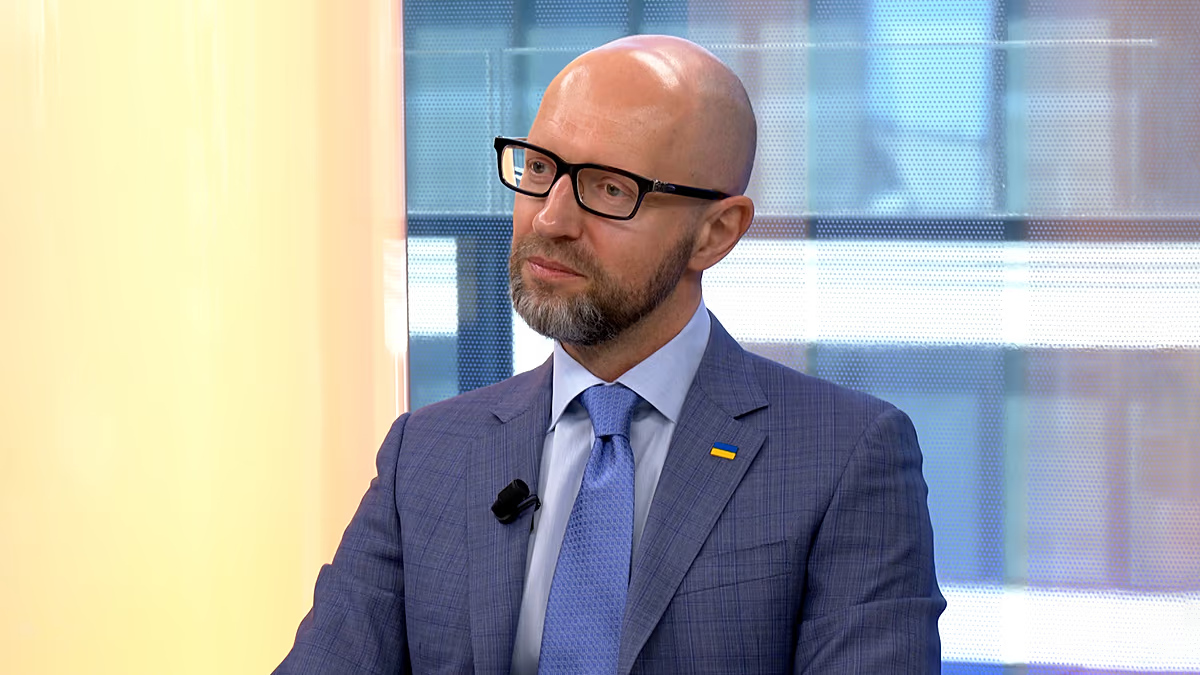



In a stark and urgent assessment of the geopolitical landscape, former Ukrainian Prime Minister Arseniy Yatsenyuk has framed the ongoing conflict not merely as a regional war, but as an existential test of European security and political will. Drawing from his own direct experience meeting Vladimir Putin, Yatsenyuk warns that the Russian leader is a master tactician whose background as a KGB operative defines his approach to diplomacy. Putin, he insists, possesses an almost instinctual ability to assess weakness or strength in those he engages with, conducting a “sniff test” of every interlocutor. This informs Yastenyuk’s grave skepticism about the European Union’s discussions regarding a potential special envoy for direct talks with the Kremlin. He cautions that any such negotiator would be seen by Putin not as a partner for dialogue, but as a target for recruitment or, more likely, as a tool to simply buy time and manipulate Western divisions. The fundamental issue, therefore, is not about finding the right personality for the job, but about recognizing that Putin currently has no genuine interest in good-faith negotiations.
According to Yatsenyuk, the only language the Kremlin understands is the unambiguous language of force and resilience. At this juncture, Putin is not prepared to accept any envoy or deal that does not equate to the surrender of Ukrainian sovereignty and, by extension, a fundamental capitulation of European security principles. This unyielding stance explains the recent escalation of Russian threats beyond Ukraine’s borders, including provocative drone incursions over NATO members in the Baltic region and menacing rhetoric towards European diplomats. Yatsenyuk interprets these actions as a deliberate “proxies war” designed to intimidate the citizens of the European Union, testing their resolve and fostering fatigue. The Kremlin’s objective, he argues, is to sow fear and pressure European populations to abandon their support for Ukraine, thereby achieving through political coercion what it has failed to achieve on the battlefield.
The reason for this intensified campaign of intimidation, Yatsenyuk contends, stems from a position of Russian weakness, not strength. Putin is losing the war. The initial grand plans—from the hybrid takeover envisioned over a decade ago to the failed three-day blitz on Kyiv—have catastrophically unraveled, resulting in staggering Russian casualties and a slow-motion economic crisis. With the war effort faltering and domestic discontent simmering beneath the surface, Putin’s only remaining strategy is relentless escalation. This is not merely a military calculation but a personal and political imperative. Escalation abroad is a tool to consolidate control at home, a desperate bid for the physical and political survival of Vladimir Putin himself. He seeks to reshape the reality of his failure by expanding the perimeter of conflict, hoping to convince Russians and the world that they are facing an existential fight against a broad Western threat.
Crucially, Yatsenyuk expands the frame of the conflict beyond the Russia-Ukraine theatre, positioning it within a far more daunting global confrontation. He identifies an “axis of evil” taking shape under the strategic auspices of China. Dismissing Beijing’s professed neutrality as a facade, he labels China an active “accomplice” in the war. Through comprehensive strategic partnerships, vital financial lifelines, and the provision of dual-use materials that fuel Russia’s war machine, China holds an “upper hand” in the conflict. This alliance transforms the war into a proxy struggle between authoritarian revisionist powers and the democratic world. While Yatsenyuk holds little hope that diplomatic outreach can persuade Beijing to pressure Moscow, he acknowledges that engaging China represents one of the few remaining, if slender, avenues to potentially creating the conditions for any future meaningful dialogue with the Kremlin.
This grim diplomatic reality is further underscored, in Yatsenyuk’s view, by the failure of other high-profile engagements. He pointedly dismisses past meetings, such as one between a former US president and Putin, as theatrical “KGB operations” designed to deceive, divide Western allies, and circumvent sanctions rather than to pursue peace. The cumulative effect of these maneuvers is a diplomatic vacuum where traditional statecraft has failed to curb Russian aggression. Instead, it has allowed the threat to metastasize, bringing the reality of war alarmingly closer to everyday European life, as symbolized by air raid sirens wailing in peaceful nations. This new, visceral sense of vulnerability must, Yatsenyuk argues, catalyze a profound realization about continental defense and solidarity.
Ultimately, Yastenyuk’s message culminates in a powerful, sobering equation for European security. He expresses a heartfelt wish for the safety of every European citizen, but immediately follows it with an inescapable logic: that safety is indivisible and contingent entirely on a Ukrainian victory. There is no separate peace, no localized compromise that will insulate the EU from a revanchist and aggressive Russia empowered by its conquest. The safety of “you folks” in Europe is directly and irrevocably tied to the success of “us Ukrainians” on the battlefield. His conclusion—”period”—is not merely a rhetorical flourish but a stark summation of the new reality: European security is being defended in the trenches of Ukraine, and only through unwavering support for that defense can true and lasting safety for the continent be secured.