

Of course. Here is a summary and humanization of the provided article, structured into six paragraphs.
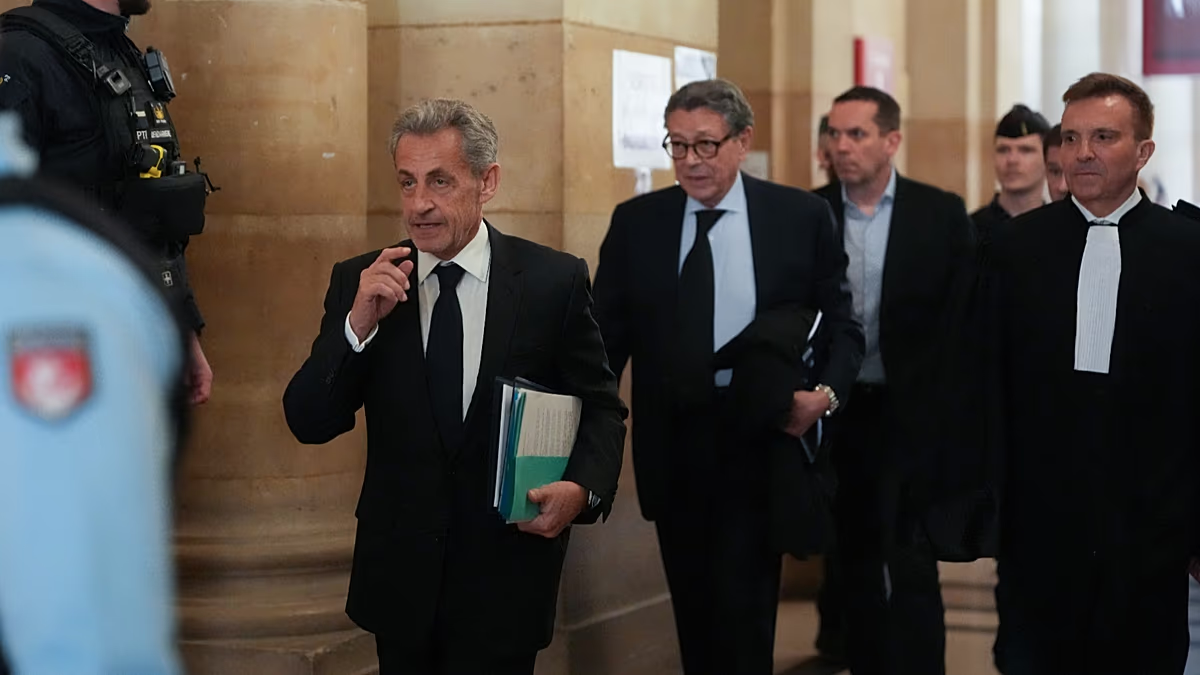
On May 27, 2026, the final chapter of a political and judicial saga that has gripped France for years played out in a Paris courtroom. Former President Nicolas Sarkozy, once the embodiment of French executive power, stood before the Court of Appeal to deliver a defiant final statement. He forcefully denied any guilt in the sensational case alleging that his 2007 presidential campaign was secretly funded by the late Libyan dictator Muammar Gaddafi. “I have not betrayed the trust of the French people,” Sarkozy declared, framing the entire proceedings as born from “lies and a conspiracy.” His closing argument was a stark refusal to capitulate: he would never confess to a crime he insisted he did not commit.
This appeal was not Sarkozy’s first encounter with the judgment of the court. In September 2025, he was sentenced to five years in prison, becoming the first former French president in modern history to be incarcerated. He served 20 days in Paris’s La Santé prison before being released under supervision. Both he and the prosecutors appealed the initial verdict, with the state seeking a stricter punishment: a seven-year sentence and a €300,000 fine. The charges at the heart of this retrial are grave—corruption, illegal campaign financing, and concealing the embezzlement of Libyan public funds. Prosecutors have sharpened their attack, now labeling Sarkozy as the “instigator” of the alleged corruption scheme, a more direct accusation than in the first trial.
The case carries an enormous weight, both legally and symbolically. It alleges that a foreign dictatorship played a role in financing the ascent of a French president, a notion that strikes at the core of national sovereignty and democratic integrity. While Sarkozy has faced multiple legal battles since leaving office, this Libyan financing case is considered the most consequential. A technicality initially spared him from a corruption conviction; the first court ruled that as a candidate, he lacked the “public authority” status required by the law. The appeal seeks to overcome that hurdle and secure a definitive guilty verdict on all major charges.
Sarkozy does not stand alone in this legal drama. The case implicates a network of his closest allies and advisors, painting a picture of a concerted effort within his inner circle. Also facing charges are his former chief of staff Claude Guéant, former Interior Minister Brice Hortefeux, longtime confidant and fixer Alexandre Djouhri, and his 2007 campaign treasurer Éric Woerth. This broad list of co-defendants underscores the prosecution’s theory of a coordinated operation, suggesting the alleged illicit financing was managed by a team at the highest levels of his campaign.
After hearing Sarkozy’s final plea and the arguments from both sides, the three-judge panel has reserved its decision. The fate of the former president, and potentially his associates, now rests in their hands. The court is scheduled to deliver its verdict on November 30, 2026. That date will mark a pivotal moment, determining whether Sarkozy’s defiant narrative of a conspiracy will prevail, or if the prosecution’s detailed allegations of foreign-backed corruption will be permanently etched into his legacy.
Beyond the personal fate of Nicolas Sarkozy, this trial represents a profound moment for French justice and political culture. It tests the ability of the legal system to hold the highest officials accountable, regardless of their former stature. The outcome will resonate as a statement about the integrity of French democracy and the boundaries of political financing. For Sarkozy, the final judgment will either be a vindication of his lifelong claim of innocence or a definitive, judicial condemnation that forever reshapes his place in history.