


Canada Charts a New Path: Choosing Saab for Arctic Surveillance Amid Shifting U.S. Relations
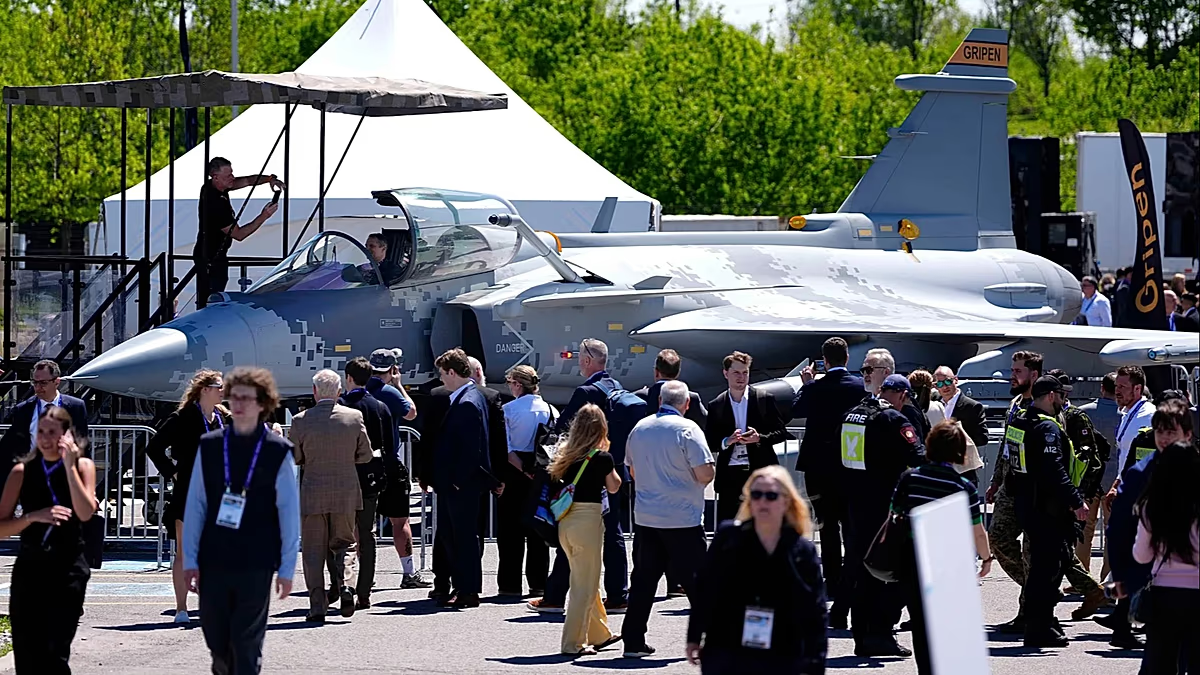
In a significant move that underscores a strategic shift in both defence policy and economic orientation, Canada has announced it will proceed with formal negotiations with the Swedish aerospace and defence company Saab to procure a new fleet of Arctic surveillance aircraft. Prime Minister Mark Carney made the announcement at a defence industry event in Ottawa, selecting Saab’s GlobalEye airborne early warning and control system over two American competitors: the Aeris X by L3Harris and the E-7 Wedgetail by Boeing. This decision is not merely about acquiring new hardware; it is a deliberate statement about Canada’s future priorities. Carney framed the choice as one that serves dual objectives: “The GlobalEye procurement will help us secure our North and build our economy at once.” By opting for a European partner, Canada aims to simultaneously enhance its sovereignty in the increasingly contested Arctic and foster a more diversified, resilient domestic defence industry through technology and knowledge transfer from Saab.
The procurement is directly tied to the urgent imperative of bolstering Canada’s defence capabilities in the Arctic, a region Carney has listed as a top strategic priority. As climate change opens new sea routes and access to resources, geopolitical competition in the High North is intensifying, notably with Russia’s sustained military investments and activities there. Canada’s vast northern territories are vulnerable, and its current surveillance and early warning infrastructure is dated and limited. The advanced GlobalEye system, with its sophisticated radar and sensor suites mounted on a Saab Global 6000 jet, would provide a transformative capability. It would allow for persistent, wide-area monitoring of Canada’s Arctic approaches, enabling the detection of aircraft, ships, and potential threats far earlier than current methods. This is a concrete step toward addressing what Canadian defence analysts have long warned is a glaring gap in the nation’s security posture.
However, the choice to sideline U.S. firms carries substantial political risk and reflects a calculated departure from decades of deep defence integration with Washington. Carney’s government is actively working to reduce Canada’s economic and security dependence on the United States, a relationship he insists has been “permanent-ly altered” and will not return to a “pre-Trump normal.” This procurement decision follows another contentious move: Ottawa’s reconsideration of a multi-billion-dollar deal to purchase U.S.-made F-35 fighter jets. The combination of these actions has already provoked frustration within the administration of President Donald Trump. Earlier this month, U.S. Undersecretary of Defence Elbridge Colby cited the stalled F-35 deal as a key reason for the Pentagon’s suspension of cooperation on a venerable 86-year-old joint defence advisory board with Canada. Choosing Saab over Boeing and L3Harris may well further anger Washington, potentially straining the broader bilateral relationship.
For Carney, this friction is seemingly a necessary cost of pursuing a more sovereign and balanced path. His argument is that over-reliance on a single, unpredictable partner jeopardizes both Canada’s economic autonomy and its strategic flexibility. By investing in a partnership with Saab, which has committed to significant technology transfer and industrial cooperation, Canada seeks to grow its own defence sector capabilities, creating jobs and retaining more value within its economy. This aligns with a broader industrial policy aimed at building resilience. In contrast, procurements from U.S. giants often come with fewer opportunities for domestic spin-offs and lock Canada into a monolithic supply chain. The Saab deal, therefore, is portrayed as an investment in national capacity—a long-term build rather than a simple purchase.
The announcement was met with enthusiasm from Saab, which highlighted its plans to “transfer knowledge and technology to Canada that will grow the domestic defence industry.” This collaborative approach is central to the political appeal of the deal within Canada. It offers a tangible narrative of economic development alongside security, a compelling combination for the public and the defence community. Nevertheless, the path forward involves complex negotiations to finalize the contract, ensure the promised technology transfers, and integrate the new system seamlessly with the Canadian Armed Forces and existing NORAD frameworks. The operational success of the program will depend on these details, as will the ultimate judgement of whether the geopolitical and economic benefits outweigh the costs of strained relations with the United States.
In conclusion, Canada’s decision to negotiate with Saab for the GlobalEye aircraft is a multifaceted strategic gambit. It is a direct response to the pressing security challenges in the Arctic, a deliberate step toward diversifying the nation’s economic and defence partnerships, and a conscious departure from historical dependence on the United States. Prime Minister Carney is navigating a complex landscape where defending sovereignty in the North requires not just new equipment, but also a reassessment of old alliances. While this move carries the risk of exacerbating tensions with Washington, it is driven by a vision of a more self-reliant and resilient Canada, capable of defending its interests in a changing world and building the industrial foundation to sustain that defence for generations to come. The coming negotiations and the subsequent integration of the GlobalEye will be a practical test of this ambitious vision.