


Of course. Here is a summary and humanization of the content, expanded to six paragraphs.
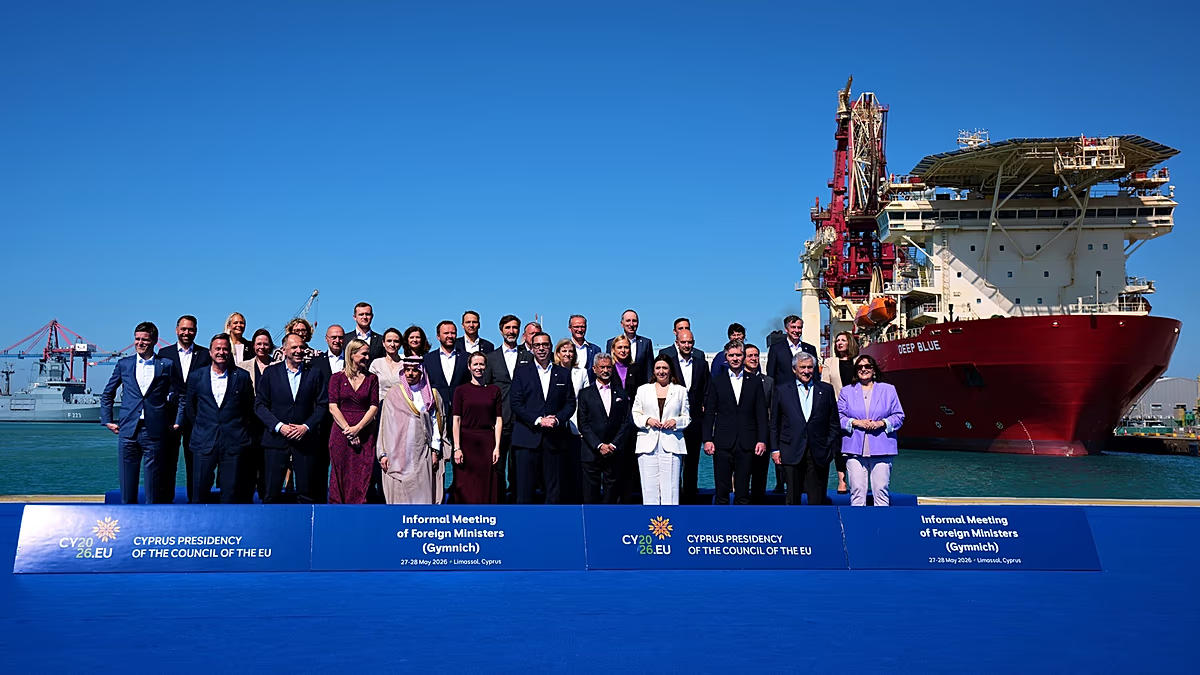
The foreign ministers of the European Union, gathered for an informal meeting in Cyprus, were confronted with the urgent and contentious question of how the bloc should engage in direct talks with Russia regarding the war in Ukraine. A central debate has emerged: should the EU first appoint a specific high-profile envoy to lead negotiations, or should it focus on crafting a unified and robust common position? The consensus among ministers leaned strongly toward the latter, emphasizing that the substance and mandate of any talks are far more critical than the personality leading them. They warned that disunity or rushing to the table under Moscow’s preferred conditions would be a strategic mistake that plays directly into Russia’s hands.
This caution was highlighted by EU High Representative Josep Borrell, who pointed to a trap set by Russia: by focusing the debate on which individual is “acceptable” to Moscow—such as the Kremlin’s suggestion of former German Chancellor Gerhard Schröder, whose close ties to Putin make him a pariah in mainstream European politics—the EU would become divided and distracted. Instead, Borrell argued, negotiations are a complex team effort requiring a clear strategy, where the “good cops” and “bad cops” work from a shared script. The priority must be to approach talks from a strong, “maximalist” stance that counters Putin’s own extreme demands, with a confidential paper already circulating outlining the concessions and expectations Russia must meet for any settlement.
The message of unity over individual action was echoed around the table. Sweden’s Foreign Minister, Maria Malmer Stenergard, urged the EU not to be “distracted by men who want to make history” by rushing to negotiate under Russian terms. Instead, she stressed the need to increase pressure on Moscow and bolster support for Ukraine to fundamentally change the calculus and make Russia genuinely seek peace. Others, like the Netherlands’ representative, emphasized that the “most crucial thing” was establishing a clear, collective mandate before any envoy is chosen, while Spain’s minister underscored the necessity of speaking with “one voice” to avoid a cacophony of 27 different national approaches.
The push for a coordinated European role gained momentum following a request from Ukrainian President Volodymyr Zelenskyy. Frustrated by perceived shifts in U.S. focus, Zelenskyy asked Europeans to take a more hands-on role in the peace process. This has led to speculation about potential envoys, with names like Finnish President Alexander Stubb, European Council President António Costa, and former leaders like Mario Draghi or Angela Merkel being floated. However, as Finland’s Foreign Minister noted, while such individuals are qualified, discussions are premature. The priority remains defining what a common European position actually entails—a process that will likely be long and complex.
Looming over all these diplomatic deliberations is the stark reality of continued Russian aggression, including its recent large-scale attack on Kyiv and explicit threats against foreign diplomats there. This violence underscores the high-risk nature of any negotiation effort. Ukrainian Foreign Minister Andrii Shyiiba, attending the meeting, provided a sobering perspective. He urged the EU to focus on “precise, doable steps”—such as securing the release of civilian detainees, demilitarizing the Zaporizhzhia nuclear plant, and establishing humanitarian corridors—that could complement existing peace efforts. His key message reinforced that of the EU ministers: the bloc must first “clarify the mandate” and ensure it represents “one united European voice,” rather than starting by choosing a person.
In essence, the meeting in Cyprus revealed a European Union acutely aware of the pitfalls of diplomacy with Russia. The ministers moved away from the glamour of appointing a historic envoy and toward the gritty, essential work of building a unified, strong, and strategically sound common position. They recognize that before anyone can sit across from Putin, Europe itself must sit together and agree on what it wants, what it will demand, and how it will speak as one. The mandate, not the messenger, is the foundation upon which any credible negotiation must be built.