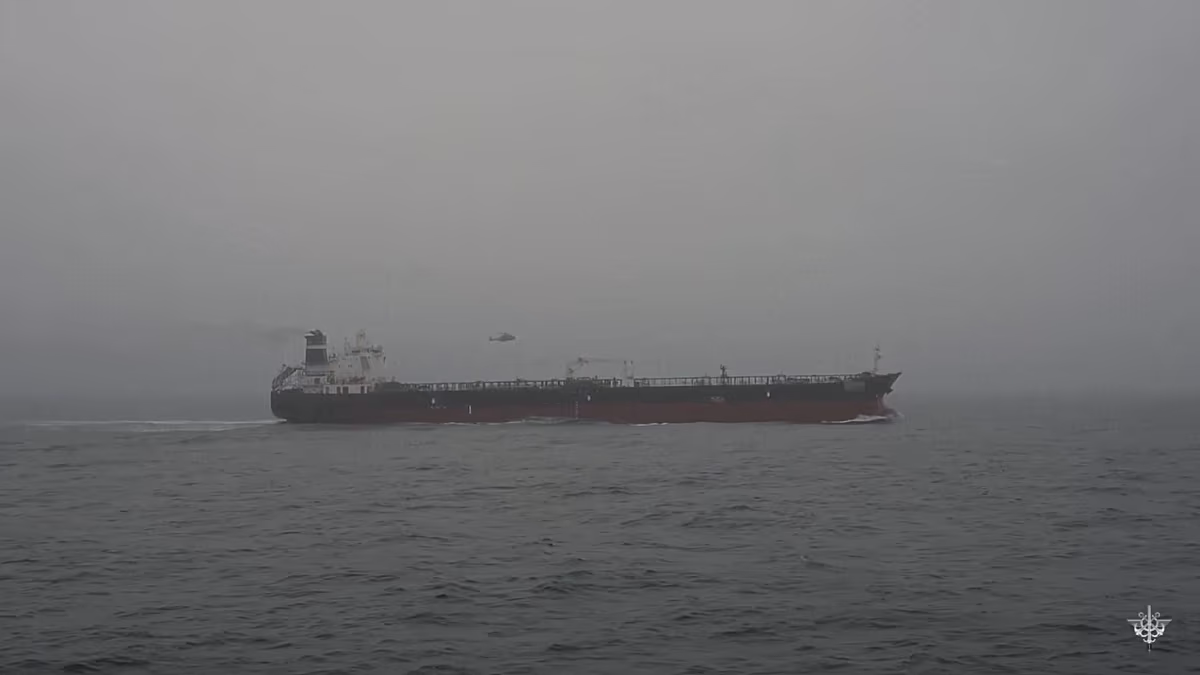


In the vast, open theater of the Atlantic Ocean, a significant maritime drama unfolded recently, captured in stark detail by the French government. On June 1, 2026, French naval forces released video footage showing a tense and precise operation: the boarding of the tanker Tagor, a vessel linked to Russia. This was not a random interdiction but a calculated move, part of a broader, international effort to enforce economic sanctions against Russia. Paris stated clearly that the mission’s objective was to disrupt the flow of Russian oil exports—revenue streams that are critically funding the ongoing war in Ukraine. This single event on the high seas is a powerful, tangible symbol of how a conflict centered in Eastern Europe has globalized, with enforcement actions now playing out thousands of miles from the original front lines.
The imagery from the operation is compelling, showing specialized teams maneuvering alongside the large tanker before securing it. Such boardings are complex and perilous undertakings, requiring immense skill and coordination to execute safely in often challenging sea conditions. The release of this video serves a dual purpose: it is a transparent demonstration of France’s commitment to the sanctions regime and a stark message to entities attempting to circumvent these international rules. It visually underscores that the network of sanctions is not merely a list on paper but an active, physical barrier being patrolled and enforced. This action transforms abstract economic policy into a concrete geopolitical reality, showing the lengths to which nations are willing to go to uphold a collective stance.
At the heart of this interception lies the critical issue of Russian energy exports. Since the invasion of Ukraine, Western nations have implemented increasingly severe sanctions aimed at crippling Moscow’s ability to finance its military operations. Oil and gas revenues represent the lifeblood of the Russian economy and its war machine. Consequently, a complex cat-and-mouse game has emerged across the world’s oceans, with some vessels attempting to obscure their origins, destinations, or ownership through opaque shipping practices. The Tagor’s detention suggests it was suspected of being part of this shadowy network, attempting to move oil in violation of agreed-upon price caps or embargoes. Each successful interception aims to tighten the financial noose, albeit incrementally, around the Kremlin’s strategic capabilities.
This event cannot be viewed in isolation; it is a single scene in a much wider narrative of international law and coalition warfare. France’s action was almost certainly coordinated with allies within the European Union and other partners like the United States and the United Kingdom. Enforcing such sanctions requires shared intelligence, coordinated naval patrols, and diplomatic unity to be effective. The boarding of the Tagor is thus a testament to the enduring, if sometimes strained, Western alliance in response to Russian aggression. It highlights a shift in modern conflict, where economic measures and their enforcement are as crucial as traditional battlefield tactics. The sea, once a domain of purely national power projection, has become a frontline for economic containment.
However, these actions on the high seas also raise profound questions and challenges. The legal authority for such boardings is derived from national and EU regulations implementing UN resolutions, but they can test the boundaries of maritime law. There are also practical and geopolitical risks, including potential escalation or accidents during confrontations at sea. Furthermore, the global energy market is intricately interconnected; every barrel intercepted influences global prices and availability, affecting economies far removed from the conflict. For the crew of the Tagor, likely civilian sailors from various nations, the incident represents a sudden and dramatic upheaval of their lives, caught in the crosscurrents of international disputes beyond their control.
Ultimately, the story of the Tagor is a human story framed within immense geopolitical forces. It is a story of sailors, naval officers, policymakers, and citizens in Ukraine hoping for peace. The French naval personnel who carried out the boarding did so as part of a principle, a collective effort to use every available non-kinetic tool to pressure an aggressor state. While a single tanker seizure will not end a war, it represents the persistent, daily work of upholding an international order. As the conflict persists, the world’s oceans will likely continue to be a silent battleground where the flow of oil, the enforcement of law, and the pursuit of peace remain inextricably and tensely linked. The video from the Atlantic is more than just footage; it is a snapshot of a world struggling to hold a line, using waves and warships to fight a war fought on land.