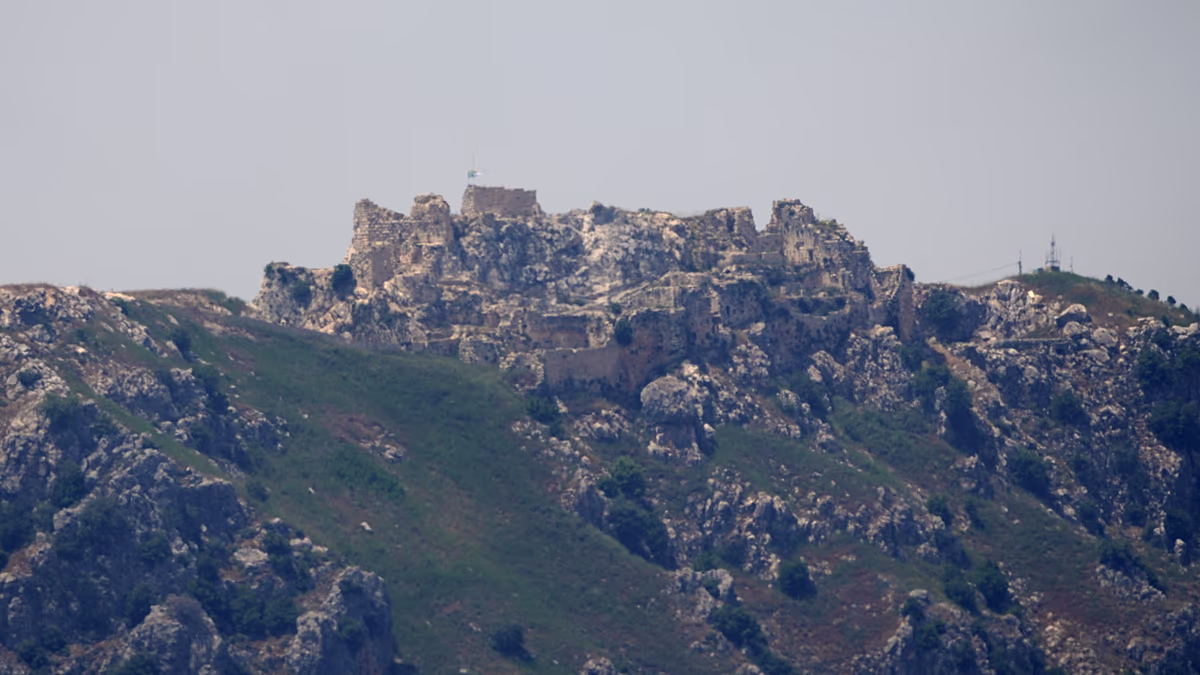


On a quiet Saturday night, the ancient stones of Beaufort Castle, perched on a strategic hill in southern Lebanon, witnessed a new chapter in a long history of conflict. Israeli troops captured the medieval fortress, marking their deepest military incursion into Lebanon in over twenty-five years. This move came after days of intense air strikes and ground clashes with Hezbollah fighters in nearby villages, culminating in the raising of the Israeli flag over the Crusader-built structure. The capture represents a significant escalation in the ongoing war, which began earlier this spring following rocket attacks by Hezbollah into northern Israel. This ground invasion, resulting in the seizure of numerous border villages, has unfolded despite a nominal ceasefire and just days before scheduled direct talks between Lebanon and Israel, casting a shadow over diplomatic hopes.
Israeli Prime Minister Benjamin Netanyahu framed the event as a historic and decisive moment. In a video statement, he declared the capture a “dramatic turning point,” emphasizing a return to Beaufort “united, determined and stronger than ever.” He portrayed the action as breaking a “barrier of fear” and seizing initiative across multiple fronts. The move carries deep symbolic weight for Israel, as the army had held the castle from 1982 until its withdrawal from Lebanon in 2000. The current operation, according to military statements, aims to dismantle Hezbollah’s infrastructure and remove threats to Israeli civilians, with explicit readiness to expand further if necessary. In recent days, this expansion has been tangible, with troops pushing beyond the Litani River—a previous de facto boundary—and designating a wide swath of southern Lebanon as a combat zone, urging residents of major centers like Nabatiyeh and Tyre to evacuate.
Despite the Israeli advance, the conflict remains fiercely active. Hezbollah continues its cross-border attacks, claiming responsibility for strikes on Israeli troops and a tank, and firing rocket salvos into northern Israel, including the town of Kiryat Shmona. Lebanese reports detail ongoing air strikes on southern villages causing casualties, with a recent strike near a Tyre hospital wounding thirteen staff members. Hezbollah’s use of hard-to-detect drones has proven particularly challenging for Israeli defenses, leading to hundreds of alerts for civilians in northern Israel. The human cost of this renewed fighting is staggering: reports indicate over 3,350 lives lost in Lebanon, more than a million people displaced, and on the Israeli side, at least twenty-five soldiers and two civilians killed. The violence persists in a grim cycle of retaliation and escalation.
The international community, alarmed by the deepening occupation, is reacting. France, through its foreign minister, Jean-Noël Barrot, has requested an emergency meeting of the United Nations Security Council. While acknowledging Israel’s right to self-defense, France condemned the continuation and expansion of military operations in Lebanon, arguing that nothing justifies the ever-deeper occupation of Lebanese territory. This call underscores growing global concern over the conflict’s trajectory and its violation of Lebanese sovereignty, potentially setting the stage for heightened diplomatic pressure.
Beaufort Castle itself is not merely a tactical hill; it is a profound symbol layered with centuries of history. Built by Crusaders in the 12th century (its Old French name meaning “beautiful fortress”), it has been a strategic prize for armies ranging from Saladin’s forces to the Ottomans, the French Mandate, the Palestine Liberation Organization, and the Israeli army. Its capture in 1982 was a major victory for Israel, a memory immortalized in the Israeli film “Beaufort,” which explores the moral ambiguities and futility of war. The castle, known in Arabic as Al-Shaqif Castle, commands sweeping views of southern Lebanon and northern Israel, making it a perennial military asset. Its cultural significance was recognized even during this war, as UNESCO granted it enhanced protection to safeguard it from damage—a protection now breached by its capture.
In summary, the seizure of Beaufort Castle is a multifaceted event: a tactical military advance, a symbolic psychological victory for Israeli leadership, a trigger for intensified international diplomacy, and a violation of a protected cultural heritage site. It occurs within a context of ongoing, devastating exchanges that have exacted a terrible humanitarian toll. This single action on a strategic hill encapsulates the broader conflict—a cycle of war where historical echoes, present-day geopolitical calculations, and the urgent cries for peace from displaced and wounded civilians collide on a landscape scarred by centuries of conquest.