


Paragraph 1: A Serious Setback for the Space Community
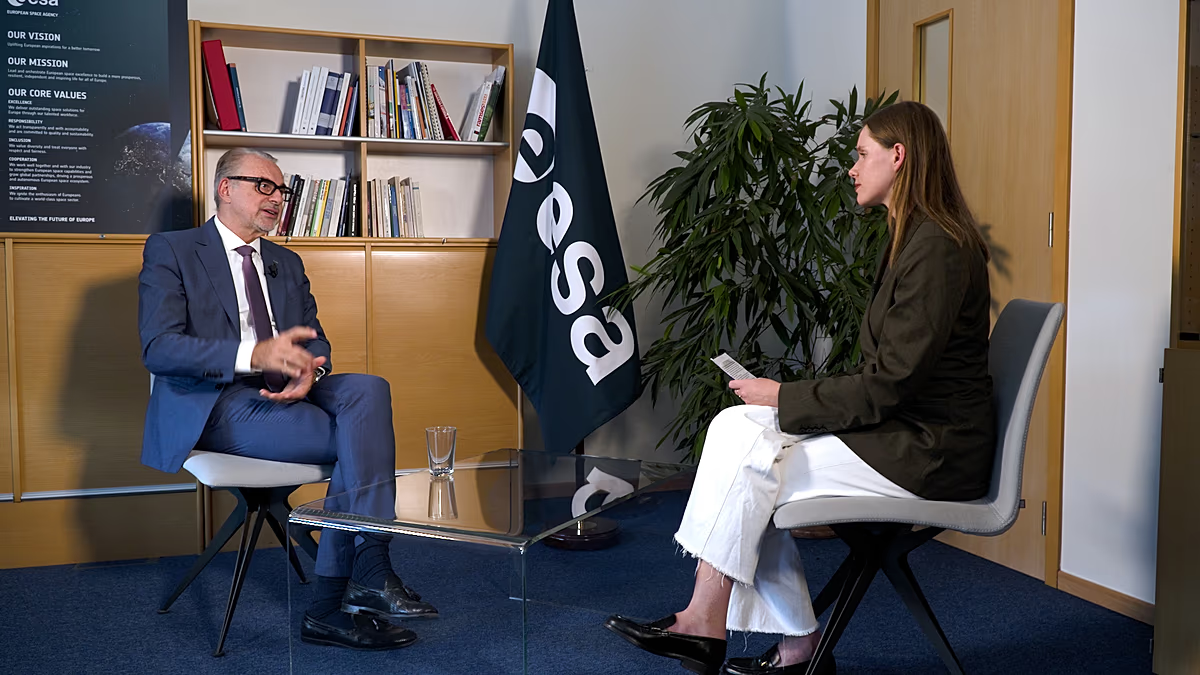
The recent explosion of a Blue Origin New Glenn rocket during a ground test in Florida has sent ripples of concern throughout the global space industry. Josef Aschbacher, the Director General of the European Space Agency (ESA), described feeling “saddened” by the images of the event, noting the damage to the launch infrastructure appeared “quite big.” While Jeff Bezos, founder of Blue Origin, confirmed there were no injuries, the incident represents a significant and sobering moment. Aschbacher emphasized that such failures are particularly painful given the immense effort, years of development, and vast resources poured into creating a new launch vehicle. For a rocket like New Glenn, which is still in its early operational phase, this kind of setback is a major blow, not just for the company but for the broader ecosystem of public and private space exploration that relies on new, reliable launch capabilities.
Paragraph 2: Implications for Lunar Ambitions and the Artemis Program
The ramifications of this explosion extend far beyond Blue Origin’s immediate plans. It directly impacts NASA’s Artemis program, the ambitious American-led effort to return humans to the Moon and establish a sustainable presence there. The New Glenn rocket was poised to play a crucial role in this multi-mission architecture. Specifically, Blue Origin is contracted to build a human-rated lunar lander for the Artemis V mission. Furthermore, the rocket itself was expected to be a key commercial launcher for various Artemis components. Before this incident, Blue Origin was considered a frontrunner alongside SpaceX in the new commercial space race. Now, the explosion raises urgent questions about timelines. With a destroyed launch pad requiring reconstruction and a lengthy investigation ahead, achieving NASA’s goal of a crewed lunar landing by the Artemis IV mission in 2028—and subsequent plans for a moon base—faces new and serious challenges.
Paragraph 3: A Vision That Now Feels More Distant
These challenges come at a pivotal moment. NASA recently outlined its vision for a permanent lunar base, envisioning astronauts living and working on the Moon by the early 2030s as a stepping stone to Mars. Aschbacher described a future where astronauts would drive rovers, conduct scientific research, and even use lunar soil to produce building materials—a scenario he acknowledged might sound “a bit science fiction.” The goal is to build a true in-situ lunar economy. However, creating this off-world infrastructure is an enormous undertaking, one that depends on a steady and reliable cadence of launches to deliver cargo and crew. The New Glenn setback is a stark reminder of the immense difficulties inherent in this new era of space exploration. While the vision remains, the path to achieving it is fraught with technical hurdles, and each delay or failure like this one underscores that we are still very much at the beginning of this ambitious journey.
Paragraph 4: Europe’s Integral but Uncertain Role
In this grand lunar endeavor, the European Space Agency has positioned itself as a vital partner. Aschbacher is actively negotiating ESA’s contributions, building on a longstanding and deep cooperation with NASA. European technology is already embedded in the Artemis program, most visibly in the form of the European Service Module that powers NASA’s Orion capsule. Looking forward, ESA is developing its own ambitious projects: the Argonaut lunar lander program to deliver cargo and the Moonlight initiative to create a lunar communications and navigation satellite constellation. However, Europe’s pathway has also faced recent uncertainty. NASA’s decision to pause development of the Lunar Gateway space station—a project to which ESA was contributing key elements—represented a setback for European industry and scientists. Despite this, Aschbacher affirms that European technology will continue to be part of the Artemis missions in various critical ways.
Paragraph 5: The Lingering Question of European Astronauts on the Moon
A more pressing and symbolic question for Europe remains: when will a European astronaut walk on the lunar surface? Aschbacher candidly admitted, “That is a big question. I wish I could answer it.” While he expressed hope that it could happen before the end of this decade, potentially as part of the Artemis IV or V missions, no formal agreement currently exists. Astronauts like Germany’s Alexander Gerst are seen as top candidates for such a historic role. These discussions are part of intense ongoing negotiations with NASA, where ESA is advocating for a guaranteed flight opportunity in exchange for its substantial technological contributions, such as the Orion service modules and Gateway elements. The goal is to secure Europe’s place not just as a hardware supplier, but as a full participant in human exploration beyond Earth orbit.
Paragraph 6: Resilience in the Face of Adversity
The explosion of the New Glenn rocket is a powerful reminder that spaceflight, despite its increasing commercialization, remains an exceptionally difficult and high-stakes endeavor. It underscores the fragility of timelines and the collective dependence of the global space community on the success of its key players. For Blue Origin, the road to recovery will be long, involving a meticulous investigation and a rebuild of both hardware and confidence. For NASA and ESA, the event necessitates a recalibration of expectations while reinforcing the need for resilience, collaboration, and a diversified strategy that does not rely on a single vehicle or provider. The dream of a sustained human presence on the Moon persists, but last week’s flames on a Florida launch pad made clear that turning science fiction into reality will require overcoming profound setbacks with determination and international partnership. The Artemis program, and the future it seeks to build, now watches and waits as the investigation into this “huge setback” begins.