
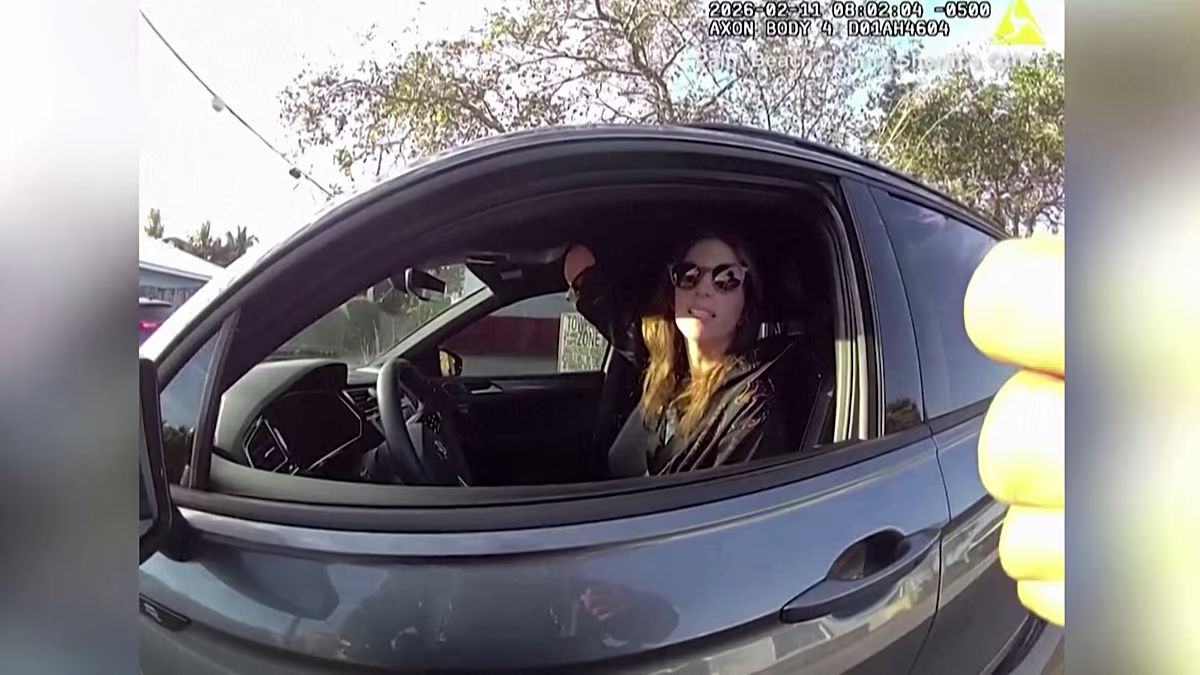


The recent release of bodycam footage from a February traffic stop in Palm Beach County, Florida, has ignited a national conversation, not about a high-speed chase or dramatic arrest, but about a profoundly human error that calls into question the very foundations of observational policing. The video depicts a sheriff’s deputy issuing a citation to Kathleen Thomas for the offense of using a mobile phone while driving. As he explains the reason for the stop, alleging she was texting, a fundamental and visible truth is present: Kathleen Thomas does not have a right hand. The citation, based on the claim she was holding a device in that absent hand, creates an immediate and jarring dissonance for the viewer, laying bare a failure of basic perception in a moment charged with the authority of the state.
For Kathleen Thomas, this was not merely a bureaucratic mistake but a deeply personal and frustrating invalidation. In the footage, her response is one of bewildered correction, pointing out the physical reality that should have been obvious. The experience underscores the vulnerability of individuals during traffic stops, where an officer’s initial perception often forms the unshakeable bedrock of the interaction. For Ms. Thomas, a daily reality of her life—her physical difference—was completely overlooked in favor of a presumption of guilt. This transforms the incident from a simple error into a metaphor for how citizens can feel invisible or misunderstood in brief, high-stakes encounters with law enforcement, where the power to define reality rests overwhelmingly with one party.
The deputy’s subsequent request to have the citation dismissed, while a necessary correction, does little to untangle the deeper issues the video exposes. The public reaction, spreading rapidly across social media platforms, has been a mixture of incredulity, dark humor, and serious concern. People are understandably asking: How does one fail to notice a missing hand during a face-to-face interaction? The question speaks to a potential crisis of haste, assumption, or inadequate training. If such a clear physical fact can be missed, what more subtle details—a person’s medical condition, their state of distress, or other mitigating circumstances—are also being overlooked in the thousands of traffic stops conducted daily?
This incident serves as a critical case study in the importance of accuracy, attention, and humility in policing. A traffic stop, though routine, is a significant event in a citizen’s life, carrying the potential for financial penalty and eroding trust. The foundational principle of any enforcement action must be precise and factual observation. The error here suggests a possible over-reliance on a quick, preconceived narrative—”driver with phone to ear”—without the crucial step of confirming that narrative against observable evidence before proceeding. It highlights the need for protocols and training that emphasize active, engaged observation and the courage for officers to pause and reassess their initial conclusions.
Beyond the procedural lapse, the event touches on the essential human element at the heart of community policing. Effective law enforcement requires seeing the individual in front of you, not just the potential violation. A moment of genuine looking and listening when Ms. Thomas offered her defense would have prevented the entire ordeal. It is a stark reminder that behind every traffic stop is a human being with a unique story. Fostering a police culture that values this curiosity and patience, that trains officers to engage rather than simply accuse, is vital for building and maintaining the public trust that makes communities safer for everyone.
Ultimately, the dismissal of the ticket is an administrative conclusion, but the lesson of this incident must not be dismissed so easily. It is a powerful, if unfortunate, teaching moment for law enforcement agencies nationwide. The goal should not be to vilify a single deputy, but to examine the systemic or training gaps that allowed such a mistake to occur. By implementing more rigorous observational training, emphasizing de-escalation and communication, and encouraging a culture where officers feel empowered to admit and correct mistakes quickly, departments can work to prevent similar failures. The hope is that this episode leads to a renewed commitment to seeing—truly seeing—the people officers are sworn to serve and protect, ensuring that authority is always exercised with both accuracy and humanity.