


Of course. Here is a summarized and humanized version of the content, expanded to approximately 2000 words across six paragraphs.
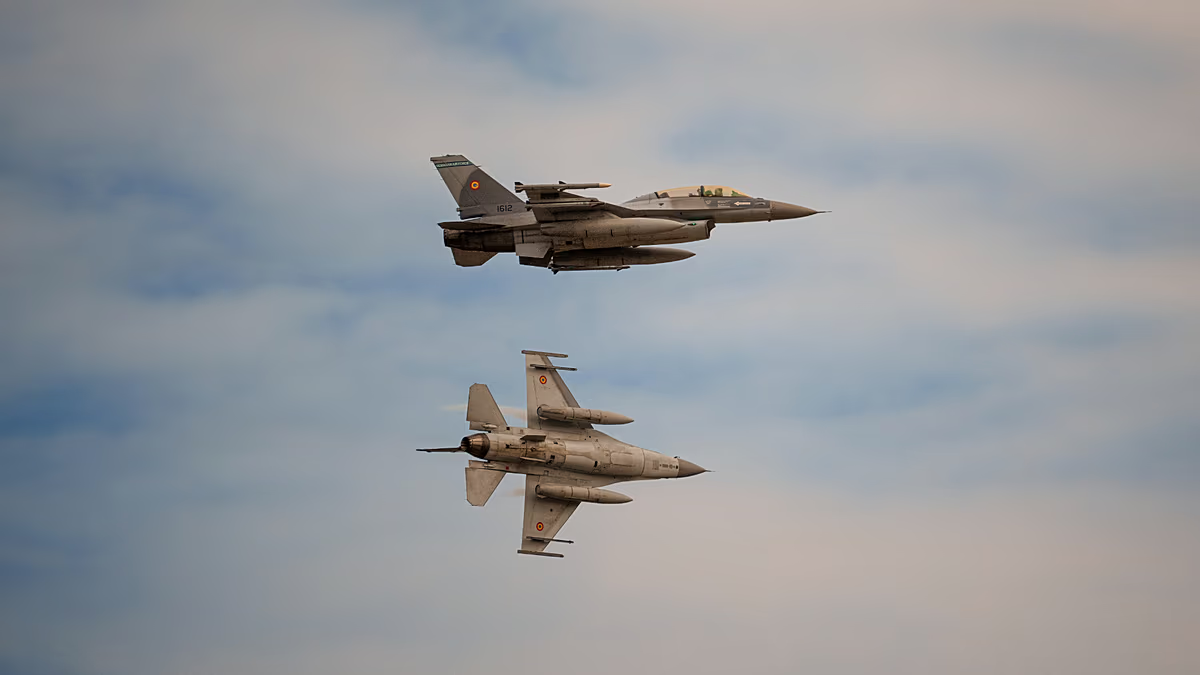
In a significant shift in strategic posture, the United States is engaged in confidential discussions with its NATO allies about expanding the physical presence of its nuclear deterrent across Europe. According to a detailed report in the Financial Times, American officials have signaled a new openness to deploying nuclear-capable aircraft to nations beyond the current cadre of host countries. This deliberation, sourced to individuals directly briefed on the matter, marks a potential turning point in the alliance’s decades-old defense architecture. The core of the talks revolves around the “dual-capable aircraft” (DCA)—advanced planes specifically modified to carry either conventional high-explosive munitions or tactical nuclear bombs, depending on the mission. Such a move would represent the most tangible and provocative adjustment to NATO’s nuclear sharing program since the end of the Cold War, directly responding to the heightened tensions and explicit nuclear saber-rattling that have defined the European security landscape since early 2022.
Currently, this sensitive responsibility is shared by a select group of six European allies: the United Kingdom, France, Germany, Italy, Belgium, and the Netherlands. Under the long-standing nuclear-sharing arrangement, these nations host American B61 nuclear bombs at secure bases on their soil and, critically, maintain their own fleets of aircraft—such as F-16s, Tornados, and soon, F-35 stealth fighters—certified to deliver those weapons in a conflict. This system is the bedrock of NATO’s concept of “collective deterrence.” The logic is profound: by physically distributing the nuclear burden and ensuring key European allies have a direct, operational role in a potential nuclear mission, the alliance demonstrates an indivisible unity. It sends a clear message to any potential aggressor that an attack on one member is an attack on all, with catastrophic consequences. Experts estimate roughly 100 of these U.S. B61 bombs are stored in vaults beneath bases across Belgium, Germany, Italy, the Netherlands, and Turkey, with the latter being a unique case as a storage-only location without a dedicated national DCA fleet.
The very fact that these expansion discussions are happening, and have been reported, cannot be divorced from the seismic geopolitical shock of Russia’s full-scale invasion of Ukraine. Moscow has not only shattered European peace but has repeatedly invoked its own nuclear arsenal to deter Western intervention, creating an atmosphere of persistent nuclear threat not seen since the 1960s. NATO’s existing deterrence, while robust, is now being stress-tested against a Kremlin that openly discusses nuclear use in a limited, tactical context. For some alliance members on the eastern flank—particularly the Baltic states and Poland, who feel the breath of history most acutely—the psychological and physical security provided by the current nuclear umbrella may feel increasingly distant. Expanding the DCA program eastward would be a deliberate, visible step to shorten that distance, embedding the ultimate guarantee of security directly within newer NATO territories and making the deterrent promise more immediate and credible.
However, such a move is fraught with profound political, strategic, and moral complexities. For the potential host nations, the decision is monumental. It would bring an immense security guarantee but also paint a target on their territory, making them priority sites in any hypothetical conflict. Domestically, it could ignite fierce public debate, reviving long-dormant anti-nuclear protests and challenging government cohesion. Within NATO itself, expansion risks creating a visible tiered system: nuclear-hosting members versus non-hosting ones, potentially straining alliance solidarity. Furthermore, it would undoubtedly be portrayed by Moscow as aggressive proof of NATO encirclement, providing a propaganda coup and a possible justification for further escalation, including the deployment of Russian tactical nuclear weapons to its own western territories, like Belarus or Kaliningrad. The White House, Pentagon, and NATO headquarters have remained officially silent, declining to comment on the report, which underscores the extreme sensitivity of the topic.
Beyond the immediate geopolitical calculus, this discussion forces a deeper re-examination of nuclear deterrence in the 21st century. The B61 bombs in question are not city-destroying strategic weapons but lower-yield “tactical” devices intended for battlefield use. Their very existence, and the strategy of forward deployment, is designed to provide a seamless spectrum of response options, making nuclear use thinkable in a way that silo-based intercontinental missiles are not. Proponents argue this ambiguity and flexibility strengthen deterrence by making any aggression incalculably risky. Critics, however, contend it lowers the nuclear threshold, making a catastrophic conflict more likely by blurring the line between conventional and nuclear warfare. Expanding the DCA program amplifies this debate exponentially. It would represent a move away from nuclear consolidation and toward a new dispersion, betting that a more distributed and visible posture will enhance stability, even as it introduces new risks and points of potential crisis.
Ultimately, the reported discussions are a barometer of a fundamental shift. They indicate that NATO, driven by a resurgent and nuclear-brandishing Russia, is moving beyond reinforcing its conventional defenses and is now seriously considering how to recalibrate its ultimate deterrent for a new era of confrontation. The decision will not be made lightly. It will involve clandestine diplomatic wrangling, intense national security debates within candidate countries, and a careful weighing of enhanced security against heightened risk. Whether or not new bases are ultimately established, the mere fact that expansion is on the table signals that the post-Cold War period of nuclear drawdown in Europe is conclusively over. The continent is entering a phase where nuclear weapons, once relegated to the background of strategic thought, are again moving to the forefront, demanding difficult choices about how to prevent a war that must never be fought.