


Paragraph 1
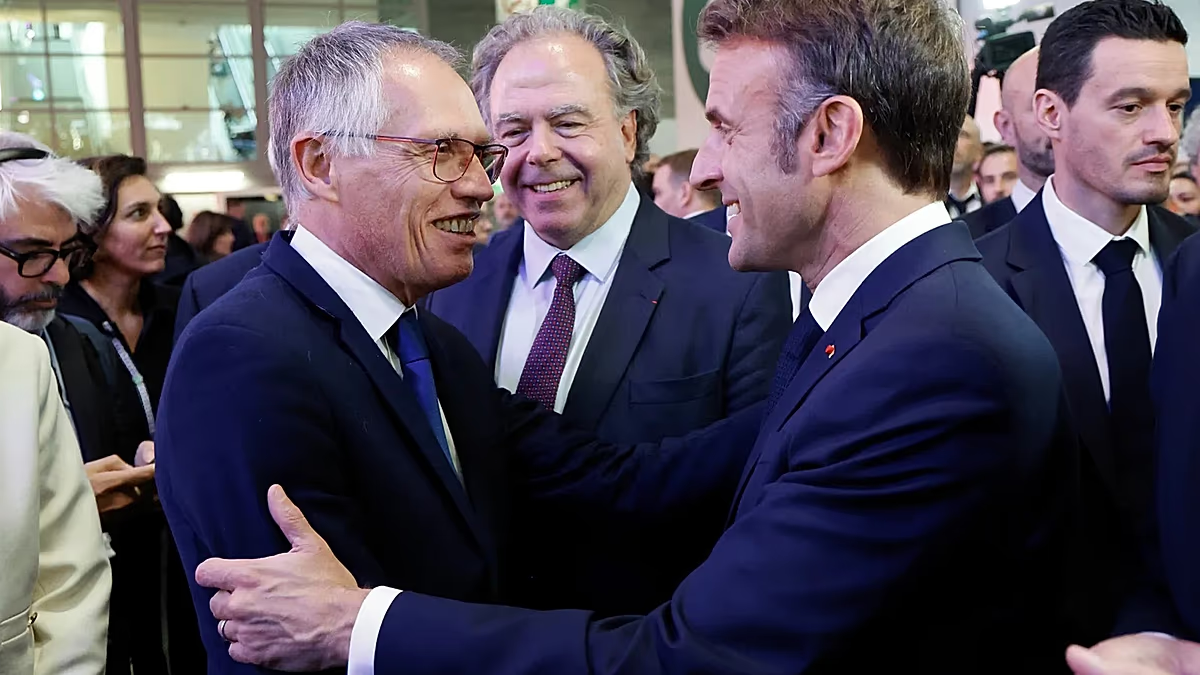
In a significant move to secure its industrial future in Europe, global automaker Stellantis has announced a major €1 billion investment in its historic Mulhouse factory in eastern France. This substantial commitment, confirmed on Tuesday, is earmarked for the development and production of three new Peugeot models—both fully electric and hybrid variants—with manufacturing set to begin in 2029. The announcement validates plans previously hinted at by French President Emmanuel Macron and represents a concrete step in Stellantis’s sprawling €60 billion strategic roadmap aimed at restoring robust profitability over the next five years. For the Mulhouse region, a longstanding heartland of French automotive manufacturing, this decision offers a powerful vote of confidence and a promise of sustained employment and technological relevance.
Paragraph监督 2
This investment is a direct response to the profound and concurrent challenges reshaping the global automotive industry. European carmakers, including Stellantis, find themselves navigating a perfect storm: transitioning their entire fleets to cleaner technologies while confronting unexpectedly tepid consumer demand for electric vehicles in some markets. Simultaneously, they face ferocious and growing competition from Chinese brands like BYD and MG, which have successfully captured a growing share of the European EV market with attractively priced and technologically advanced models. Stellantis’s own leadership has openly acknowledged misjudging the pace of EV adoption, a miscalculation that led to a painful €22 billion write-down earlier this year. The Mulhouse investment, therefore, is not merely an expansion but a strategic recalibration for a new era of competition.
Paragraph 3
The new vehicles from Mulhouse are strategically chosen to fortify Peugeot’s position in a crucial battleground. They will be compact sedans and SUVs, a segment that alone accounts for nearly a third of all car sales in Europe. By focusing here, Stellantis aims to leverage Peugeot’s strong brand identity and design prowess to offer compelling choices in the market’s most popular category. The success of these models is paramount, as they are intended to be both technologically modern and commercially viable, appealing to a broad swath of European drivers who may be considering the transition to electric or hybrid powertrains but are sensitive to cost and practicality.
Paragraph 4
To make these future vehicles competitive, Stellantis is banking on a fundamental shift in how it engineers its cars. The cornerstone of this effort is the new “STLA One” electric vehicle platform. This modular architecture is designed to be a game-changer, drastically reducing production costs and development timelines for a wide range of models. By creating a more efficient and flexible foundation, Stellantis hopes to close the cost gap with competitors and accelerate its ability to bring new, affordable electric and hybrid vehicles to market. This technological streamlining is a critical component of the broader plan to ensure the Mulhouse-built Peugeots can succeed in a price-conscious environment.
Paragraph 5
The Mulhouse commitment is part of a larger, and sometimes painful, corporate transformation. As the world’s fourth-largest carmaker, Stellantis is consciously narrowing its focus to concentrate resources on four core global brands: Peugeot, Fiat, Jeep, and Ram. This focus comes with difficult decisions, including a planned reduction of its European manufacturing capacity by approximately 20%, equating to around 800,000 vehicles annually. The strategy presents a stark contrast: deep investment in strategic sites like Mulhouse is paired with consolidation and retrenchment elsewhere. It is a clear signal that the company is prioritizing efficiency and sharpening its competitive edge in its strongest markets and segments.
Paragraph 6
Finally, Stellantis’s approach reflects the complex, interconnected reality of today’s auto industry. While investing heavily in European manufacturing to defend its home turf, the company is also pragmatically expanding cooperation with Chinese partners to boost sales both in France and internationally. A recent joint venture agreement with Chinese automaker Dongfeng, covering manufacturing, sales, and engineering in Europe, exemplifies this dual strategy. Thus, the story of the €1 billion Mulhouse investment is more than a local economic announcement. It is a microcosm of a global industry in flux—a blend of regional preservation, technological innovation, strategic focus, and pragmatic partnerships, all aimed at navigating the tumultuous journey toward an electric future.