



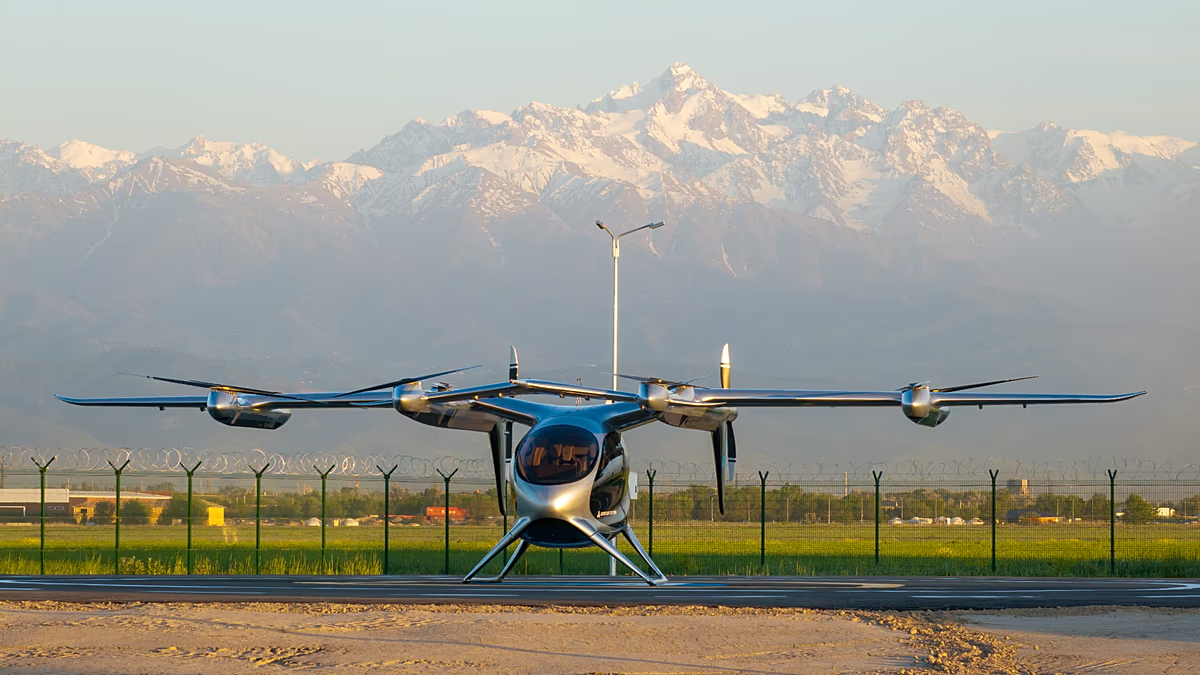
A new chapter in urban transportation quietly began in the skies above Kazakhstan recently, as Central Asia’s first air taxi completed its inaugural test flight. The V2000 Prosperity, a sleek electric vertical take-off and landing (eVTOL) aircraft, lifted off from the emerging Alatau City in the Almaty region, performing a ten-minute unmanned demonstration watched by a hopeful crowd. This moment was more than a technological showcase; it signaled Kazakhstan’s ambitious entry into the elite global club exploring urban air mobility. Developed through a multinational partnership involving Kazakh, Chinese, South Korean, Italian, and American firms, the project represents a substantial investment, with infrastructure development in Alatau City alone expected to reach approximately €260 million. For local leaders, this venture is a cornerstone of a new economic vision. As Alisher Abdykadyrov, CEO of the Alatau City Authority, explains, it embodies a strategic shift toward an urban development model where innovation, digital transformation, and advanced mobility solutions fuse to create entirely new economic sectors.
The aircraft at the heart of this initiative, the V2000 Prosperity from Chinese manufacturer AutoFlight, is engineered for practical urban use. Capable of carrying one pilot and up to five passengers at speeds up to 200 kilometres per hour, its thirteen electric motors promise a cleaner, quieter alternative to traditional helicopters. With a range of 250 kilometres on a one-hour charge, it is designed for both intra-city hops and connections to nearby destinations. A key selling point is its reduced acoustic footprint; at 100 metres during take-off, noise levels are under 70 decibels, and it becomes virtually inaudible when cruising at 250 metres altitude. While built to operate in a wide temperature range, the harsh Kazakh climate will necessitate rigorous additional testing. This careful, step-by-step validation process underscores the project’s focus on safety and reliability before any passenger ever steps aboard.
However, these futuristic aircraft cannot operate in a vacuum; they require a new kind of urban infrastructure. Unlike planes or helicopters, eVTOLs use dedicated vertiports—compact take-off and landing pads that can be integrated into cityscapes, placed on the ground or atop buildings. This network is being spearheaded by Italian developer UrbanV, with the first vertiport already under construction in Alatau City. This site will form the nucleus of the planned Eurasia Urban Air Mobility Centre. The vision expands to include vertiports at Almaty International Airport and key locations across the city, aiming for six operational sites by 2028, potentially growing to ten. The choice of Alatau City as the hub is strategic. As a new, digitally-native urban centre initiated by President Kassym-Jomart Tokayev, it offers a rare blank slate, allowing planners to weave air mobility seamlessly into the fabric of the city from its very foundations.
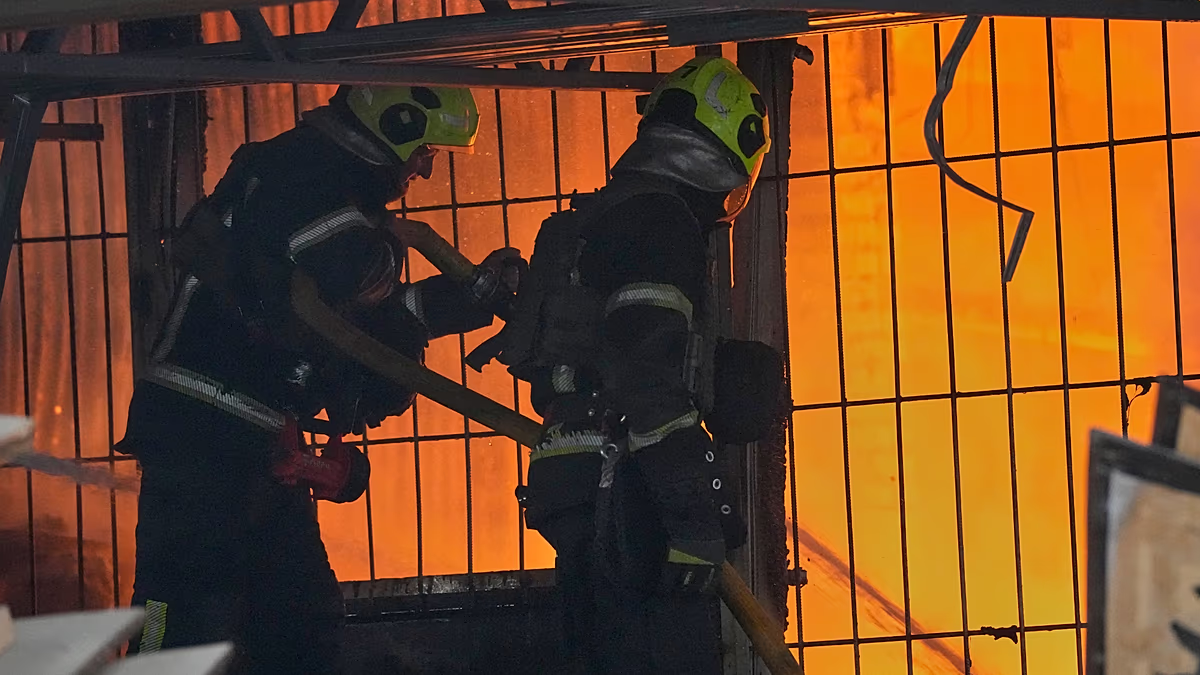
The practical benefits of this network could be transformative, particularly for a region like Almaty, a bustling economic and tourist hub. Authorities envision the air taxis primarily linking Alatau City with central Almaty and surrounding tourist areas. A trip from Almaty Airport to Alatau City—a 50-kilometre road journey vulnerable to congestion—could be slashed to a mere ten minutes. But the application extends beyond passenger convenience. AutoFlight highlights versions of the aircraft configured for emergency response, capable of carrying firefighting equipment to douse blazes over 800 square meters, or delivering emergency supplies and deploying life rafts. This multifunctional potential strengthens the project’s value proposition, positioning the eVTOL not just as a luxury transport but as a versatile tool for public safety and logistical support.
Of course, the path from a successful test flight to a functioning commercial service is complex and requires more than just hardware. Kazakhstan must now build the legal and regulatory runway for this new mode of transport. Over the past year, the Ministry of Transport and project partners have been drafting a comprehensive package of legislative amendments to govern air taxi operations and the broader urban air mobility ecosystem. These proposals are currently in advanced discussions. Concurrently, the aircraft must undergo rigorous certification processes, first in its country of manufacture and then with Kazakh aviation authorities. Only after these dual pillars—regulation and certification—are firmly in place can commercial services begin. Project manager Daniyar Uteulin is clear: “Only after that will we be able to launch commercial services using this new mode of transport.” Authorities are targeting late 2028 or early 2029 for the first trial operations, with fares projected to be around one US dollar per kilometre.
The successful test flight is, therefore, a foundational milestone. It validates the technology on Kazakh soil and sets the stage for the immense logistical and regulatory work ahead. For stakeholders like Vyacheslav Kim, a key investor, it reinforces the “Low Altitude Economy” as a viable, high-tech sector with the potential to shape regional economic futures. The ambition extends far beyond Alatau City. The knowledge and experience gained here are intended to serve as a blueprint, first for expansion to other major Kazakh cities, and ultimately for a broader rollout across Central Asia. If all goes to plan, Kazakhstan will not only pioneer a new form of urban mobility within its own borders but could also position itself as the innovation leader for an entire region, literally elevating the concept of connectivity to new heights.