
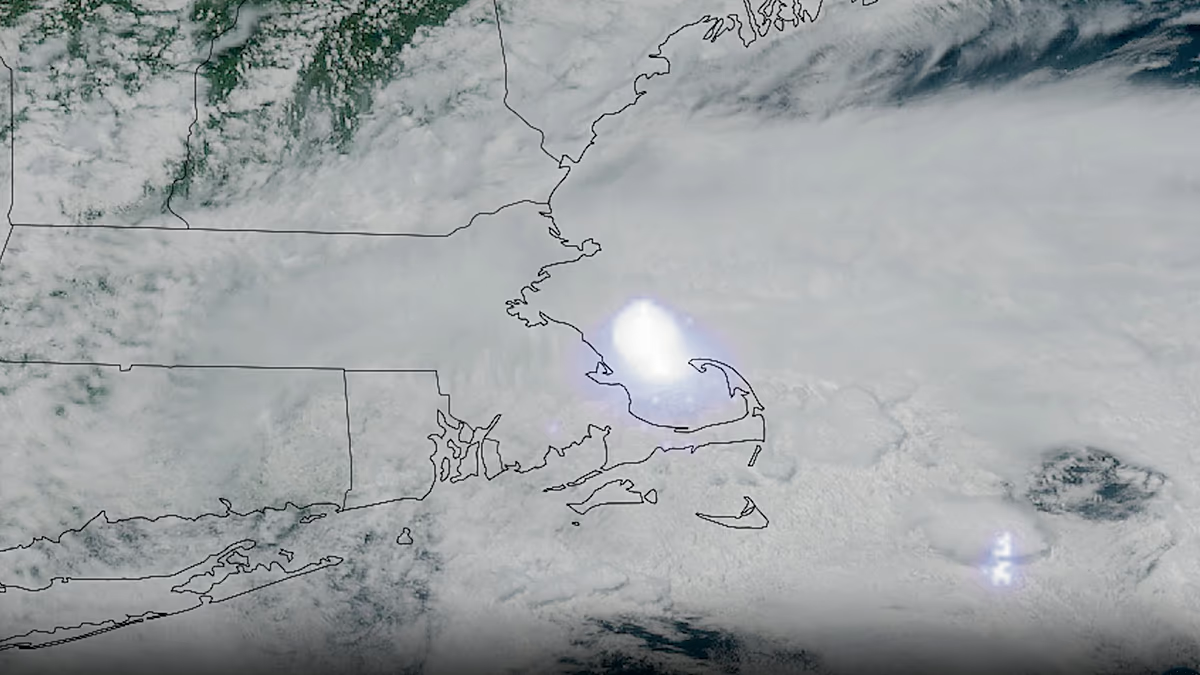


On a seemingly ordinary Saturday, the skies over New England delivered a startling reminder of our dynamic solar system. A natural meteor, traveling at a staggering speed of approximately 75,000 miles per hour, entered Earth’s atmosphere and fragmented in a brilliant burst of light approximately 40 miles above the border of northeastern Massachusetts and southeastern New Hampshire. NASA later calculated that the energy released in this atmospheric explosion was equivalent to about 300 tons of TNT. This event, unrelated to any known meteor shower or human-made space debris, served as a powerful natural spectacle, transforming from a silent cosmic traveler into a dramatic fireball visible in the daylight sky.
The scientific explanation, however, arrived after the visceral human experience. The meteor’s violent disintegration created powerful sonic booms that rippled across the region, manifesting not as a distant rumble but as a sudden, jarring physical reality for residents below. Reports emerged from multiple states of two distinct, thunderous claps that shook buildings and rattled windows. In Massachusetts and Rhode Island, the unexpected blasts prompted immediate concern and confusion, with many taking to social media to share their experiences and seek answers. The vibrations were so pronounced that one Massachusetts resident, interviewed by local media, described the sensation inside her fourth-floor apartment as akin to a minor earthquake, a profound shaking that seemed to come from the sky itself.
This celestial event underscores a fascinating truth: space is not empty, and our planet is constantly intersecting with a stream of natural debris. NASA was quick to clarify that this was not a piece of falling satellite or spacecraft, but a fragment of rock, likely from the asteroid belt, on a fortuitous collision course with Earth. Its incredible velocity, typical for such objects, ensured its fate was not to impact the ground but to vaporize in a final, fiery display. The fact that it occurred independently of a scheduled meteor shower like the Perseids or Geminids highlights how such random, albeit stunning, encounters can happen at any time, turning an average afternoon into a moment of cosmic wonder.
Fortunately, the story of this meteor had a harmless conclusion. Despite the widespread reports of shaking homes and loud booms, no injuries or significant property damage were immediately reported. This positive outcome was due entirely to the object’s composition and the protective blanket of our atmosphere, which acted as a shield, breaking the rock apart at a high altitude. The event stands in contrast to more serious atmospheric explosions, like the 2013 Chelyabinsk meteor in Russia, and instead served as a potent, yet safe, demonstration of planetary forces. It was a natural experiment in physics and astronomy, played out on a grand scale for millions of witnesses, culminating in sonic booms and startled residents, but no casualties.
The public response, blending alarm with awe, highlights our deep-seated curiosity about the universe. The rapid dissemination of reports on social media, followed by the authoritative analysis from agencies like NASA, illustrates the modern pathway from mystery to understanding. What began as a series of unsettling, unexplained explosions was quickly contextualized within the known phenomena of meteoroid entry. This process transforms fear into fascination, allowing people to retroactively appreciate the spectacle they witnessed—not as a threat, but as a front-row seat to the ongoing process of cosmic cleanup, where Earth’s atmosphere diligently protects us.
In the end, the New England meteor of 2026 will be remembered less for any disruption it caused and more for the perspective it offered. For a brief moment, the routine of daily life was interrupted by a powerful reminder that we are inhabitants of a planet moving through a busy neighborhood of space rocks. It was a fleeting intersection of human and cosmic timelines, a story written in light and sound that prompted us to look up and consider our place in a much larger system. Such events, while startling, enrich our connection to the cosmos, providing a shared experience of wonder that is felt in the rumble of a building and seen in the flash across the sky.