


Of course, here is a summary and humanization of the content, expanded to six paragraphs.
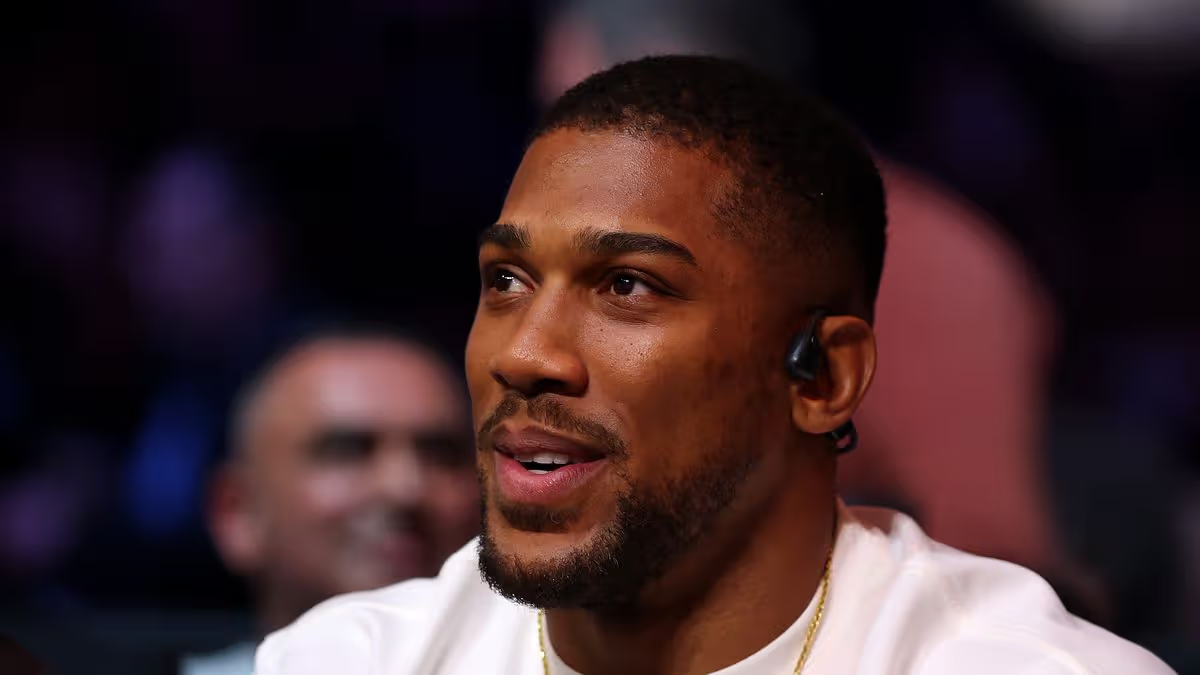
The world of heavyweight boxing is no stranger to stories of resilience, but the tale currently unfolding around Anthony Joshua transcends the sport. In December, just five months ago, Joshua was involved in a catastrophic car accident in Nigeria that claimed the lives of two of his closest companions: his personal trainer, Latif Ayodele, and his strength coach, Sina Ghami. The physical details of the crash are harrowing—a collision with a stationary truck that left Joshua hospitalised with injuries and his two friends dead at the scene. Yet, the true devastation lay not in the broken metal but in the profound personal loss for Joshua, who escaped with his life but witnessed the unimaginable. The legal proceedings against the driver, charged with causing death by dangerous driving, offer little solace for a grief of such magnitude.
In the aftermath, the question for promoter Eddie Hearn was not about Joshua’s next fight, but about whether the former champion would ever be able to return to the ring at all. Hearn recently revealed the depth of this uncertainty, explaining that Joshua was “seriously damaged” physically from the accident, requiring three months of gruelling, monotonous rehabilitation just to regain basic movement. More daunting than the physical hurdles, however, was the psychological toll. Hearn articulated what many feared: “Mentally and emotionally, you can only imagine what was going through his mind… After the accident, you never know if you’re ever going to be the same. I don’t think you can be.” The vision of a fighter’s comeback was overshadowed by the image of a man grieving for his left and right hand.
Joshua himself has spoken with raw vulnerability about the void left by Ayodele and Ghami, whom he described as his “left and my right.” He acknowledged the universal pain felt by their families and all who knew them, but framed his friends not just as loved ones, but as vital architects of his journey. “They actually dedicated their own lives to the movement of AJ and achieving his dreams in the sport,” Hearn noted, highlighting a bond forged in shared purpose. This reframes their loss; it wasn’t merely personal, but professional in the most profound sense. They were believers, supporters, and essential cogs in the machine of his ambition, making their absence a crisis of identity as much as of heart.
It is from this abyss of grief and physical setback that Joshua has begun his arduous climb back. According to Hearn, the fighter has channeled his trauma into a “driving force” and a renewed “purpose.” This purpose is twofold: to steadfastly support the families of his lost friends, and to honour their faith in him by returning to the vocation they dedicated their lives to. Boxing, in this context, transforms from a mere sport or profession into a vessel for legacy and a testament to friendship. Hearn believes this has forged a new, more dangerous version of Joshua—one propelled not just by titles or rivalry, but by a deeper, more poignant motivation to fulfil a promise to those who are no longer here to see it.
This comeback narrative is now moving toward its next public chapter. Joshua is scheduled to return to the ring this summer in Saudi Arabia against Kristian Prenga. This bout is strategically positioned as a vital step in shaking off ring rust and rebuilding his formidable physique, all part of the larger, long-awaited roadmap to a historic showdown with Tyson Fury. The fact that Fury himself is also planning a summer tune-up fight adds a layer of parallel preparation, keeping the dream of that all-British mega-fight alive for fans. However, for Joshua, the Prenga fight undoubtedly carries a weight that no other warm-up ever could.
Ultimately, Anthony Joshua’s journey back to the ring is a stark human story of tragedy, survival, and the search for meaning in the wake of loss. It transcends the typical narrative of athletic injury and recovery. His challenge is to harness the memory of his friends as strength, to carry their aspirations into the ring with him, and to confront not just an opponent in front of him, but the ghost of a traumatic past behind him. When he steps through the ropes this summer, he will be fighting for more than a victory on a record; he will be fighting to honour a profound debt of love and loyalty, making his comeback one of the most emotionally charged chapters in modern boxing history.