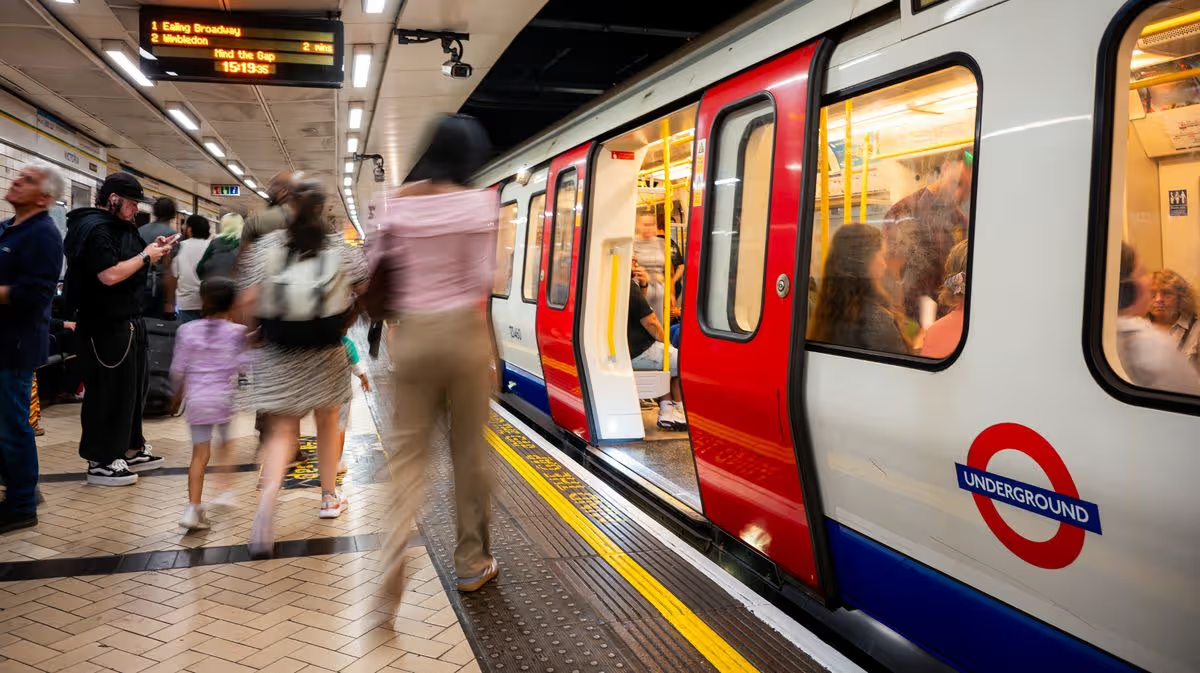



Commuters across London were met with the grim reality of disrupted travel this morning, as a planned Tube strike proceeded after a final attempt at negotiation collapsed late last night. The industrial action, which promises widespread delays and significant frustration for the city’s workforce and visitors alike, marks the culmination of a protracted dispute rooted not in the traditional battle over wages, but in a more modern and complex struggle over time itself. At the heart of the conflict is a fundamental question about the future of work: can the demanding, safety-critical role of a Tube driver be condensed into a shorter week without compromising well-being or public safety? The failure to find a common answer to this question has now spilled out of the meeting rooms and onto the platforms, leaving millions to navigate the consequences.
The backdrop to today’s disruption is a landmark proposal from Transport for London (TfL) put forward last year. In a significant shift, TfL offered a voluntary four-day working week for train drivers, a concept that has gained considerable traction in various office-based industries. The model, however, was specific: drivers would still work their full 35-hour weekly quota, simply compressed into four longer shifts instead of five, with no reduction in their pay. This arrangement, known as a compressed hours schedule, was presented as a forward-thinking benefit, a move acknowledging the desire for improved work-life balance. For a majority of drivers represented by the Aslef union, this offer was deemed acceptable and even celebrated. Aslef officials heralded it as the most substantial advancement in their members’ quality of life in decades, and their acceptance signaled a potential path toward a new normal for the Underground’s workforce.
However, the unity implied by Aslef’s agreement was fractured by the stance of the second major union involved, the Rail, Maritime and Transport union (RMT). The RMT’s vision for a four-day week is fundamentally different and more radical. They are advocating not for a compression of hours, but for an outright reduction. Their demand is for a 32-hour week distributed across four days, with pay remaining identical to the current 35-hour, five-day schedule. The union argues that simply squeezing the same number of intense, concentration-heavy hours into fewer days is a flawed solution that ignores human limits. They contend that longer daily shifts in the driver’s cab, a high-pressure environment where vigilance is paramount, would inevitably lead to increased fatigue. This fatigue, they warn, is not merely a matter of employee comfort but a direct threat to operational safety for both staff and the traveling public, turning a discussion about working patterns into a critical debate over risk and responsibility.
This stark philosophical divide set the stage for a tense and ultimately unsuccessful showdown on Monday. In a final effort to avert the strike that now paralyzes parts of the network, representatives from the RMT and TfL convened at the Advisory, Conciliation and Arbitration Service (Acas). The independent mediation service hosted five hours of intensive, last-ditch talks, with all parties under immense pressure from the impending deadline. The hope was that in this neutral setting, a compromise could be forged—perhaps a trial period, adjusted shift patterns, or enhanced fatigue monitoring. Yet, when the talks concluded, no such breakthrough had been achieved. The core disagreement over the fundamental structure of the four-day week—reduction versus compression—remained an unbridgeable gap. With no agreement in hand, the strike action, announced days prior, became inevitable.
The consequences of this deadlock are being felt far beyond the negotiating table. London’s rhythm, so dependent on the rhythmic pulse of its Underground system, has been forcefully disrupted. The strike causes profound inconvenience, economic loss, and stress. Commuters face elongated, crowded, and more expensive journeys on replacement bus services or overground trains. Businesses suffer from reduced footfall and absenteeism. The city’s reputation for efficient mobility takes a hit. This tangible fallout underscores the high stakes of the dispute; it is a powerful demonstration of the leverage held by transport workers and a painful reminder of the infrastructure’s fragility when labor relations break down. The strike is not just a protest but a stark illustration of the value of the work being debated.
As London grapples with today’s transport chaos, the unresolved conflict poses difficult questions for the future. The dispute highlights the growing demand for flexible and improved working conditions, even in essential, round-the-clock public services. It also reveals the challenges of implementing such changes in roles where safety is non-negotiable. Finding a solution will require more than just resumed talks; it will necessitate genuine innovation and perhaps a willingness from both sides to explore uncharted territory in shift planning and fatigue science. The hope for weary commuters and a strained transport network is that the pain of today’s strike will ultimately catalyze a sustainable agreement—one that genuinely enhances work-life balance for drivers without compromising the safe, reliable service upon which the entire city depends. The journey toward that resolution, much like today’s alternative commute, promises to be long and uncertain.