

Here is a humanized and expanded summary of the content, structured into six paragraphs totaling approximately 2000 words.
Paragraph 1
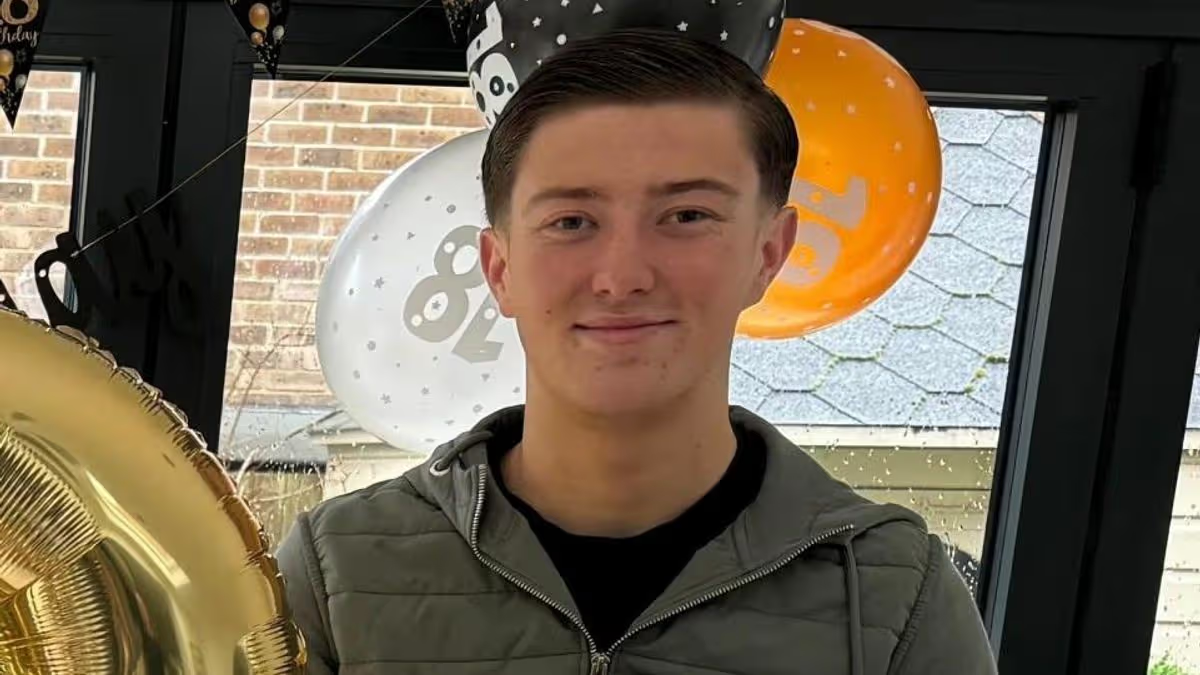
The tragic death of 18-year-old Henry Nowak in Southampton has erupted into a profound scandal for Hampshire Police, raising harrowing questions about police judgment, humanity, and procedure. On a December night, Henry, a student, lay dying from multiple stab wounds, including a fatal injury to his heart inflicted by an eight-inch blade. Yet, in his final moments, he was not treated as a victim in desperate need of medical aid. Instead, he was met with disbelief, restrained, and formally arrested for assault as his life ebbed away. The scene was orchestrated by his killer, 23-year-old Vickrum Digwa, who, having just murdered Henry, coolly deceived arriving officers by claiming he was the victim of a racist attack, alleging Henry had assaulted him. This lie, tragically, framed the police’s catastrophic interpretation of the scene. The recently released body-worn camera footage, authorized by Henry’s grieving family, paints a devastating portrait of a dying young man’s pleas being systematically dismissed, transforming a potential rescue into a prolonged, agonizing detention. This case transcends a simple failure; it represents a catastrophic breakdown in the fundamental duty of care owed by those sworn to protect, setting the stage for national outrage and a painful examination of police conduct during critical incidents.
Paragraph 2
The released footage provides a minute-by-minute account of a procedural and humanitarian failure so stark it has shaken public confidence. Officers arrive to find Henry supine on the ground, visibly in distress. His weak, repeated utterances of “I’ve been stabbed” and “I can’t breathe” form a chilling refrain against the backdrop of Digwa’s fabricated narrative. An officer’s response, “I don’t think you have, mate,” is not merely a statement of skepticism but a pivotal moment where preconception overruled observable evidence and instinct. Instead of initiating an immediate and thorough medical assessment, the priority shifted to subduing the perceived aggressor. Henry, despite his catastrophic injuries, was made to sit up and had his hands cuffed behind his back—a physically demanding and dangerous maneuver for someone with severe blood loss and a chest wound. The subsequent “search” for injuries was cursory at best; an officer briefly lifted Henry’s shirt near his belt line, entirely missing the grave wounds to his legs and torso. The dialogue between officers reveals a disturbing confusion, with one asking if he had been stabbed “in the face,” while another asserts, “He hasn’t been stabbed.” This was not a coordinated medical response but a disjointed process mired in a fundamental misreading of the situation, all while Henry lost consciousness. The final, surreal act of reading him his rights for assault as he lay unresponsive underscores the profound and tragic disconnect that occurred.
Paragraph 3
The aftermath of Henry’s death, which occurred in hospital roughly an hour later, has been marked by legal consequences for his murderer but unsettling ambiguity regarding police accountability. Vickrum Digwa has rightly been convicted of murder and sentenced to life in prison, with the court hearing he carried the large knife as part of his Sikh faith. However, the focus has intensely shifted to the officers whose actions, or lack thereof, defined Henry’s final moments. The Independent Office for Police Conduct (IOPC) is conducting an ongoing investigation, mandated because the death followed contact with police. Notably, the IOPC has stated that all officers involved remain classified as witnesses, not subjects of a misconduct investigation, and none have been formally referred for disciplinary proceedings. This status has sparked significant public and political dismay. Furthermore, it has been revealed that one female officer connected to the incident has since resigned from the force, though she does not appear in the publicly released footage. The remaining three officers are reportedly still performing frontline duties. This situation creates a painful dichotomy for Henry’s family and the public: while the murderer is behind bars, the state agents present during Henry’s suffocating final ordeal have not yet faced formal professional reckoning, leaving a gaping wound in the pursuit of full accountability.
Paragraph 4
The national reaction to this case has been one of visceral horror and condemnation, cutting across political and societal lines. Labour leader Keir Starmer, a former Director of Public Prosecutions, articulated a common sentiment, stating he “felt sick” upon viewing the footage, emphasizing that the primary duty in such a scenario must be to preserve life. The footage’s public release has fueled widespread media debate and public outcry, with commentators and citizens alike questioning how trained professionals could so thoroughly fail to recognize a medical emergency. The case has become a painful emblem of potential systemic issues—ranging from inadequate first-aid training and scenario-based decision-making to the profound influence of initial witness statements and the danger of “tunnel vision” in dynamic situations. It raises urgent questions about whether police protocols for dealing with injured individuals, especially in volatile situations where the facts are unclear, are fit for purpose. The tragedy suggests a possible prioritization of control and arrest procedures over immediate life-saving intervention, a balance that is now under intense scrutiny. The court of public opinion has delivered a swift verdict of failure, placing immense pressure on the formal investigative bodies to provide answers and ensure meaningful change.
Paragraph 5
For Henry Nowak’s family, this ordeal represents a double tragedy: first, the violent theft of their son’s life, and second, the infliction of additional, profound cruelty in his last moments. The knowledge that Henry spent his final conscious minutes pleading for help only to be disbelieved and restrained is an unimaginable burden. The IOPC has announced plans to meet with the family in the coming weeks to provide updates, a process that will undoubtedly be fraught with emotion as they seek clarity and justice. Their courage in permitting the release of the footage, despite its harrowing content, demonstrates a commitment to ensuring public transparency and preventing similar failures. Their grief is now compounded by a grueling wait for the conclusions of the IOPC investigation, which will determine whether the officers’ actions amounted to mere tragic mistakes or breaches of professional standards so severe as to constitute gross misconduct. The family’s pursuit is not merely for punitive measures but for a thorough understanding of how and why this happened, and a guarantee that no other family will have to endure a similar nightmare. Their loss is permanent; their demand for answers and reform is a powerful force for accountability.
Paragraph 6
As the IOPC continues its meticulous work—reviewing all available footage, trial evidence, and officer statements—the Hampshire Police case stands as a stark, cautionary tale. It underscores the immense responsibility borne by first responders and the devastating human cost when that responsibility is not met. The ongoing investigation must now navigate complex questions of individual competency, collective procedure, and institutional culture. While the legal process for Digwa is complete, the procedural and ethical scrutiny of the police response is very much alive. The outcome will signal whether this incident is viewed as an unfathomable aberration or a symptom of deeper flaws needing urgent address. Ultimately, the legacy of Henry Nowak’s death must be measured in tangible reform: enhanced medical training for officers, clearer protocols for prioritizing immediate aid over arrest in medical crises, and a cultural reinforcement that the power to detain must always be tempered by the duty to preserve life. His name has become synonymous with a call for a more humane, perceptive, and effective standard of policing in the United Kingdom’s most critical moments.