


The tragic murder of 18-year-old Henry Nowak, and the deeply troubling circumstances of his final moments, have ignited a profound and painful chapter for the city of Southampton and the United Kingdom at large. In December, Henry was returning home from a night out with friends when he was attacked and stabbed multiple times by 23-year-old Vickrum Digwa. Last month, Digwa was found guilty of the murder, and this Monday he was sentenced to life in prison with a minimum term of 21 years. The case, however, transcended a single act of violence when it emerged that Digwa, at the scene, falsely told attending police officers that he was the victim of a racist attack. This deceit led to the catastrophic misstep of officers handcuffing and arresting the dying teenager. Recently released bodycam footage shows the harrowing scene: a wounded Henry telling police, “I can’t breathe” and that he had been stabbed, only to be met with an officer’s dismissive, “Don’t think you have, mate.” This failure to recognize a medical emergency and instead treat a victim as a suspect has sparked nationwide outrage and a reckoning over police accountability, with the force referring itself to the Independent Office for Police Conduct.
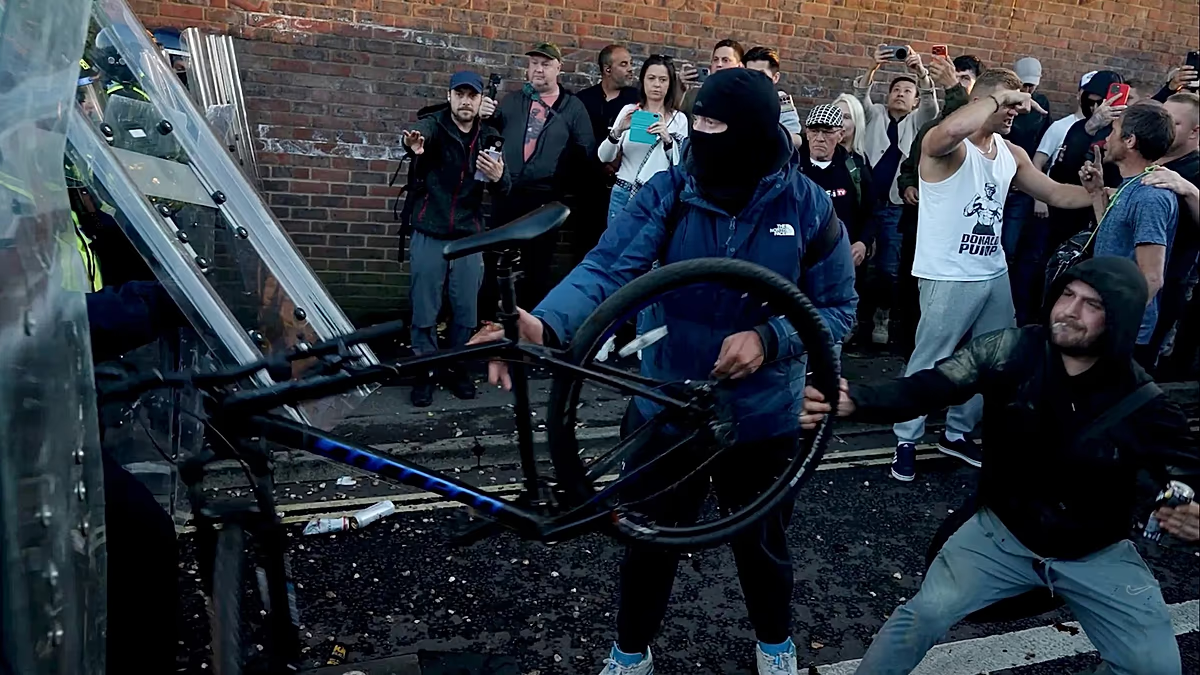
The public release of this bodycam footage acted as a catalyst, transforming grief and frustration into civil unrest. On Tuesday, hundreds of protesters gathered in Southampton, clashing violently with police. Bricks and bins were hurled, the air filled with chants of “Henry, Henry.” The confrontation left a painful toll: eleven officers and one police dog were injured in the chaos. The disorder also drew the presence of far-right activist Tommy Robinson (Stephen Yaxley-Lennon), who addressed a rally and called for the imprisonment of the officers involved. In the aftermath, the Crown Prosecution Service announced charges against two men in relation to the protests: Matt Styler, 50, charged with assaulting a police officer, and Daniel Frost, 44, charged with violent disorder and possession of an offensive weapon. Deputy Chief Crown Prosecutor Sophie Stevens emphasized that the decision to prosecute was based on sufficient evidence and the public interest.
The political fallout from the tragedy was immediate and stark. Nigel Farage, leader of the Reform party, stirred significant controversy by calling for a response of “pure cold rage” to Henry’s murder. This rhetoric was directly condemned by Prime Minister Keir Starmer in the House of Commons, who accused Farage of exploiting the incident to “create division.” Starmer pointedly noted that Henry’s grieving family had publicly pleaded for calm and unity. “Exploiting this tragedy to create grievance and division would be wrong in any circumstances,” Starmer stated. “But to do it when the family are expressly saying, ‘please don’t,’ is unforgiveable. It shows exactly who he is.” This exchange underscores how a personal family tragedy can become a flashpoint in the nation’s political and cultural debates, often drowning out the voices of those most directly affected.
Amidst the anger directed at police failings and the political sparring, another community found itself in a painful spotlight: the Sikh community. Vickrum Digwa is a Sikh man, and prosecutors noted he carried both a standard Kirpan—a small, sacred blade that forms part of orthodox Sikh religious attire—and a larger, separate dagger used in the attack. A conglomerate of Sikh community groups issued a joint statement expressing profound sorrow, calling Henry’s killing a “moment of madness by an individual for which there can be no excuses.” They also detailed the “considerable abuse and hate” faced by the wider Sikh community during Digwa’s trial, largely centered on misunderstandings about the Kirpan. The statement sought to separate the individual’s criminal act from an entire faith, affirming, “This was an isolated incident, the Sikh community is committed to promoting greater understanding and ensuring lessons are learned.” They reminded both their own community and the public of the “serious responsibility” that accompanies wearing the Kirpan, which has limited legal protection in the UK only for genuine religious purposes.
In the wake of the violence, Hampshire Police Chief Constable Alexis Boon released a statement that attempted to balance accountability with a plea for societal stability. “We understand and appreciate as police officers that we are accountable for our actions,” Boon said. “What we ask, however, is that those actions are judged through fair and transparent processes.” He drew a firm line, however, at the violent protests: “What we, as a society, cannot accept is the violent scenes we saw in Southampton last night.” This statement captures the complex tension at the heart of the episode: the legitimate, furious demand for police transparency and justice, set against the collapse of civil order and the safety of the wider public. The path forward requires navigating this tension, ensuring a thorough and impartial investigation into the officers’ conduct without allowing rage to manifest in further violence on the streets.
Ultimately, the story of Henry Nowak is a multi-layered tragedy. It is the story of a young life brutally cut short. It is a story of a terrible failure in a moment when compassion and critical care were desperately needed. It is a story of a community’s raw grief spilling over into destruction, and of other communities fearing unjust backlash. And it is a story of how politicians and public figures can either help heal or deliberately deepen societal wounds. The charges against the protestors and the ongoing police conduct investigation are the first formal steps in a long process of seeking justice and accountability. For true resolution, however, the focus must remain on the core truths: a family is in mourning, a city is scarred, and a nation is left to reflect on how justice, accountability, and community cohesion can be pursued without sacrificing any one for the other. The memory of Henry Nowak deserves nothing less than a committed, unified, and peaceful pursuit of those ideals.