


A New Dawn for European Unity: Breakthroughs and Challenges
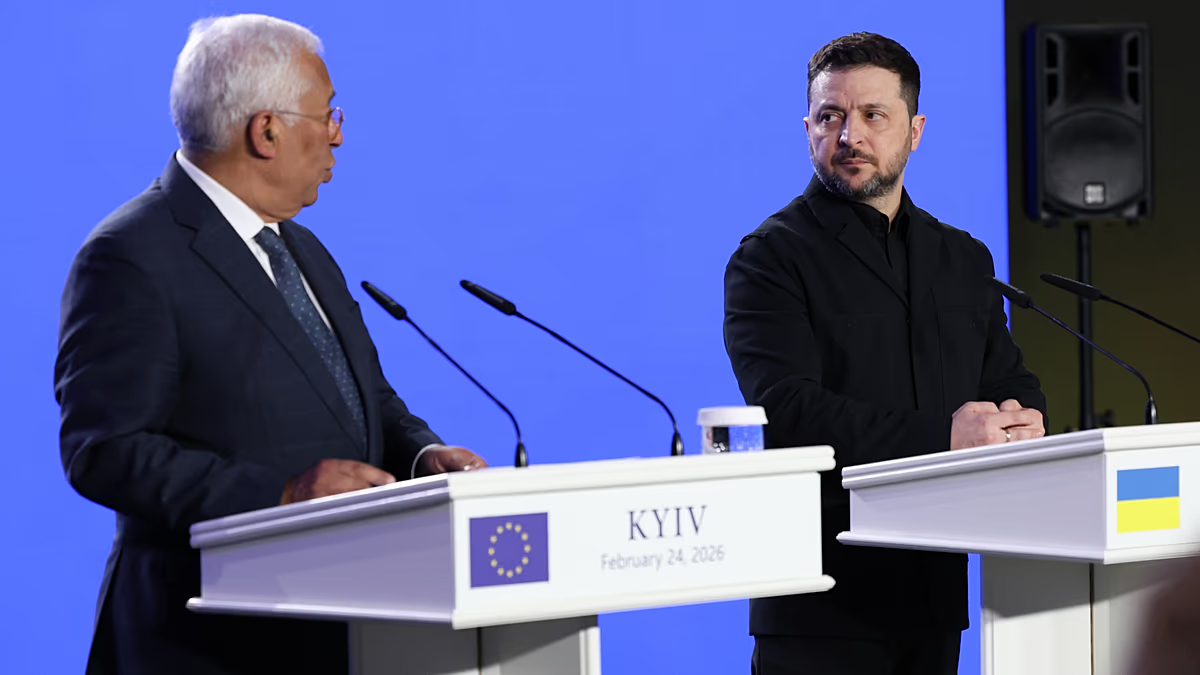
Good morning from Brussels, where a significant shift in the geopolitical landscape is unfolding. In a move that alters the trajectory of European integration, Hungary has lifted its longstanding veto on Ukraine’s accession talks with the European Union. This breakthrough, announced by Hungarian Prime Minister Péter Magyar, hinges on a newly struck deal concerning the rights of the Hungarian-speaking minority in Ukraine’s Transcarpathia region. Magyar framed the agreement as a comprehensive expansion of linguistic, educational, cultural, and political rights for this community—addressing the core grievance of the previous Orbán government. While Kyiv did not immediately detail the terms, Ukrainian Deputy Prime Minister Taras Kachka expressed gratitude for Hungary’s “constructive engagement,” heralding a new chapter of mutual respect and a shared European future. This diplomatic resolution, emerging from ambassadorial discussions in Brussels, now clears the path for both Ukraine and Moldova to formally open the first cluster of membership negotiations, a process eagerly encouraged by EU Enlargement Chief Marta Kos.
This forward momentum for Eastern Europe arrives as EU leaders prepare to demonstrate solidarity with another set of aspirant nations. A major summit in Tivat, Montenegro, will convene EU leaders and their counterparts from six Western Balkan countries, reaffirming the bloc’s commitment to the region’s European future. However, the path is not without its obstacles. Serbia, the region’s largest economy, presents a particular challenge due to persistent rule-of-law concerns and a foreign policy that notably diverges from the EU’s, especially regarding sanctions against Russia. The EU has already withheld certain funds from Belgrade over these issues. The choice of Montenegro as the summit venue is symbolic, as it is widely seen as the next candidate poised to join the Union, potentially within the coming year. This gathering underscores a dual-track reality: the EU’s strategic push for enlargement while navigating complex political realities within candidate states.
Beyond enlargement, the EU is actively managing fragile stability on its periphery. Following U.S.-led mediation, Israel and Lebanon have agreed to a conditional ceasefire, predicated on a “complete cessation” of fire by the Iran-backed Hezbollah. Lebanese Culture Minister Ghassan Salamé, while stressing the importance of implementation, voiced concern over what he called “not very healthy” and “far-fetched interpretations” emerging from some Israeli officials. This delicate diplomatic achievement highlights the ongoing role of external actors in seeking to de-escalate conflicts that border Europe, with the EU maintaining a vested interest in regional stability.
Concurrently, the EU is grappling with significant external economic pressures, particularly from China and the United States. EU Trade Commissioner Maroš Šefčovič is set for a critical meeting with his Chinese counterpart amid heightened tensions. Brussels is contending with a record trade deficit with Beijing and has moved to introduce measures, like the Industrial Accelerator Act, which China views as protectionist and has threatened to retaliate against. From across the Atlantic, the Trump administration has threatened further tariffs on the EU, citing concerns over forced labour—a charge the European Commission vehemently rejects as “unjustified.” As German MEP Bernd Lange pointed out, this accusation seems particularly discordant given the EU’s recent adoption of what it considers the world’s strictest rules against forced labour products, suggesting political motives behind the trade challenges.
Within the halls of the European Parliament itself, a different kind of debate is sparking controversy. A roundtable event focused on the rights of young LGBTQI+ individuals and children’ s sexual autodetermination has drawn sharp criticism from a group of MEPs. Approximately sixty lawmakers have petitioned President Roberta Metsola to reassess the event’s appropriateness, with critics like Paolo Inselvini arguing that children must be protected from “crazy ideologies.” This internal discord reflects the deeply societal and cultural fault lines that continue to shape political discourse within the Union, even as it addresses vast geopolitical and economic concerns.
In summary, this moment captures the European Union in a state of dynamic and multifaceted action. It is celebrating a hard-won diplomatic victory that advances its eastern enlargement project, while simultaneously tending to the complex Western Balkan portfolio. It is monitoring fragile security agreements on its borders and engaging in high-stakes economic diplomacy to defend its interests against both traditional and non-traditional trade pressures. Internally, it continues to wrestle with profound social debates that define its values. Together, these developments paint a picture of a bloc striving to assert its unity, project its principles, and secure its future in an increasingly volatile world.