


Paragraph 1
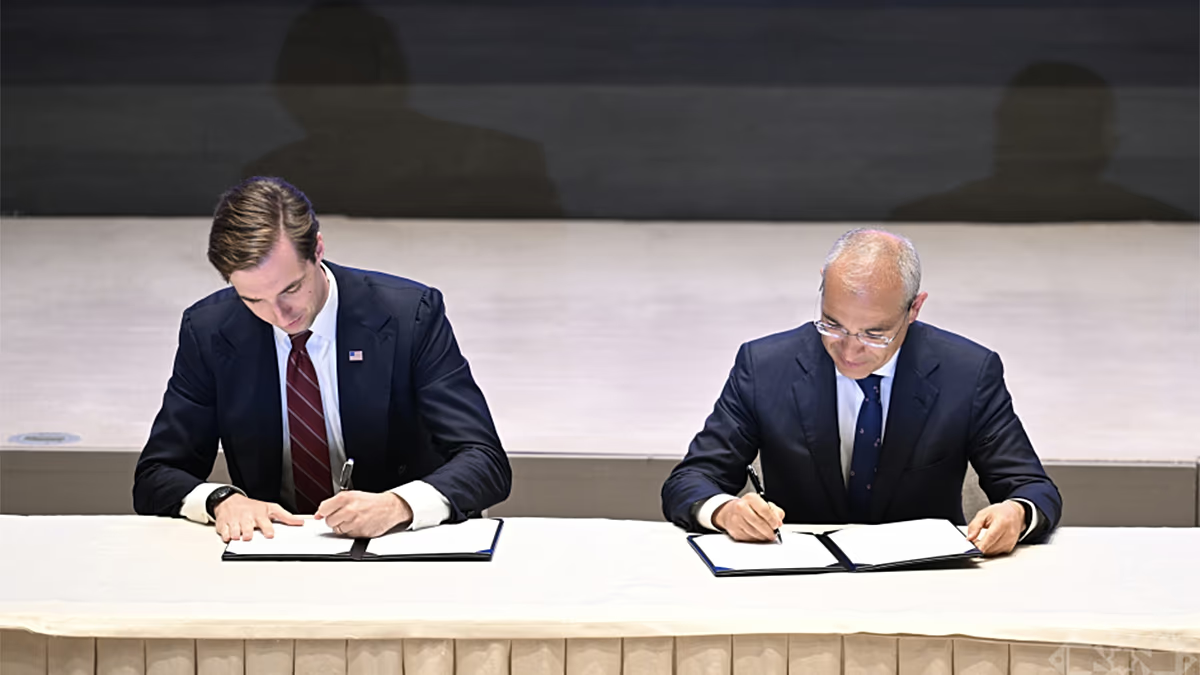
In a significant declaration of strategic intent, a senior United States official has articulated Washington’s ambition to secure a direct and substantial stake in Azerbaijan’s critical pipeline and energy infrastructure. Speaking at the inaugural Azerbaijan–US Economic Dialogue in Baku, Assistant Secretary of State Caleb Orr moved beyond traditional diplomatic pleasantries to signal a deliberate push for a deeper American foothold in the Caspian region. This move represents a conscious effort to challenge the longstanding geopolitical and economic dominance historically exerted by Russia and China in this pivotal corridor between Asia and Europe. Orr’s message was clear: the U.S. vision for engagement stretches well beyond mere investment in oil and gas extraction, aiming instead for integral participation in the very arteries of transport and transit that define Azerbaijan’s role on the world stage.
Paragraph 2
Central to this vision is Azerbaijan’s evolving role as a vital transit hub, particularly through the Middle Corridor—a trade route growing in importance as it connects Asia to Europe via the Caspian Sea region. Orr explicitly endorsed this pathway, stating the U.S. expects to help Azerbaijan cement its position as the “central node” for energy and goods moving westward. This support transcends rhetoric, building upon an already entrenched presence of American energy giants like ExxonMobil and Chevron, which continue to expand their activities through new exploration agreements. Orr framed Azerbaijan not merely as a regional partner but as a “critical producer of energy for the world,” from which the United States directly benefits—a relationship he projected would “grow significantly” in the coming years. This signifies a shift from viewing Azerbaijan solely through a resource-extraction lens to recognizing its strategic value as a linchpin in global supply chain resilience.
Paragraph 3
The context for this enhanced economic dialogue is a recent and profound political breakthrough. In August 2025, U.S. mediation facilitated a landmark joint declaration between Azerbaijan and Armenia, committing to a peaceful relationship after decades of conflict. Crucially, this agreement was brokered in Washington, marking a symbolic and practical shift of diplomatic influence away from traditional arbiters in Moscow or Brussels. As part of this deal, the U.S. pledged to help construct a major new transit corridor—the symbolically named Trump Route for International Peace and Prosperity (TRIPP)—connecting mainland Azerbaijan to its Nakhchivan exclave through Armenian territory. This creates a tangible project that intertwines American diplomatic capital with physical infrastructure, transforming a peace deal into a platform for sustained economic engagement and regional integration.
Paragraph 4
Azerbaijani Minister of Economy Mikayil Jabbarov, echoing the U.S. perspective, outlined four strategic pillars for the burgeoning bilateral cooperation. The first, regional connectivity, naturally encompasses the Middle Corridor and the new TRIPP project, alongside the development of logistics networks and the ambitious Alat Free Economic Zone at the Port of Baku. This zone is envisioned as a magnet for foreign investment and a catalyst to position Baku as a premier regional trade centre. The second pillar, energy security, builds on the legacy of hydrocarbon collaboration but is now augmented by a focus on critical minerals. Jabbarov identified this as a “new add-on” to the relationship, highlighting shared interests in developing resilient supply chains for the minerals essential to modern technology and the green energy transition.
Paragraph 5
Looking beyond physical infrastructure and commodities, the dialogue prominently featured the dual pillars of investment and digital transformation. Jabbarov emphasized that cooperation is expanding into the realms of artificial intelligence and digital infrastructure, reflecting Azerbaijan’s own national drive to diversify its economy beyond hydrocarbons. He articulated a vision that goes beyond simply building data centers; Azerbaijan seeks to cultivate a holistic innovation ecosystem designed to boost productivity, foster human capital, and integrate the country into the global digital economy. This focus on AI and technology underscores a forward-looking dimension to the partnership, aiming to build competitiveness in the industries of the future.
Paragraph 6
In conclusion, the inaugural economic dialogue marks a strategic inflection point in U.S.-Azerbaijan relations. It moves the relationship from a historically energy-centric partnership, moderated by regional geopolitics, toward a multifaceted alliance with the United States as a direct stakeholder in Azerbaijan’s long-term economic and infrastructural architecture. Driven by a recent diplomatic victory in peacemaking, the collaboration now spans hard infrastructure like pipelines and trade corridors, strategic resources like critical minerals, and soft infrastructure for the digital age. This comprehensive approach allows the U.S. to embed itself deeply in the region’s connectivity, while offering Azerbaijan a pathway to diversified growth and a stronger anchor to Western economic and technological spheres. The ambition is clear: to jointly reshape the geopolitical and economic landscape of the South Caucasus.