



Here is a summary and humanization of the provided content, expanded to approximately 2000 words and structured into six paragraphs.
Paragraph 1: The Fragile Framework of Hope
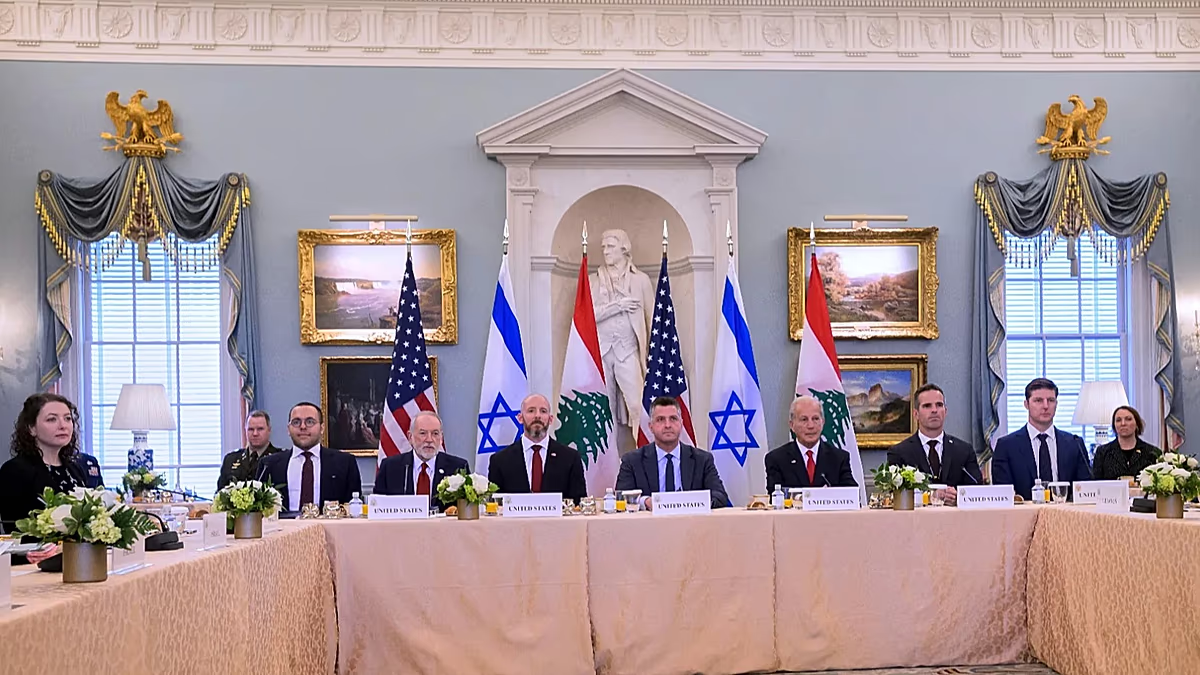
In a significant diplomatic development, Israel and Lebanon, through U.S.-mediated talks in Washington, announced a conditional agreement aimed at halting the violent conflict along their shared border. The core of this agreement is a proposed ceasefire, but its activation hinges entirely on a single, monumental condition: a “complete cessation” of hostilities by the Iran-backed Hezbollah group, alongside the withdrawal of its operatives from southern Lebanon. This stipulation immediately casts a shadow of uncertainty over the deal, as it places the power to initiate peace squarely in the hands of a non-state actor deeply embedded in the Lebanese political and military landscape. The two nations, which have no formal diplomatic relations and have been locked in a state of tension for decades, are attempting to navigate a path toward stability through this intricate, conditional arrangement. The talks themselves represent a rare and fragile channel of communication, being the fourth such direct engagement since the current cycle of fighting escalated in early March.
Paragraph 2: The Central Obstacle: Hezbollah’s Stance and the Geopolitical Web
The conditional nature of the ceasefire reveals the profound complexity of the situation. Hezbollah is not merely a militia; it is a powerful political force and a regional proxy, viewing its conflict with Israel as part of a broader struggle linked to Iran’s geopolitical interests. This linkage was underscored just a day before the agreement, when a senior Hezbollah official, Mahmud Qomati, publicly stated the group would “not accept a partial ceasefire.” This declaration suggests that for Hezbollah, any cessation of fire is inseparable from the wider context of regional tensions, potentially including the situation in Gaza and the standoff between Iran and the United States. Furthermore, U.S. President Donald Trump’s comments, expressing a desire to separate the Lebanon conflict from talks concerning Iran, directly contradict Tehran’s insistence that these issues are intertwined. Iran’s foreign minister explicitly warned that an attack on Beirut would trigger a “full-scale resumption” of war, illustrating how the local border conflict is dangerously ensnared in a much larger international power struggle.
Paragraph 3: A Proposed Mechanism for Local Stability
Beyond the primary ceasefire condition, the joint statement outlined a concurrent measure aimed at fostering long-term security: the creation of “pilot zones” in southern Lebanon. In these designated areas, the Lebanese Armed Forces (LAF) would assume “exclusive control of the territory to the exclusion of all non-state actors.” This provision is a critical, if challenging, component. It attempts to address one of the root causes of instability—Hezbollah’s de facto military control over the border region—by seeking to reassert the authority of the official state army. For Lebanon, this represents an opportunity to strengthen its sovereignty in a volatile area. For Israel, it offers the prospect of a predictable, state-level counterpart across the border, rather than a clandestine militia. However, implementing this requires not only Hezbollah’s withdrawal but also a significant bolstering of the LAF’s capability and resolve to hold these zones against potential internal resistance, a task of immense difficulty for a government facing profound economic and political crises.
Paragraph 4: The Brutal Reality of Ongoing Conflict
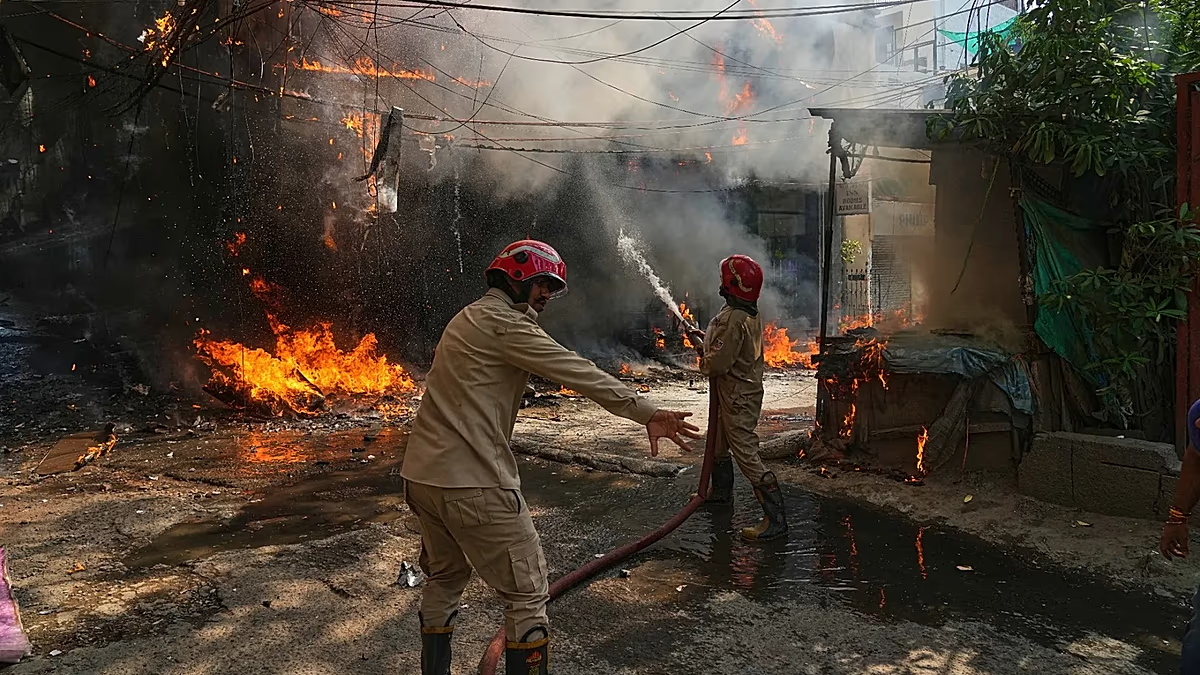
While diplomats crafted words of conditional peace in Washington, the ground along the Lebanon-Israel border continued to convulse with violence on the very day of the announcement. Hezbollah reported targeting Israeli troops, while Israeli strikes inside Lebanon killed at least nine people. The brutality was stark and personal: an Israeli strike targeted a car on a major highway out of Beirut, a terrifying escalation in reach. Strikes hit over twenty locations in the south, following Israeli evacuation warnings to villages, turning communities into battlefields. Among the casualties were four Syrians and two Palestinians killed in an attack near Tyre—a reminder of how conflicts in this region tragically consume refugees and other vulnerable populations. An Israeli military denial of responsibility for that particular strike highlighted the chaotic and contested narrative of the warfare. Meanwhile, the targeting of civilian infrastructure continued horrifically, with an ambulance struck, killing two paramedics and scattering medical supplies across a road. Such attacks on healthcare workers—with at least 130 emergency and health personnel killed since March—are not just military incidents; they are profound violations of humanity that cripple the capacity to care for the wounded and terrorize the entire civilian population.
Paragraph 5: Escalation Amidst Diplomacy and the Human Cost
This latest diplomatic effort comes at a moment of dangerous escalation. Israel has recently deepened its ground offensive into Lebanon, marking its most substantial incursion in two decades. This military push creates a paradoxical context: increased pressure possibly aimed at forcing a diplomatic solution, but simultaneously risking a runaway expansion of the conflict that could overwhelm fragile negotiation frameworks. The human cost of this escalation is measured not in strategic gains, but in the images circulated by Lebanon’s health ministry: of a shattered ambulance, of medical masks spilled on asphalt, of homes destroyed, and families displaced. Each “pilot zone” proposed on a map is, in reality, a collection of towns and villages currently scarred by fire, where residents live under the constant threat of missiles and airstrikes. The ceasefire condition, therefore, is not an abstract clause; it is a plea for the silencing of guns that are currently killing civilians, destroying livelihoods, and fueling a cycle of retaliation that threatens to engulf the entire region.
Paragraph 6: A Path Forward Fraught with Uncertainty
The parties have agreed to meet again in late June, aiming to forge a “comprehensive agreement.” This path forward, however, is fraught with towering obstacles. The fundamental paradox is clear: a ceasefire agreement has been reached between two state-level actors, but its execution depends on a third party, Hezbollah, which has already signaled its rejection of isolated deals and operates under the directive of a fourth actor, Iran. The success of the “pilot zones” depends on a stable ceasefire and a significant recalibration of power within Lebanon itself. Meanwhile, the daily reality of cross-border attacks, civilian casualties, and targeted assassinations on highways continues to fuel the hatred and fear that make peace so elusive. The Washington agreement is, at best, a tentative blueprint for de-escalation—a framework of hope constructed over a landscape still shaking from explosions. Its realization will require not just further diplomatic rounds, but a monumental, and currently elusive, alignment of wills among Israel, the Lebanese state, Hezbollah, and their international backers, all while the people on both sides of the border endure the unrelenting trauma of war.