

Bolivia finds itself in the grip of a profound and escalating national crisis, marked by the recent resignations of its Defence and Education Ministers. These high-profile departures are not isolated events but rather the latest convulsion in a political storm that has been building for weeks, with protestors paralysing major cities and directly challenging the presidency of Rodrigo Paz. The ministers’ exits signal a government under severe strain, struggling to maintain its cohesion and authority as public unrest reaches a fever pitch. This unfolding drama paints a picture of a nation at a crossroads, where the very foundations of governance are being shaken by the collective fury of its people.
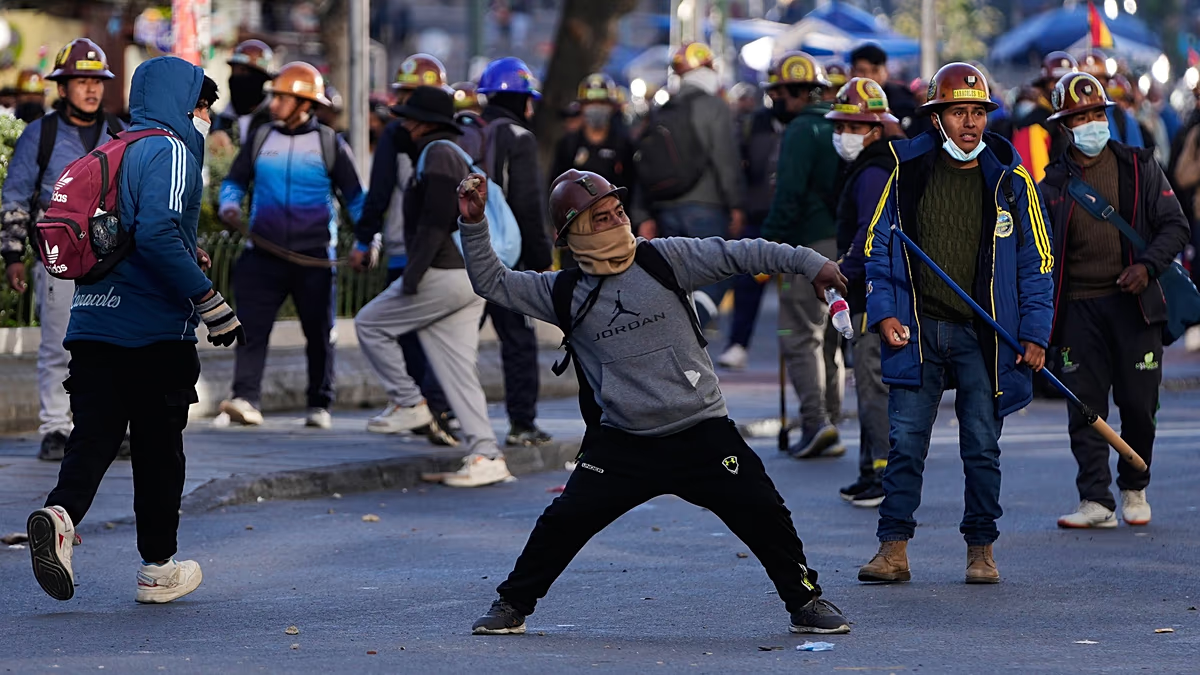
The source of this fury is deeply rooted in economic despair. The protests are a broad-based uprising, uniting workers, farmers, miners, transport workers, and teachers who are bearing the brunt of what is widely described as Bolivia’s worst economic crisis in forty years. The tangible effects are stark: approximately one hundred roadblocks nationwide have strangled supply lines, leading to severe shortages of food, medicine, and fuel in key urban centres like La Paz and El Alto. As basic goods become scarce, their prices skyrocket, squeezing an already suffering populace. This isn’t merely political dissent; it is a fight for survival, with communities using blockades as their primary weapon to voice a deep-seated anguish that symbolic governmental gestures have failed to alleviate.
In response, President Paz’s administration has taken a hardline stance, framing the protests as a threat to democracy itself and pointing the finger at a familiar antagonist: former socialist president Evo Morales. The government suggests Morales, who is currently in hiding facing serious legal charges, is the hidden hand orchestrating the unrest. From his exile, Morales has fired back, claiming the rebellion is a justified uprising against a “government that is utterly submissive” to Washington and its neoliberal policies. This exchange underscores the crisis as a brutal chapter in Bolivia’s enduring political feud, a battle between the legacy of Morales’s socialist era and the current, U.S.-aligned leadership. Paz’s attempts at conciliation—cutting his own salary, promising greater inclusion for Indigenous and labour groups—have been dismissed as insufficient, leaving the political deadlock complete.
With the streets gridlocked and trust in the government evaporating, a potential constitutional path out of the chaos is gaining unexpected traction: a recall referendum. Opposition figures and some analysts are increasingly advocating for this mechanism, proposing that Bolivians themselves should go to the polls in the coming months to decide whether Paz should remain in office. This idea, once considered unlikely, has gained momentum as the pain caused by the prolonged blockades intensifies and faith in the government’s ability to restore order collapses. It represents a democratic pressure valve, offering a way to measure the president’s mandate directly and definitively, rather than through the destructive proxy of street conflict.
However, the government currently rejects this path, insisting that dialogue remains its priority and outright ruling out Paz’s resignation. This position, combined with its refusal to exclude declaring a state of emergency and deploying the military, sets the stage for a dangerous escalation. The nation stands on a knife’s edge, as President Paz himself warned, at a “breaking point.” The replacement of the defence minister with the country’s anti-drug tsar could be read as a routine reshuffle or a preparation for a more militarized response to the civil disobedience. The coming days will reveal whether the government can forge a credible dialogue with the multifaceted protest movement or if the cycle of blockade and crackdown will spiral into greater conflict.
Ultimately, Bolivia’s crisis transcends a simple power struggle. It is a complex tapestry woven from threads of economic desperation, historical political polarization, and a desperate yearning for effective governance. The resignations of key ministers are symptoms of a deeper sickness—a loss of consensus and a failure of policy to address profound human need. Whether the solution emerges from a historic recall vote, a successful and inclusive dialogue, or a tragic descent into greater state repression, the outcome will profoundly reshape Bolivia. The Bolivian people, across the political spectrum, are now waiting to see if their institutions can channel this explosive energy into a renewed democratic process or if the nation will fracture further under the unbearable pressure.