


In a sobering address that underscores a fundamental shift in Europe’s security landscape, UK Prime Minister Keir Starmer has issued a stark warning: Western intelligence assessments suggest Russia could launch an attack on a NATO member state within the next four years, potentially as early as 2030. This dire forecast, delivered during a visit to a drone manufacturer in southwest England, frames the current moment not as a distant geopolitical concern but as an immediate and pressing crisis. Starmer’s words echo alarms sounded by other European leaders and NATO Secretary General Mark Rutte, who in December cautioned that Russia might be prepared to use military force against the Alliance within a five-year window. This collective intelligence paints a picture of a ticking clock, transforming the war in Ukraine from a regional conflict into a potential prelude to a wider, catastrophic confrontation with a revanchist and re-arming Russia.
The urgency of this threat forms the bedrock of Starmer’s newly announced policy response. He pledged that his government will publish a long-delayed, comprehensive defence investment plan before the upcoming NATO summit in Turkey, which begins on July 7th. This plan, intended to chart a decade-long course for modernizing the UK’s military capabilities, had been stalled since last year, with UK media reporting disputes between the Treasury and other government departments over its enormous cost. Starmer firmly insisted to reporters that the ambitious blueprint will be “fully funded,” signaling a political priority that overrides fiscal hesitation. His commitment is anchored in a specific spending promise: to raise defence expenditure to 2.5% of GDP starting next year, with a goal of reaching 3% in the next parliamentary term, a clear move to bolster the nation’s readiness.
This political urgency is mirrored in the grave assessments of military leadership. Air Chief Marshal Sir Richard Knighton, Britain’s most senior military officer, provided a chilling personal perspective, stating that in his 35-year career, the present era represents “the most dangerous period that I have known.” His interview with the BBC served as a powerful reinforcement of the Prime Minister’s message, framing the need for enhanced capability and readiness as a vital deterrent. The goal, he stressed, is to prevent adversaries “from doing something daft”—a colloquial yet profoundly serious term for a miscalculation that could spark a major war. This alignment between political and military leadership highlights a unified front within the UK establishment, recognizing that deterrence has failed in Ukraine and must now be reconstructed at a far higher level to prevent a spillover.
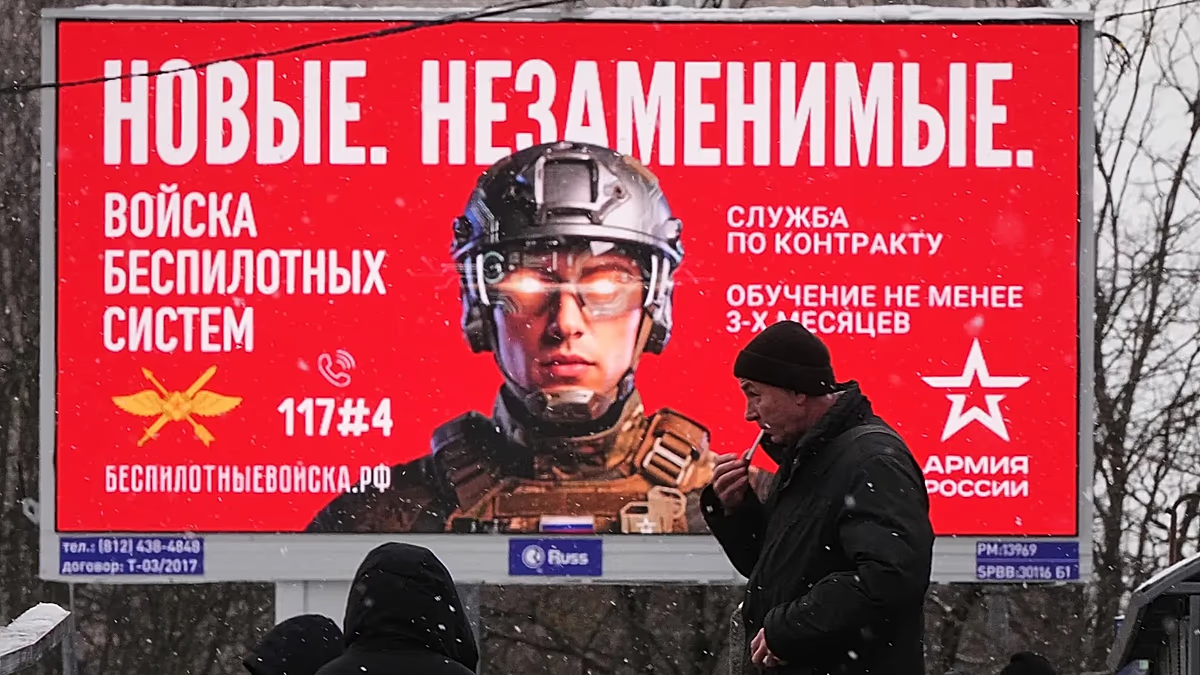
The context for this heightened alert is, of course, the ongoing war in Ukraine, now in its fifth year. Russia’s full-scale invasion demonstrated a willingness to shatter long-standing European security norms and has acted as a massive catalyst for Russian military modernization and expansion. Western intelligence now observes not a Russia exhausted by the conflict, but one that is learning, adapting, and reconstituting its forces with a wartime economy. The assessment of a potential NATO attack within this decade suggests that the Kremlin may seek to test the Alliance’s resolve and unity directly once it consolidates its position or concludes its campaign in Ukraine. This scenario moves the threat from the theoretical to the concretely temporal, forcing a rapid reevaluation of post-Cold War defence postures that were largely shaped for a different era.
Furthermore, the transatlantic dimension adds another layer of complexity to this strategic equation. Starmer’s warning and spending commitments come against the backdrop of persistent pressure from the United States, notably from President Donald Trump, for European NATO members to shoulder a greater share of the collective defence burden. The longstanding American exhortation for allies to meet the 2% of GDP spending target—and beyond—is now met with a European realization that this is not merely a request for equitable burden-sharing, but an existential necessity. The UK’s push towards 3% can be seen as an attempt to lead by example, hoping to spur a broader European ramp-up in defence investment to create a more resilient and self-sufficient front line, capable of deterring aggression regardless of the political winds in Washington.
In conclusion, Prime Minister Starmer’s announcement is more than a routine policy update; it is a candid admission of profound vulnerability and a call to action. By publicly citing specific intelligence timelines of a potential Russian attack by 2030, he is attempting to galvanize both political will and public understanding for a historic shift in resource allocation towards national defence. The promised investment plan, the elevated spending targets, and the synchronized warnings from military chiefs collectively mark a pivotal moment. They represent a reluctant but determined acknowledgement that Europe has entered a pre-war period of preparation, where the lessons of Ukraine must be absorbed and acted upon with unprecedented speed and scale to preserve the peace that has defined the continent for generations. The coming NATO summit will now serve as a critical test of whether this sense of acute peril translates into a unified and adequately funded response across the entire Alliance.