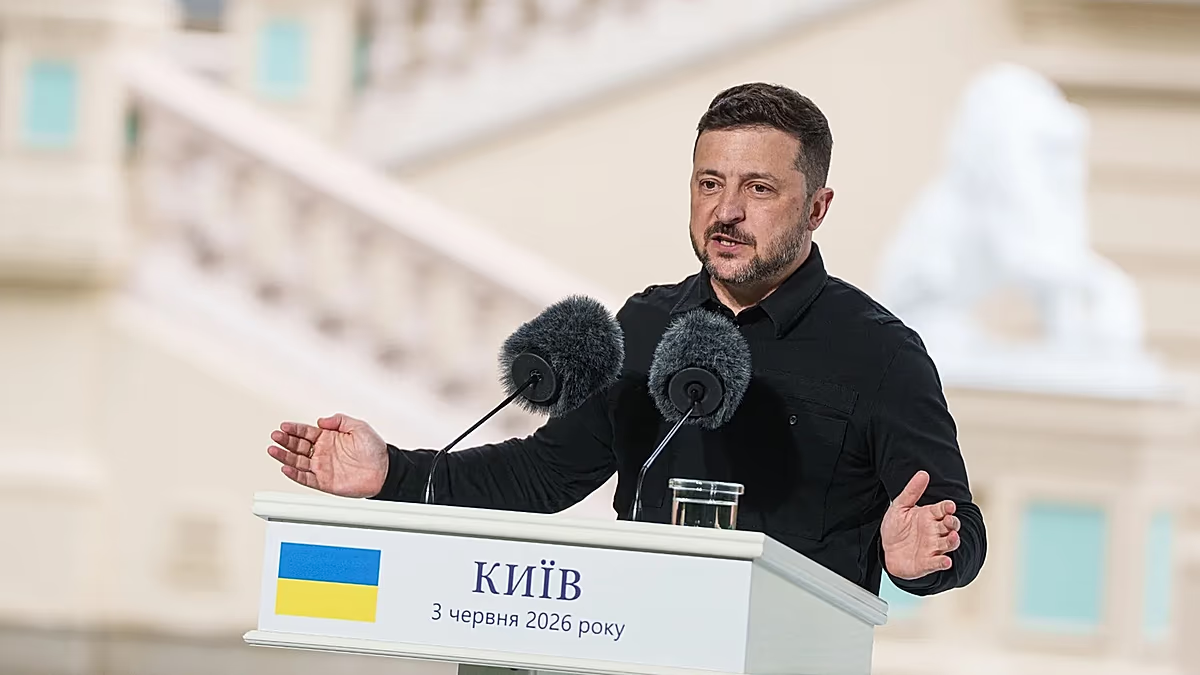


In a dramatic and deeply personal appeal, Ukrainian President Volodymyr Zelenskyy has directly addressed Vladimir Putin, proposing a face-to-face meeting to end the devastating war that has raged since Russia’s full-scale invasion in 2022. This open letter, published in early June 2026, marks a significant moment, as it is one of the few times Zelenskyy has appealed straight to the Russian leader and the first time he has ever sent a formal letter to him. Striking a tone that blends historic gravity with a stark ultimatum, Zelenskyy declared, “The choice is yours now. Enough of war.” He positioned the conflict not as an inevitable clash of empires, but as a solvable matter between two leaders, writing, “It is leaders who resolve the key issues.” His proposal was simple yet profound: a definitive ceasefire negotiated directly, urging Putin to “set a clear date for such a meeting” and not to “be afraid to take the path out of this war.”
Zelenskyy framed his letter as a direct conversation with Putin, juxtaposing the Russian president’s long tenure with the grim reality of the conflict. He opened by acknowledging that a quarter-century ago, when Putin first came to power, many Ukrainians viewed him positively. “That is how it was,” he wrote, “But that is now in the past.” That past, he suggests, has been irrevocably shattered by Putin’s own choices. With a pointed reminder of Ukraine’s resilience and growing military reach, Zelenskyy noted that Ukrainians now viewed it positively that their long-range drones “paid a visit” to a forum in St. Petersburg, adding pointedly, “that distance is not the limit of our capabilities.” The message was clear: the war has transformed Ukraine, forging a nation capable of striking back at the heart of Russian power.
The core of Zelenskyy’s argument is a forceful and personal indictment. He asserts that Putin has spent nearly half of his 26-year rule waging war against Ukraine, dismissing all of Moscow’s stated justifications—NATO expansion, geopolitics, language rights—as mere “false pretext.” “This war is your personal choice — a war without a real cause. That is how history will remember it,” he states unequivocally. This personalization of the conflict is a strategic move, aiming to isolate Putin from narratives of national destiny and place the moral and historical burden squarely on his shoulders. Zelenskyy contrasts this with the collective pain of Ukraine, stating that even with a favorable loss ratio, “every loss is painful to us.” The human cost, he insists, is what truly matters.
Beyond the indictment, the letter extends a tangible, if challenging, olive branch. Zelenskyy expresses a fundamental longing for peace, stating, “We in Ukraine do not want a permanent war. We know very well that life without war is infinitely better. And we want to achieve that.” He expresses a conviction that the majority of Russians would welcome an end to the fighting, implying that continued conflict serves not the Russian people, but a narrowing set of personal interests in the Kremlin. He also subtly challenges Putin’s own judgment and that of his advisors, noting, “Many did not believe that Ukraine would be able to hold out for so long. You did not believe it… That was a mistake.” The subtext is an offer of a dignified off-ramp, a chance to correct that catastrophic miscalculation.
The Ukrainian presidential office confirmed the letter was shared with Kyiv’s international partners, including the United States, ensuring the proposal would be seen as a serious diplomatic overture rather than a isolated plea. Zelenskyy has long insisted that only direct talks between the two leaders can resolve the core territorial disputes. In a swift, almost dismissive response, the Kremlin stated that Zelenskyy was welcome to meet Putin in Moscow “any time,” while adding that the Russian president had not yet been shown the letter. This exchange highlights the profound asymmetry that has characterized the war: Zelenskyy offers a summit for negotiation, while the Kremlin’s response frames it as a unilateral visit to the seat of Russian power.
Ultimately, Zelenskyy’s letter is a powerful piece of political and moral theater, crafted for multiple audiences. For the international community, it reinforces Ukraine’s identity as the rational actor seeking a just peace. For the Russian people, it attempts to bypass state propaganda and speak directly to their war-weariness. And for Putin himself, it is a direct challenge, mixing historical reckoning with a practical proposal. It questions the legacy of a leader now described as facing the toll of age and growing fatigue. Whether this letter becomes a historical footnote or a catalyst remains in Putin’s hands, but Zelenskyy has forcefully restated a fundamental truth: the war began with a choice, and it can end with one.