

The recent social debate surrounding Bad Bunny’s latest tour centers on a segment known as the “Casita,” where public figures, often women, are invited to dance during his concerts. While this has sparked criticism from some conservative feminists who view it as a form of objectification, other journalists have defended the practice. They argue that the criticism often serves to instrumentalize feminism, focusing disproportionately on the women involved rather than on the broader cultural context of reggaeton—a genre still fighting for legitimacy despite its global dominance. This surface-level debate, however, obscures the profound cultural significance of the Casita itself, which is far more than a simple concert prop.
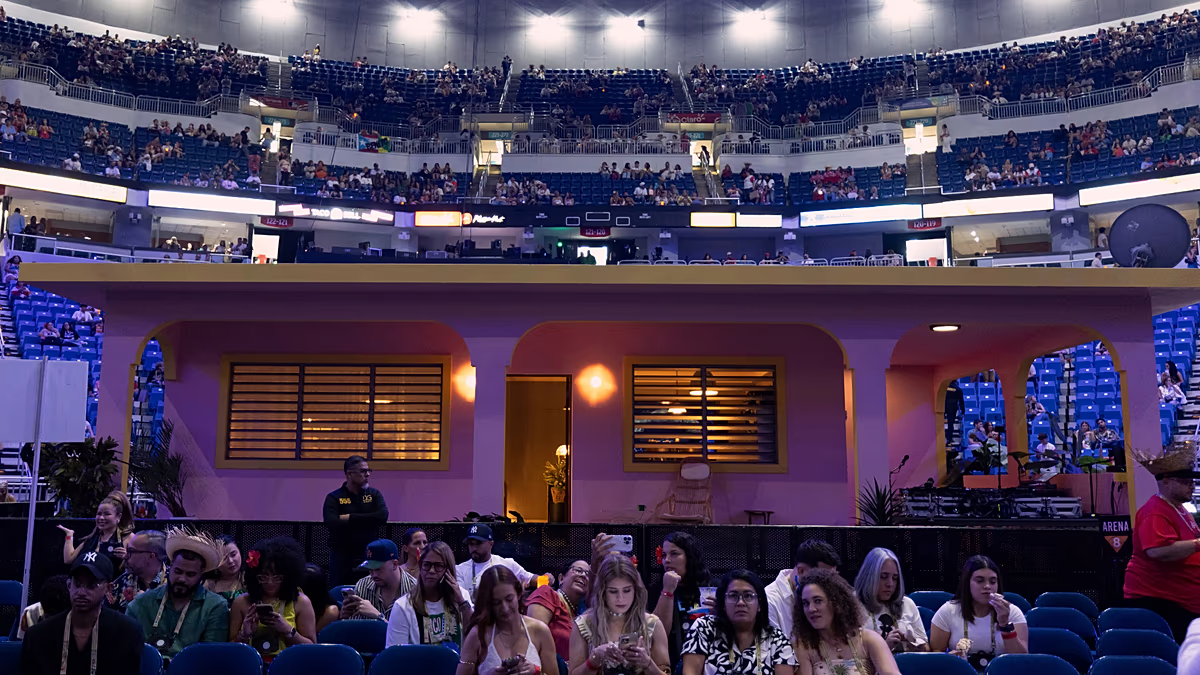
Beneath the ideological skirmish lies a powerful symbol of Puerto Rican identity. The Casita is a meticulous recreation of a home from Humacao, a town on Puerto Rico’s east coast, and serves as a physical anchor for the themes of Bad Bunny’s album “Debí tirar más fotos.” Its existence directly engages with Puerto Rico’s complex political status as a U.S. unincorporated territory, a condition that grants its citizens fewer rights and no voting representation in Congress. By placing this specifically Puerto Rican structure at the heart of a global tour, Bad Bunny insists on the visibility and narrative of his homeland, challenging the political and cultural periphery to which it is often relegated.
The history of Humacao, as reflected in the Casita’s architecture, is a layered story of resistance and fusion. The town’s name honors Jumacao, one of the last Taíno leaders to fight Spanish colonization. Its urban layout follows the Spanish-imposed “Laws of the Indies,” yet its early buildings utilized local materials like thatch and timber, preserving indigenous and adaptive practices. The arrival of Neoclassical elements in the 19th century was tied to the sugar trade, an industry built on enslaved African labor. This architectural evolution mirrors the island’s painful history: a tapestry woven from Taíno, Spanish, and African threads, each layer imposed through conquest or bondage.
The 20th century introduced another transformative layer with the U.S. takeover in 1898. The Casita’s design for the tour, as conceived by designer Mayna Magruder Ortiz, draws inspiration specifically from mid-century housing estates built for American expatriates, such as those in Levittown. This choice is deeply resonant; these communities symbolized a new wave of American influence and economic disparity. Therefore, the Casita on stage is a fusion upon fusion—a humble Puerto Rican home style reimagined through the aesthetic of American suburban expansion, creating a potent visual metaphor for the ongoing cultural and political negotiation that defines modern Puerto Rican life.
Inside, the Casita’s decor continues this narrative of cultural assertion. It is filled with Antillean pieces and works by seminal Puerto Rican artists like graphic designer Lorenzo Homar and muralist Alexis Díaz. This intentional curation transforms the structure from a mere set piece into a mobile gallery of Puerto Rican creativity. It aligns Bad Bunny with a legacy of anti-colonial artistry, following figures like Residente of Calle 13, who have used their global platforms to critique oppression and celebrate the island’s resilient identity. The Casita, therefore, becomes a sacred space, a declaration that Puerto Rican history and art are non-negotiable parts of the global mainstream.
Consequently, to reduce the controversy to a simple question of objectification is to miss the entire point. The Casita is a deliberate, multifaceted act of cultural storytelling. While the debate over the participation of public figures is valid, it exists within a far larger framework. Bad Bunny has constructed a powerful symbol that forces a conversation about Puerto Rico’s colonial reality, its syncretic heritage, and its right to self-definition on the world’s biggest stages. As his tour continues across Europe, the Casita stands not just as a backdrop for dancers, but as an unignorable monument to a people’s history, struggle, and enduring pride.