

Paragraph 1
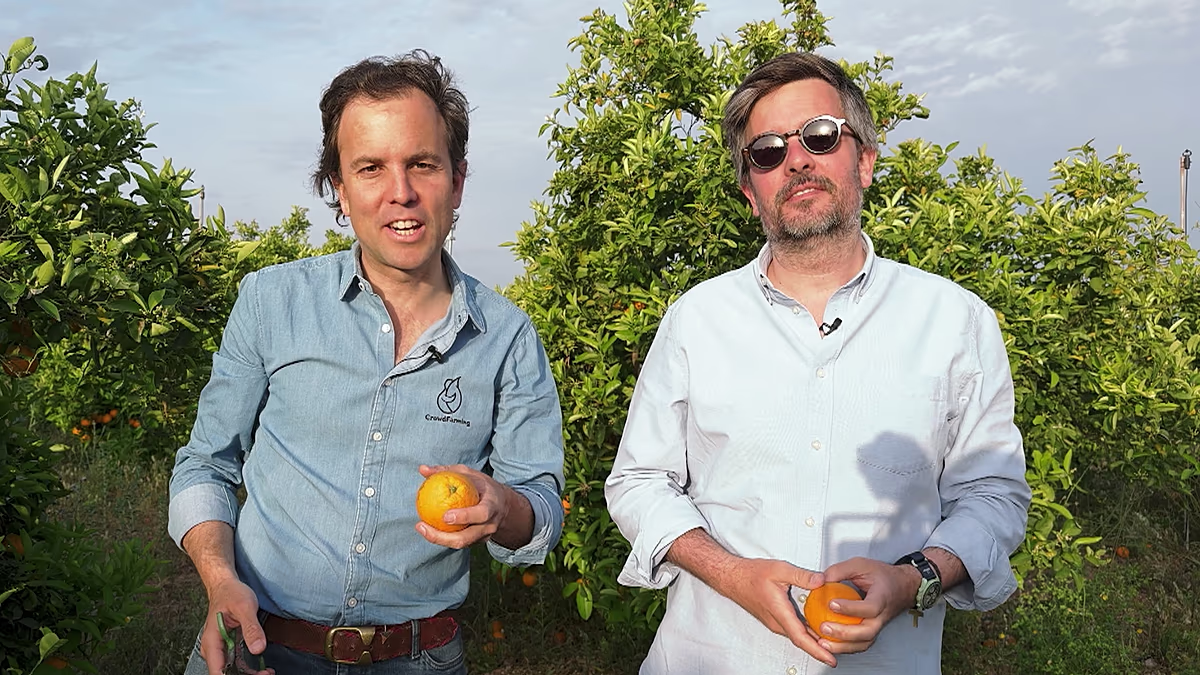
The dawn of the final harvest day at Masia El Carmen, an orange grove north of Valencia, holds a quiet significance. In the gentle morning light, brothers Gonzalo and Gabriel Úrculo move alongside their workers, filling crates with fruit destined for European tables within hours. This scene is the culmination of a deeply personal journey. Neither brother imagined themselves as farmers, inheriting a plot of land that had fallen into abandonment after their grandfather’s passing. In 2010, without formal training but driven by a sense of legacy and a burgeoning idea, they made a pivotal decision: not merely to revive the family farm, but to transform it. They committed to regenerative organic farming, a system that works in harmony with nature, rebuilding soil health and biodiversity. This choice planted the seed for what would become a quiet revolution in European agriculture.
Paragraph 2
The foundational innovation that grew from their grove was deceptively simple yet profoundly effective: tree adoption. Customers, primarily families and individuals seeking a direct connection to their food’s source, could “adopt” an orange tree for an annual fee. In return, the farm cared for that specific tree and shipped its harvest directly to the adopter’s door. This model created a powerful bond, transforming anonymous consumers into vested partners in the farming process. For the Úrculos, it provided crucial financial stability, securing demand and income in advance. Seeing the model’s success on their own farm, they realized its potential could empower other farmers. In 2017, they launched CrowdFarming, a digital platform designed to scale this intimate farmer-consumer connection across Europe.
Paragraph 3
CrowdFarming functions as a digital marketplace built on transparency and relationship. Customers browsing the platform can select not just a product, but the very farm and farmer who produced it—whether it’s olives from Greece, almonds from Spain, or vegetables from France. This dismantles the traditional, opaque supply chain where produce loses its story and the farmer remains a distant, unnamed entity. The platform now facilitates over 300,000 active tree adoptions and partners with more than 300 independent producers. One such farmer is Fernando Agramunt, who manages an organic olive farm. He attests that selling high-quality oil directly to thousands of dedicated families, who value the provenance and method, is far more sustainable than bulk wholesale. This direct link ensures his entire harvest is sold and validates the higher costs of conscientious farming.
Paragraph 4
To support its network of farmers, CrowdFarming developed robust logistical backbone. Their central hub, Crowd Log in Valencia, buzzes with activity, sorting, packing, and dispatching thousands of personalized orders daily. By operating without holding stock and partnering with multiple transport companies, the system achieves remarkable efficiency and speed, ensuring fresh produce reaches customers promptly. This shared infrastructure alleviates a major burden for small and medium-scale farmers, who often lack the resources for complex distribution. The model’s success is reflected in its growth; 2024 revenues reached 65 million euros, and a recent acquisition expanded the community to connect nearly 10,000 producers with two million users across thirty European countries.
Paragraph 5
Beyond commerce, CrowdFarming is driven by a mission to reform an agricultural system its founders see as broken. Co-founder Juliette Simonin speaks of pressures facing farmers: unsustainable production models dictated by large distributors, the devastating impacts of climate change on harvests, and prices so low they threaten livelihoods. The platform is conceived as a practical alternative, fostering resilience by giving control back to the producer and educating the consumer. It demonstrates that a food system can be both ethical and economically viable. The direct sales model ensures a fairer share of the final price goes to those who work the land, creating a foundation for farms to invest in regenerative practices that heal the ecosystem rather than deplete it.
Paragraph 6
The story that began with two brothers in a Valencian orange grove has blossomed into a hopeful vision for Europe’s food future. Gonzalo Úrculo’s dream is to prove conclusively that regenerative organic farming is not a niche or romantic ideal, but a scalable, profitable, and essential model. It is a testament to the power of reconnecting people with the source of their nourishment. By fostering a community where consumers become supporters and farmers are valued as stewards of the land, CrowdFarming charts a path away from anonymous, extractive agriculture. It stands as a working example that Europe can be fed through a network of thriving, diverse, and resilient farms, where every harvest day, like the one at Masia El Carmen, is a celebration of a healthier relationship between people, food, and the planet.