


Here is a humanized and expanded summary of the provided content, formatted into six paragraphs as requested.
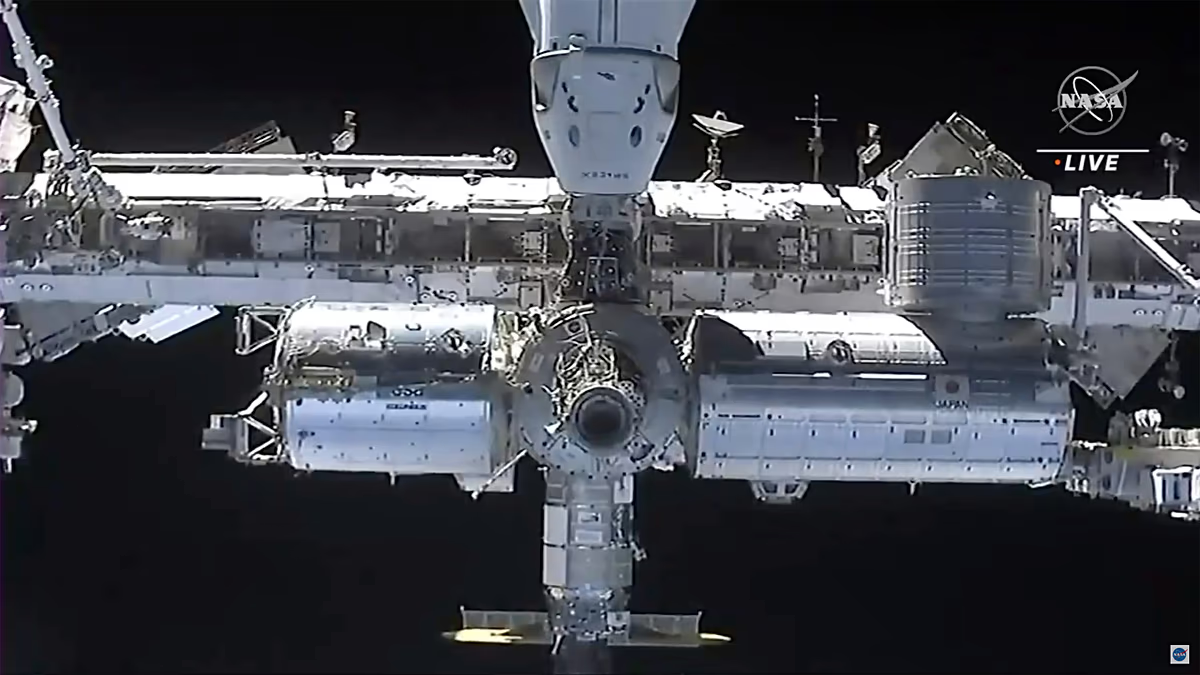
High above our planet, a silent and persistent issue aboard the International Space Station has escalated into a sobering reminder of the inherent risks of living in orbit. According to international reports, including from outlets like the Daily Mail, NASA has instructed astronauts to prepare for a potential emergency evacuation. The cause for this heightened state of alert is a series of troubling air leaks originating from the station’s Russian segment, a problem that has lingered for years but has recently taken a more serious turn. This development shifts the narrative from one of routine maintenance to one of imminent contingency planning, highlighting the fragile equilibrium upon which life in space depends.
The heart of the issue lies in the Zvezda service module, a critical Russian component that provides living quarters and life support systems. As confirmed by NASA press officer Bethany Stevens in a public statement, the transfer tunnel within Zvezda, known as PrK, has long been known to have cracks and leaks. Since 2019, the Russian space agency, Roscosmos, has managed to contain these leaks through ongoing repairs and monitoring. However, the persistence of the problem underscores the aging infrastructure of the ISS, which has been continuously inhabited for over two decades, and the constant battle against the harsh environment of space that engineers and crews must wage.
The situation reached a pivotal point in early June 2026. Faced with new or worsening leaks, Roscosmos made the decision to undertake more extensive repair work. In a move that underscores the seriousness with which NASA viewed the operation, the agency issued a precautionary order for specific crew members to adopt maximum safety measures. This directive primarily affected the four astronauts of the SpaceX Crew-12 mission—two Americans, a French astronaut, and a Russian cosmonaut—along with another U.S. astronaut, Chris Williams. For the duration of the Russian repair activity, they were instructed to sequester themselves inside their Crew Dragon spacecraft, which remains docked to the station as a permanent lifeboat.
Reports indicate this order came through from mission control at 9:04 a.m. Eastern Time on a Monday, with the crew going so far as to don their intra-vehicular spacesuits—a clear step in preparing the spacecraft for a potential rapid undocking and return to Earth. This imagery powerfully frames the reality of the moment: highly trained professionals, floating in their sleek capsule, suited up and ready to abandon their orbital home at a moment’s notice. It is a vivid illustration of the layered protocols that exist not as mere paperwork, but as essential, practiced procedures for survival.
What triggered this shift from managed nuisance to emergency protocol was a measurable change in the leak’s severity. While the air loss had been minor in preceding months, data showed a sudden spike from losing approximately half a kilogram of air per day to a full kilogram. To contextualize this, an average adult human breathes in and exhales between 10 and 15 kilograms of air daily, meaning the station’s systems were compensating for a significant, though not immediately catastrophic, loss. Nonetheless, in the precision-engineered environment of the ISS, such a doubling of the leak rate is a red flag, signaling that existing containment strategies might be failing and prompting a more aggressive response.
Through it all, NASA has publicly emphasized continued cooperation with its international partners. The agency’s statement concluded by affirming ongoing work with Russian counterparts and the broader ISS community to find a “lasting solution.” This incident, while alarming, also serves as a testament to the enduring, if sometimes strained, international partnership that the station represents. It demonstrates a shared commitment to crew safety above terrestrial geopolitics, and a unified focus on solving complex technical challenges. As repairs are attempted and monitoring continues, the episode stands as a stark lesson in vigilance, showcasing the relentless demands of maintaining humanity’s permanent foothold in the void of space.