



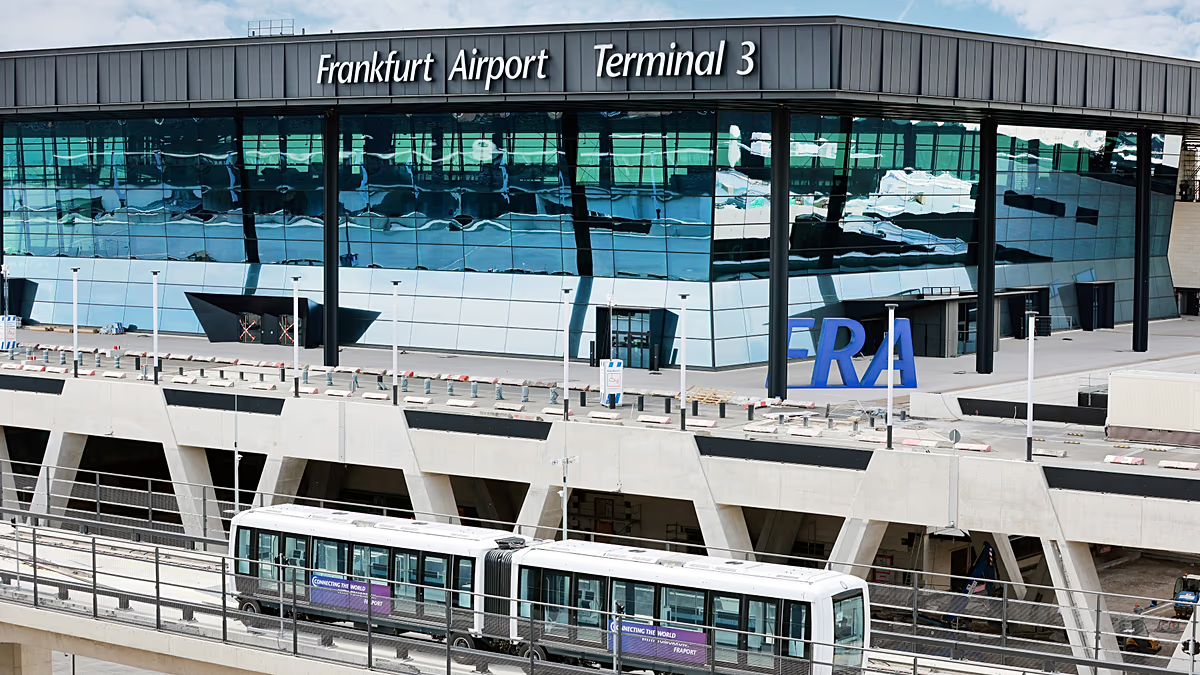
Frankfurt Airport, a titan of global aviation and long a central hub for international travel, is poised for a transformative expansion. Having welcomed over 57.5 million passengers last year alone, its reach and capacity are set to soar with the grand opening of Terminal 3 on April 23. This isn’t merely an addition; it’s a significant rebalancing of the airport’s ecosystem. Designed to handle up to 19 million passengers annually through its main building and two piers (H and J), the new terminal will be integrated into the existing complex via the Sky Line people mover, ensuring a seamless eight-minute connection to the other terminals. This strategic growth solidifies Frankfurt’s position on the world stage, catering to the ever-increasing demand for global connectivity and offering a refined gateway for millions more journeys.
The operational shift accompanying this physical opening is substantial. Over the next three months, all airlines currently operating from Terminal 2 will transition to their new home in Terminal 3. This move brings a constellation of major international carriers under one modern roof, with Cathay Pacific, Emirates, Etihad Airways, Korean Air, and Qatar Airways among the first to relocate. Passengers are advised to consult the airport’s website for specific airline migration dates. Notably, this reshuffle means Terminal 3 will become a vibrant international nexus, while Terminal 1 remains the dedicated domain for the Lufthansa Group and its Star Alliance partners, such as Air Canada and United Airlines, ensuring a streamlined experience for their vast network of customers.
The philosophy behind Terminal 3, conceived by German architect Christoph Mäckler, elevates it from a mere transit point to a dynamic urban experience. Mäckler’s vision is to transform the sterile corridors of typical air travel into the lively “streets and squares” of a city, acknowledging that modern airports often host more daily visitors than city centers. This ambition is realized in the terminal’s striking seven-level design, featuring a gently bulging facade. Inside, after security, passengers emerge into a grand “marketplace” crowned by an undulating, reflective steel ceiling that plays with light and space. Adding a layer of contemplative artistry, Frankfurt-based Tobias Rehberger serves as “Artist in Residence,” embedding installations themed around travel’s transient nature. Phrases like “Say Hello To Goodbye” woven into the environment invite travelers to reflect on the poetic flux of arrivals and departures.
This concept of an airport-as-city truly comes to life in Terminal 3’s diverse culinary landscape. The facility ensures that every craving and time constraint is met, moving far beyond standard airport fare. Within the main building, two food courts and a bar host destinations like the Instagram-famous EL&N London, the sophistically Italian Sophia Loren Restaurant, and the globally-inspired Origin Bar + Eatery. For superb artisanal bread, there’s Brot., while quick, reliable options include Asia Street Cooking and Burger King. The experience extends into the piers: Pier J offers porridge from Haferkater, sandwiches at Mainbissen, and fresh pasta at Zigolini, while Pier H caters to caffeine and craft beer enthusiasts with Brewgate, alongside Brew’d and Espresso House. It’s a gastronomic tour that rivals a city’s downtown offering.
The retail therapy available complements this urban feel, blending luxury with practicality. Alongside the expected duty-free shopping, Terminal 3 introduces a curated selection of brands. Travelers can browse menswear at BOSS, jewellery at CHRIST, fine hosiery at FALKE, leather goods at LONGCHAMP, timepieces at Montblanc, and accessories at TUMI and Victoria’s Secret. For last-minute tech needs, CAPI Electronics provides solutions like chargers, while Germany On My Mind offers quintessential souvenirs. Adding a contemporary edge, the Gatezero concept store will showcase street culture fashion and accessories. Understanding the weariness of travel, the terminal also introduces napcabs—private pods where one can book precious hours of rest, a sanctuary of calm above the bustling “city” below.
In essence, Terminal 3 is more than an expansion of concrete and glass; it is a reimagining of the airport experience for the 21st century. By consciously designing spaces that foster a sense of place, community, and discovery—through art, cuisine, shopping, and rest—Frankfurt Airport acknowledges that the journey itself is a significant part of any voyage. It transitions from a purely functional conduit to a destination with its own character, ready to welcome the world’s travelers not just as passengers, but as temporary residents in its novel, efficient, and thoughtfully crafted urban landscape. This new terminal promises to handle the staggering numbers of global mobility while aiming to make the process of moving through it a notably more human experience.