

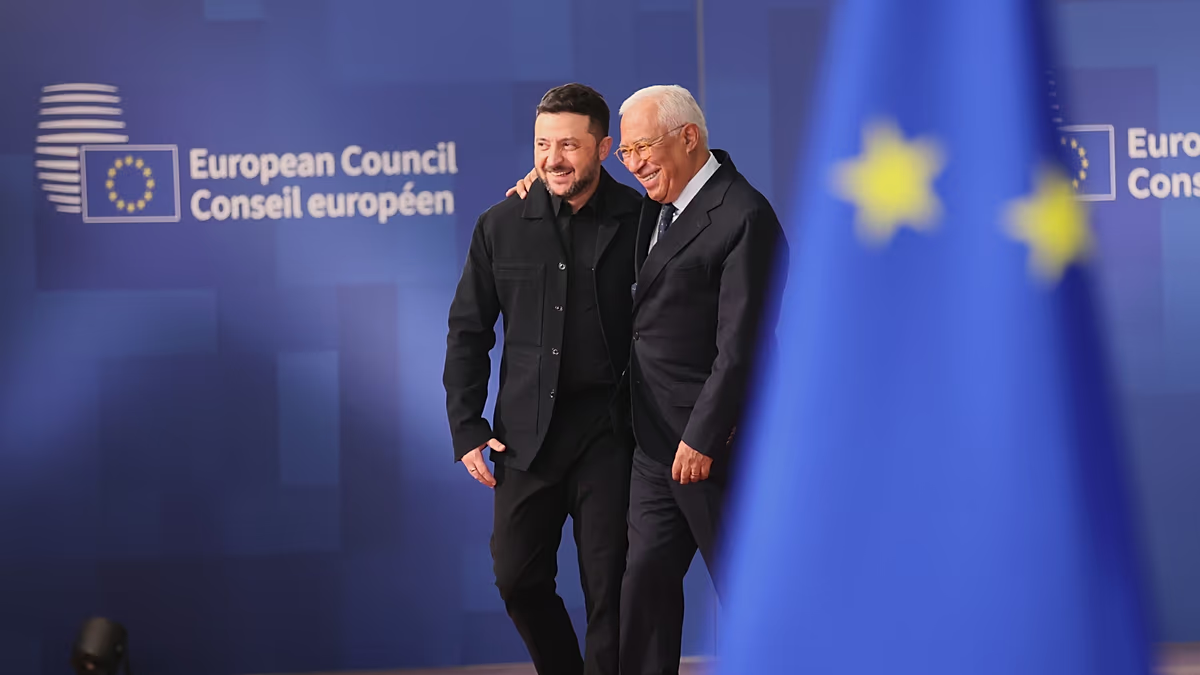
After months of political stalemate, a significant breakthrough appears imminent in the European Union’s support for Ukraine. The EU has formally initiated an internal process to approve two critical measures: a substantial €90 billion loan package for Kyiv and a new, twentieth round of sanctions targeting Russia. This procedural step, begun during a meeting of ambassadors in Brussels, gives member states 24 hours to raise any objections. With Cyprus, which holds the rotating presidency of the EU Council, expecting the process to conclude successfully, the long-running standoff between Budapest and Kyiv is finally nearing its end. The move signals a potential restoration of unified European resolve after a period of internal discord that had threatened to undermine collective support for Ukraine amidst its ongoing defense against Russian aggression.
The deadlock had been primarily orchestrated by Hungary’s outgoing Prime Minister, Viktor Orbán. For months, he vetoed the financial aid, citing a very specific grievance: the alleged blockage of oil flows through the Soviet-era Druzhba pipeline, which runs through Ukraine to Hungary. Orbán claimed Kyiv was withholding this crucial energy supply for political reasons, a charge he wielded prominently during a heated re-election campaign. However, in a dramatic political shift, Orbán was decisively defeated by opposition leader Péter Magyar, who campaigned on promises to mend relations with the EU and restore the rule of law. This historic transition of power in Budapest, the first in sixteen years, effectively removed the primary obstacle, paving the way for the current diplomatic movement and demonstrating how internal European politics are inextricably linked to continental security.
The resolution hinges on a tangible fix to the very issue Orbán highlighted. Ukrainian President Volodymyr Zelenskyy announced that repairs to the Druzhba pipeline, which was damaged by Russian drone strikes in late January, have been completed and that operations would resume imminently. In his evening address, Zelenskyy explicitly connected this action to the EU’s commitments, stating, “We have repaired it. We hope the EU will also deliver on the agreed commitments.” This reciprocal gesture—Ukraine addressing a key Hungarian concern in exchange for the unblocking of vital EU funds—illustrates the complex, quid-pro-quo nature of wartime diplomacy. Slovakia, which had also joined Hungary in blocking the parallel sanctions package over the same pipeline issue, has similarly indicated its veto will be lifted once oil flows are confirmed, further solidifying the path forward.
While the loan package now seems assured, the twentieth sanctions package presents its own intricate challenges. A central measure within it—a proposed full ban on European maritime services for Russian oil tankers—has encountered resistance from within the bloc itself. Major shipping nations Malta and Greece have expressed serious economic concerns, leading to a compromise that made the measure conditional on a broader agreement being reached at the G7 level. This condition now appears difficult to fulfill in the near term, particularly after the United States recently decided to extend sanctions relief for Russian oil transactions, a move that has caused consternation among European allies. This divergence highlights the ongoing struggle to maintain a perfectly synchronized transatlantic front on economic pressure against Moscow, as national economic interests occasionally temper the pace of punitive measures.
The unfolding situation underscores a pivotal moment for European unity and strategic autonomy. The unblocking of the €90 billion loan is not merely a financial transaction; it is a powerful reaffirmation of the EU’s commitment to Ukraine’s long-term resilience and reconstruction, sent at a critical time on the battlefield. Simultaneously, the nuanced struggle over the sanctions package reveals the persistent tensions between the imperative for collective action and the protection of individual member states’ economic interests. The episode demonstrates that while political will can be marshaled to overcome vetoes, crafting effective, universally acceptable policies to cripple the Russian war machine remains a delicate and ongoing negotiation, requiring constant diplomacy and adaptation.
In conclusion, the expected approval of the aid package marks the closing of a fraught chapter dominated by Viktor Orbán’s obstructionism and opens a new one defined by a renewed, though still complex, European consensus. The repair of the Druzhba pipeline served as a practical key to unlock the diplomatic logjam, proving that even in a war of grand narratives, technical solutions and direct reciprocity can drive progress. As the EU prepares to deliver this substantial support to Ukraine, the parallel discussions on sanctions serve as a reminder that the alliance’s strength is continually tested and forged in the balancing of solidarity with sovereignty. The coming days will confirm the formal decision, but the broader lesson is clear: European support for Ukraine, though sometimes turbulent, possesses a fundamental durability.