



Europe’s Repeating Mistake: How Misguided Energy Policies Prolong Crisis
Europe finds itself reeling from a second major energy shock in just four years, this time triggered by the blockade of the Strait of Hormuz. Governments have responded with alarming speed, yet have demonstrated a profound failure to learn the painful lessons of the 2022 crisis. As the Governor of the National Bank of Belgium, Pierre Wunsch, starkly warned, the primary response must be to reduce demand. He likened the widespread adoption of broad energy subsidies to “pouring gasoline” on the fire. Tragically, this is precisely what most European capitals are doing, replicating past errors with striking, and at times intensified, precision. This reflexive return to politically expedient but economically destructive measures threatens to deepen the crisis, strain public finances, and delay the essential energy transition Europe so urgently requires.
The fundamental flaw in the current policy mix is the systematic suppression of the price signal. A clear framework for effective crisis response exists, articulated by the European Central Bank (ECB) around three principles: measures must be targeted (reaching those truly unable to absorb the shock), tailored (preserving the price incentive for conservation and efficiency), and temporary (preventing emergency aid from becoming a permanent entitlement). An assessment of major economies like Germany, France, Italy, Spain, Poland, and Hungary reveals that not a single one fully meets this standard. The logic is inescapable: price signals are not the enemy; they are the most powerful mechanism to drive the demand reduction Europe needs. Every euro spent to artificially lower prices for all consumers is a euro spent prolonging the very crisis governments seek to solve, as it dulls the imperative for both individuals and industries to adapt.
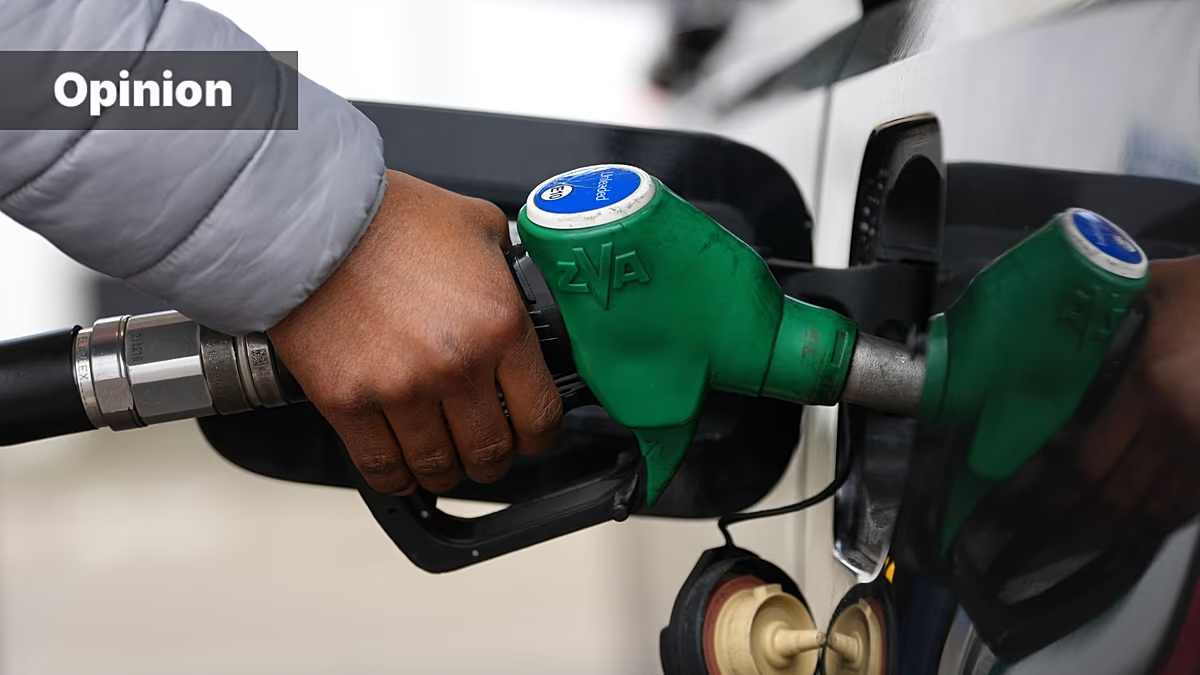
A clear hierarchy of policy failure emerges across the continent. At the most damaging end of the spectrum sit Hungary and Poland, which have implemented direct price caps on fuels. These measures obliterate the price signal entirely, disproportionately benefit high-consumption households, and spawn secondary market distortions. Hungary’s accompanying export ban on energy products and the “fuel tourism” encouraged by Poland’s caps further fragment the single market. On the next rung are nations, including Spain, Italy, and Germany, that have opted for broad-based cuts to VAT or excise duties on fuels. While politically popular, these measures are economically blunt instruments that fail both targeting and tailoring; their value increases with consumption, offering the greatest relief to those who use the most energy. The European Commission has rightly questioned the legality of some of these cuts under existing EU rules.
Yet, not all interventions are poorly conceived, offering glimmers of a more rational approach. Spain’s reinforced thermal social voucher—a direct cash transfer to vulnerable households identified by specific criteria—stands out as a model that passes the triple-T test, providing relief without distorting market prices. Similarly, Italy’s sectoral tax credits for transport, fisheries, and agriculture, while not perfect, at least focus on demonstrably exposed industries. However, by linking support to fuel consumption, they still partially blunt the incentive for those sectors to innovate and conserve. In notable contrast, France has pursued a more coherent strategy, resisting intense pressure to cap pump prices. Instead, Paris has focused on administrative actions like anti-profiteering inspections, liquidity support for companies, and tax deferrals. Its weakest link remains budgetary support tied to fuel use, but its overall framework acknowledges the critical role of market signals.
Beyond national measures, a contentious debate has reignited over how to fund these costly interventions. A coalition of five nations—Austria, Germany, Italy, Portugal, and Spain—has called for a new European levy on the “extraordinary profits” of energy companies, echoing the controversial solidarity contribution of 2022. However, that earlier effort was fundamentally flawed in two ways: it often taxed the wrong financial base (like Spain’s levy on turnover, which is unrelated to windfall gains), and it allowed a patchwork of national designs that damaged the single market. Any new instrument must strictly tax genuine, windfall economic profits, not simply broad revenue. Furthermore, policymakers must remember that as energy prices rise, corporate tax revenues naturally increase; a windfall tax should not become an automatic reflex, but a tool of last resort applied with surgical precision.
The pattern is damning, and the required course correction is not optional. European governments must cease their war on the price mechanism. Blanket tax cuts and price caps must be replaced with direct income support for vulnerable households and non-earmarked liquidity aid or tax credits for vulnerable sectors. Crucially, emergency measures should not expire on arbitrary calendar dates, which politicians are prone to extend, but on predefined market triggers, thereby depoliticizing their withdrawal. Finally, the European Commission must establish a robust, ex-ante assessment framework based on the ECB’s triple-T criteria, forcing member states to evaluate the aggregate impact of their schemes before implementation, not after the damage is done. The alternative—another cycle of untargeted subsidies that delay adjustment, drain public coffers, and undermine the green transition—is not crisis management. It is the active and wilful prolongation of collective hardship.